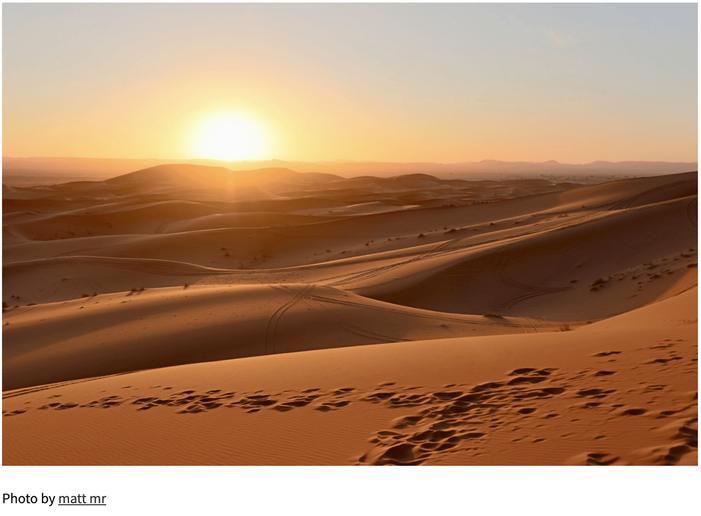
 Sabah, Libya, is an oasis town at the northern edge of the Sahara Desert. To stand at the edge of the town and look southward into the desert toward Niger is forbidding. The sand stretches past infinity, and if there is a wind, it lifts the sand to cover the sky. Cars come down the road past the al-Baraka Mosque into the town. Some of these cars come from Algeria (although the border is often closed) or from Djebel al-Akakus, the mountains that run along the western edge of Libya. Occasionally, a white Toyota truck filled with men from the Sahel region of Africa and from western Africa makes its way into Sabah. Miraculously, these men have made it across the desert, which is why many of them clamber out of their truck and fall to the ground in desperate prayer. Sabah means “morning” or “promise” in Arabic, which is a fitting word for this town that grips the edge of the massive, growing, and dangerous Sahara. For the past decade, the United Nations International Organization of Migration (IOM) has collected data on the deaths of migrants. This Missing Migrants Project publishes its numbers each year, and so this April, it has released its latest figures. For the past ten years, the IOM says that 64,371 women, men, and children have died while on the move (half of them have died in the Mediterranean Sea). On average, each year since 2014, 4,000 people have died. However, in 2023, the number rose to 8,000. One in three migrants who flee a conflict zone die on the way to safety. These numbers, however, are grossly deflated, since the IOM simply cannot keep track of what they call “irregular migration.” For instance, the IOM admits, “[S]ome experts believe that more migrants die while crossing the Sahara Desert than in the Mediterranean Sea.” Sandstorms and Gunmen Abdel Salam, who runs a small business in the town, pointed out into the distance and said, “In that direction is Toummo,” the Libyan border town with Niger. He sweeps his hands across the landscape and says that in the region between Niger and Algeria is the Salvador Pass, and it is through that gap that drugs, migrants, and weapons move back and forth, a trade that enriches many of the small towns in the area, such as Ubari. With the erosion of the Libyan state since the NATO war in 2011, the border is largely porous and dangerous. It was from here that the al-Qaeda leader Mokhtar Belmokhtar moved his troops from northern Mali into the Fezzan region of Libya in 2013 (he was said to have been killed in Libya in 2015). It is also the area dominated by the al-Qaeda cigarette smugglers, who cart millions of Albanian-made Cleopatra cigarettes across the Sahara into the Sahel (Belmokhtar, for instance, was known as the “Marlboro Man” for his role in this trade). An occasional Toyota truck makes its way toward the city. But many of them vanish into the desert, a victim of the terrifying sandstorms or of kidnappers and thieves. No one can keep track of these disappearances, since no one even knows that they have happened. Matteo Garrone’s Oscar-nominated Io Capitano (2023) tells the story of two Senegalese boys—Seydou and Moussa—who go from Senegal to Italy through Mali, Niger, and then Libya, where they are incarcerated before they flee across the Mediterranean to Italy in an old boat. Garrone built the story around the accounts of several migrants, including Kouassi Pli Adama Mamadou (from Côte d’Ivoire, now an activist who lives in Caserta, Italy). The film does not shy away from the harsh beauty of the Sahara, which claims the lives of migrants who are not yet seen as migrants by Europe. The focus of the film is on the journey to Europe, although most Africans migrate within the continent (21 million Africans live in countries in which they were not born). Io Capitano ends with a helicopter flying above the ship as it nears the Italian coastline; it has already been pointed out that the film does not acknowledge racist policies that will greet Seydou and Moussa. What is not shown in the film is how European countries have tried to build a fortress in the Sahel region to prevent migration northwards. Open-Air Tomb More and more migrants have sought the Niger-Libya route after the fall of the Libyan state in 2011 and the crackdown on the Moroccan-Spanish border at Melilla and Ceuta. A decade ago, the European states turned their attention to this route, trying to build a European “wall” in the Sahara against the migrants. The point was to stop the migrants before they get to the Mediterranean Sea, where they become an embarrassment to Europe. France, leading the way, brought together five of the Sahel states (Burkina Faso, Chad, Mali, Mauritania, and Niger) in 2014 to create the G5 Sahel. In 2015, under French pressure, the government of Niger passed Law 2015-36 that criminalized migration through the country. G5 Sahel and the law in Niger came alongside European Union funding to provide surveillance technologies—illegal in Europe—to be used in this band of countries against migrants. In 2016, the United States built the world’s largest drone base in Agadez, Niger, as part of this anti-migrant program. In May 2023, Border Forensics studied the paths of the migrants and found that due to the law in Niger and these other mechanisms the Sahara had become an “open-air tomb.” Over the past few years, however, all of this has begun to unravel. The coup d’états in Guinea (2021), Mali (2021), Burkina Faso (2022), and Niger (2023) have resulted in the dismantling of G5 Sahel as well as the demand for the removal of French and U.S. troops. In November 2023, the government of Niger revoked Law 2015-36 and freed those who had been accused of being smugglers. Abdourahamane, a local grandee, stood beside the Grand Mosque in Agadez and talked about the migrants. “The people who come here are our brothers and sisters,” he said. “They come. They rest. They leave. They do not bring us problems.” The mosque, built of clay, bears within it the marks of the desert, but it is not transient. Abdourahamane told me that it goes back to the 16th century, long before modern Europe was born. Many of the migrants come here to get their blessings before they buy sunglasses and head across the desert, hoping that they make it through the sands and find their destiny somewhere across the horizon. AuthorVijay Prashad is an Indian historian, editor and journalist. He is a writing fellow and chief correspondent at Globetrotter. He is an editor of LeftWord Books and the director of Tricontinental: Institute for Social Research. He is a senior non-resident fellow at Chongyang Institute for Financial Studies, Renmin University of China. He has written more than 20 books, including The Darker Nations and The Poorer Nations. His latest books are Struggle Makes Us Human: Learning from Movements for Socialism and, with Noam Chomsky, The Withdrawal: Iraq, Libya, Afghanistan and the Fragility of U.S. Power. This article was produced by Globetrotter. Archives April 2024
0 Comments
Leave a Reply. |
Archives
July 2024
Categories
All
|
 RSS Feed