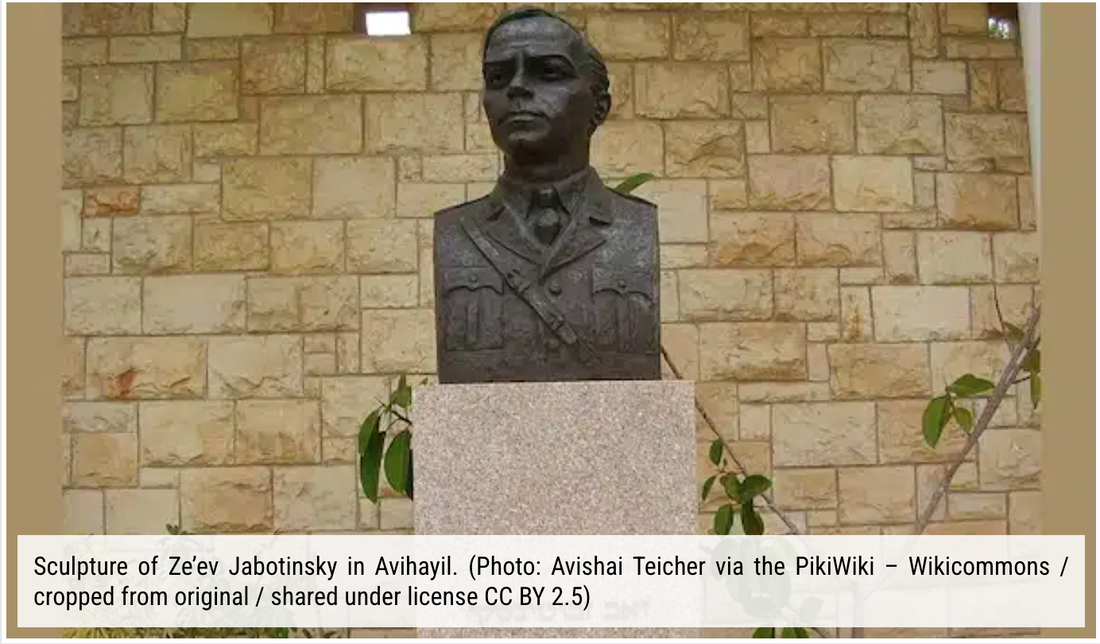
 If there is one leader whom the current Israeli prime minister, Benjamin Netanyahu, follows, it is Ze’ev Jabotinsky, the founder of Revisionist Zionism, which would form the bedrock of Netanyahu’s Likud party. Since 2005, Israel has had a Memorial Day to honour Jabotinsky (29 Tammuz, the day of his death on 4 August 1940, according to the Hebrew calendar). At a 2017 celebration, Netanyahu said: ‘I have Jabotinsky’s works on my shelf, and I read them often.’ He reminded his audience that he keeps the Zionist leader’s sword in his office. At the 2023 Memorial Netanyahu stated: ‘One hundred years after the “iron wall” was stamped in Jabotinsky’s writings we are continuing to successfully implement these principles. I say “continuing” because the need to stand as a powerful iron wall against our enemies has been adopted by every Government of Israel, from the right and the left. We are developing defensive and offensive tools against those who seek to harm us, and I can tell you with certainty that they do not distinguish between this or that camp among us. Whoever tries to harm us on one front, or more than one front, needs to know that they will pay the price. We will continue to oppose, with uncompromising strength, Iran’s efforts to develop a nuclear arsenal, and we will stand steadfast against its efforts to develop terrorist fronts on our borders—in Gaza, in Judea and Samaria, in Syria and in Lebanon. This was at a time of mounting tension in the occupied West Bank, where the Israelis would kill over 300 Palestinians in that year, beginning long before Hamas’s 7 October attack on Southern Israel. The ‘Iron Wall’, which Netanyahu invokes, was a 1923 essay by Jabotinsky in which he argued a Jewish state could only be created from a position of overwhelming military strength, by proving in arms to the Palestinians and the Arab states, that Zionism could not be defeated. Today it underlines the position of the coalition government Netanyahu leads in how to respond to Hamas’ 7 October attack on Southern Israel. Far-right Zionism Revisionist Zionism was founded by Jabotinsky after he rejected the belief that Britain would grant the Zionists a Jewish state, and instead he stood for the establishment of a Jewish state and army. During the First World War he had established three battalions of the Jewish Legion, part of the British army in Palestine’s King’s Fusiliers, which fought in the latter part of General Allenby’s conquest of Palestine and Syria. They were disbanded by the British in 1920 as they became effectively a Zionist militia engaged in fighting with the Arabs. It would become the backbone of the Haganah, the main Zionist armed group key to the 1948 Nakba. He wanted all of European Jewry to migrate to Palestine and the extension of the Jewish state to both banks of the River Jordan. The Israeli historian Benny Morris writes: In 1925 he established the Revisionist Party (so named because it sought to “revise” the terms of the Mandate, particularly to provide for the re-inclusion of Transjordan [Jordan] in Mandatory Palestine). He also set up the party’s youth movement, Betar, which was characterised by militaristic, some might say fascist, appearances (dark brown uniforms), activities (parade ground drill and firearm exercises), slogans and ideology (“in fire and blood Judea will be reborn”) and structure (A rigid hierarchy). Jabotinsky admired Mussolini and his movement and repeatedly sought affiliation and assistance from Rome. Jabotinsky summed up his beliefs by stating: There is no justice, no law and no God in heaven, only a single law which decides and supersedes all—settlement. Jabotinsky believed the Arabs were implacably hostile to the creation of a Jewish state and, accordingly, concluded: We cannot promise any reward either to the Arabs of Palestine or to the Arabs outside Palestine. A voluntary agreement is unattainable. And so those who regard an accord with the Arabs as an indispensable condition of Zionism must admit to themselves today that this condition cannot be attained and hence that we must give up Zionism. We must either suspend our settlement efforts or continue them without paying attention to the mood of the natives. Settlement can thus develop under the protection of a force that is not dependent on the local population, behind an iron wall which they will be powerless to break down. In his 1923 essay called ‘The Iron Wall’, Jabotinsky argued that the Palestinian Arabs would not agree to a Jewish majority in Palestine and that: Zionist colonization, even the most restricted, must either be terminated or carried out in defiance of the will of the native population. This colonization can, therefore, continue and develop only under the protection of a force independent of the local population—an iron wall which the native population cannot break through. This is, in toto, our policy towards the Arabs. To formulate it any other way would only be hypocrisy. He then explained his differences with Chaim Weizmann and David Ben-Gurion, heads of the Jewish Agency, the Zionist proto-government, thus: ‘One prefers an iron wall of Jewish bayonets, the other proposes an iron wall of British bayonets …’ In fact, by 1936, after the great Arab Revolt against Zionist immigration and British rule, Ben-Gurion had come round to the same way of thinking: Both realised that the Arabs would continue to fight for as long as they retained any hope of preventing the Jewish takeover of their country. And both concluded that only insuperable Jewish military strength would eventually make the Arabs despair of the struggle and come to terms with a Jewish state in Palestine. Ben-Gurion did not use the terminology of the iron wall, but his analysis and conclusions were virtually identical to Jabotinsky’s. In 1931, Jabotinsky founded the Irgun (The National Military Organization in the Land of Israel), an armed militia separate from the more mainstream Haganah, which Jabotinsky saw as fighting both the British authorities and Palestinians resisting colonisation. In 1937, it moved from defence of the Yishuv (Jewish community in Palestine) to terror attacks on the Palestinians. In December 1937, a member of the Irgun hurled a hand grenade at a market in Jerusalem killing and injuring dozens. In Haifa in March 1938, members of the Irgun and Lehi (the Stern gang) threw grenades into the market, killing eighteen, and injuring 38. Later that same year, again in Haifa, Irgun exploded booby-trapped vehicles in the market, killing 21 and injuring 52. The two operations for which Irgun is best known are the bombing of the King David Hotel in Jerusalem, headquarters of the British administration, where 91 people, Arabs, Jews and British, were killed, and the April 1948 Deir Yassin massacre, which killed at least 107 Palestinian Arab villagers, including women and children, carried out together with another terrorist group Lehi, or the Stern Gang. By then, Jabotinsky was dead, having died of a heart attack on a visit to the U.S. in August 1940. Benjamin Netanyahu’s father, Benzion, was an activist in Jabotinsky’s Revisionist movement, editor of its publications a private secretary to the leader. In 1993, the year Benjamin Netanyahu was elected leader of Likud, he also published a book, A Place among the Nations: Israel and the World. It sought to show that it was not the Jews who had taken the land from the Arabs, but the Arabs who had taken it from the Jews: ‘Netanyahu viewed Israel’s relations with the Arab world as one of permanent conflict, as a never-ending struggle between the forces of light and the forces of darkness.’ He claimed: Violence is ubiquitous in the political life of all the Arab countries. It is the primary method of dealing with opponents, both foreign and domestic, both Arab and non-Arab. For Netanyahu, there was no right to self-determination for the Palestinians, and there could be no compromise with them, because they were out for the liquidation of Israel. In a chapter titled, ‘The Wall’, he argues Israel must expand its military hold of the high ground in the Golan Heights and in what he calls Judea and Samaria—the West Bank—and exert military control over virtually all of the territory west of the Jordan River. His conclusion is a one-state solution, from the river to the sea: To subdivide this land into two unstable, insecure nations, to try to defend what is indefensible, is to invite disaster. Carving Judea and Samaria out of Israel means carving up Israel. In response to the Oslo Accords, he wrote an op-ed piece for the New York Times on 5 September 1993, titled ‘Peace In Our Time’, referencing Neville Chamberlain’s claim on his return from Munich in September 1938 after agreeing to carve up Czechoslovakia with Hitler. In it he rejected the whole suggestion of a Palestinian state in the West Bank, stating: ‘A P.L.O. state on the West Bank will strip the Jewish state of the defensive wall of the Judean and Samarian mountains won in the Six-Day War, re-creating a country ten miles wide, open to invading armies from the east.’ He went onto say that the PLO would use that state to foment an allied Arab assault against a truncated Jewish state. Adding, for two decades Yasir Arafat has championed this plan. In 1996 Netanyahu stated bluntly: ‘Might is a condition for peace. Only a strong deterrent profile can preserve and stabilise peace.’ After his first election win, he declared: ‘The government will oppose the establishment of an independent Palestinian state and will oppose the “right of return” of the Arab population to parts of the Land of Israel west of the Jordan.’ He added that his government would ‘act to consolidate and develop the settlement enterprise,’ and that ‘united Jerusalem, the capital of Israel … will forever remain under Israeli sovereignty.’ Today, Netanyahu is Israel’s longest-serving prime minister. He first came to power in 1996 and served a three-year term before he was replaced by Ehud Barak. He would return to power in 2009 and then serve for fourteen of the last fifteen years. Netanyahu and his government oppose the establishment of a Palestinian state, support the expansion of illegal Jewish settlement in the occupied Palestinian territories, wish to annex the West Bank, and have introduced a law which denies equality to the native Palestinian minority in the Jewish State. Above all, they wish that the Palestinians accept they have suffered a historic defeat and accept the Zionist control of Palestine. Peace can only follow total defeat. It’s often said that Netanyahu needs the current war in Gaza to go on because, if it ends, his political career is over. There is truth in that, but it’s not the only reason. On 7 October, Israel lost something Netanyahu and his cabinet colleagues held most dear—military deterrence. Suddenly Israel looked vulnerable. The instinct of his government and IDF commanders is to inflict maximum retaliation on the people of Gaze to deter anyone from repeating that attack. That’s the ‘Iron Wall’ in today’s Israel. But despite killing over 30,000 people, overwhelmingly civilians and a third of children, and levelling Gaza, Netanyahu has been seen to fail in his pledge to ‘annihilate’ Hamas; they are still standing, still resisting. Internationally, the war in Gaza has brought a tidal wave of revulsion against Netanyahu and co, but not in Israel, where polls and the local elections results show a big majority in support of Likud and their allies to the right. Netanyahu and his supporters want to continue the war, and they are looking at extending it by taking on Hezbollah, in the belief they can achieve an elusive victory to restore deterrence. It is, of course, a manic pipe dream; Hezbollah are far stronger and better armed than Hamas, have had time to prepare, and, back in 2006, gave the IDF a bloody nose. Netanyahu is driven by his belief in the ‘Iron Wall’. His is the logic at the heart of Zionism. But the wall is rusty. Israel does not seem invincible. The clock of history is ticking for Zionism. AuthorChris Bambery is an author, political activist and commentator, and a supporter of Rise, the radical left wing coalition in Scotland. His books include A People’s History of Scotland and The Second World War: A Marxist Analysis. This article was produced by Monthly Review. Archives March 2024
0 Comments
Leave a Reply. |
Archives
July 2024
Categories
All
|
 RSS Feed