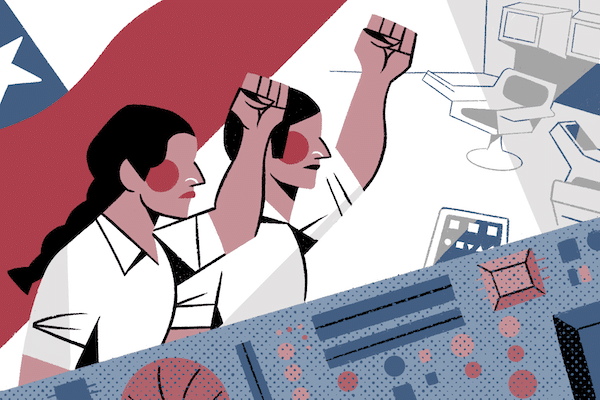
 FIFTY years back, Pinochet's coup destroyed Allende's government and the structure of liberal democracy in Chile. Allende died with a machine gun in his hands, defending his attempt to build socialism in Chile against the combined power of the US and the forces of reaction in Chile, including the military. For people of my generation, this story is well-known, as along with liberation struggles in Vietnam and Africa, Chile was very much what brought us to the streets in solidarity. What is less known, except in more scholarly or tech circles, is the attempt by Allende and his government to use technology, specifically information from factories which Allende had nationalised, and use this information for real-time planning and interventions in the economy. This project – Cybersyn – resonates in the tech community for its vision of marrying technology to social needs, including direct feedback from workers on the factory floor. Cybersyn's control room is iconic and a precursor to what develops later as an intuitive graphic user interface, differentiating companies such as Apple from the more clunky user interfaces of Microsoft and others. Eden Medina and Evgeny Morozov are two authors who have explored the project Cybersyn for more than two decades. Medina's 2011 book, Cybernetic Revolutionaries: Technology and Politics in Allende's Chile, remains the most important one in bringing together the context and the constraints of both technology and politics in Chile at that time. Evgeny, who has been researching Chile and the project Cybersyn for a long time, has recently done a series of podcasts (nine of them, to be exact) called The Santiago Boys. These podcasts give us not only an overview of the project Cybersyn but also the unequal struggle of a set of young technocrats, engineers and economists (The Santiago Boys) along with Stafford Beer, a British information technologist, against the might of the US forces – ITT and other US MNCs, CIA, the Chilean Armed Forces and economists (The Chicago Boys led by the economist Milton Friedman). He also locates the much larger context within which we must see Cybersyn, not simply as how to manage or control the economy but how to develop knowledge that underlies technology and production for the future. Information, in this larger sense, is creating new knowledge and, therefore, the fight over the patent system is a fight over knowledge. The Indian patent system had undergone a huge break with its earlier colonial version of the 1911 Indian Patent Act in the 1971 Patent Act. Evgeny brings out the vision of the Santiago Boys/School, similar to what we in India had regarding self-reliance. It is not enough to do import substitution. Breaking out of dependence means creating new knowledge. That means you have to marry advances in knowledge, both scientific and technological, to industry. Patent systems reform can create conditions with which we can create knowledge, but bringing it into industry means marrying different forms of knowledge in a way that can lead to manufacturing products: simple products that go into other products to complex ones that need to integrate a very large number of such parts. I am not going into the details of what Evgeny has covered in his podcasts or other writings. I will pick out one example of what might have been if Chile had pursued its path to self-reliance. He writes of how the Allende-era Corfo launched the National Electronics Company, tasked with building a semiconductor plant in the country's north. This would have allowed Chile – once a mere exporter of nitrates and copper – to become a technologically sophisticated economy capable of meeting its development needs. Those who have followed these columns will remember how India built the semiconductor complex in Mohali, which within a few years had brought Indian chip-building capabilities within one or two generations of what then were the cutting-edge chips. And how, after its mysterious burning down in 1989, it was never rebuilt. This led us to go out in the world offering huge "incentives" to set up, not chip manufacturing, but chip packaging plants. In the Chilean case, the US-inspired coup brought down the Allende government and the abandonment of self-reliance – or technological independence – as a goal. In India, a self-goal by the neoliberal forces across a spectrum of political parties, from the Congress to the BJP, led to the abandonment of self-reliance. Evgeny also brings out the eery similarities in the information network of Project Cybersyn and the information and control infrastructure of Operation Condor, the infamous CIA project to sabotage and assassinate Left forces and governments in Latin America. Both were informed and limited by the technology of their times, using telex as the primary means of communicating data and information. It is a cautionary tale for those who believe in techno-utopias and how technological advances will automatically solve all the world's problems. Advances in technology and science have the potential to create enough for our human needs, now and for the future. But it comes up against the simple question of who owns such advances. Or, more correctly, the knowledge embedded in the artefacts we produce as a society? Who owns the means of production, not simply the physical infrastructure producing these goods but also the infrastructure producing knowledge? This is where we confront the reality of class struggle, both national and international. Allende's overthrow by the CIA, ITT (read US capital) and its feudal-military elite remind us of the nature of this class struggle, both national and international. The other part of the story is that of information technology, still in its infancy during the Allende era. A number of people had naively believed that new digital technologies could liberate all of us: free software and the internet would by itself introduce socialism, democratising technology and, therefore, society. Norbert Weiner, the father of Cybernetics, had warned us in his books Cybernetics (1948) and Human Use of Human Beings (1950) that information in the typical American world is destined for a special future: it will turn into a commodity to be bought, sold and bargained over. This will inevitably be in conflict with human values of promoting the common good. "Just as technology opens up new opportunities, so does it impose new limitations." Miron Amit writes about Weiner's vision of this conflict and how transforming information into a commodity enables its private appropriation and harms life itself. Even though the information network has changed enormously with the emergence of the internet, the politics of information and technology remain the conflict between people and capital. Archives October 2023
0 Comments
Leave a Reply. |
Archives
July 2024
Categories
All
|
 RSS Feed