|
4/29/2024 How Africa’s National Liberation Struggles Brought Democracy to Europe: The Seventeenth Newsletter (2024). By: Vijay PrashadRead Now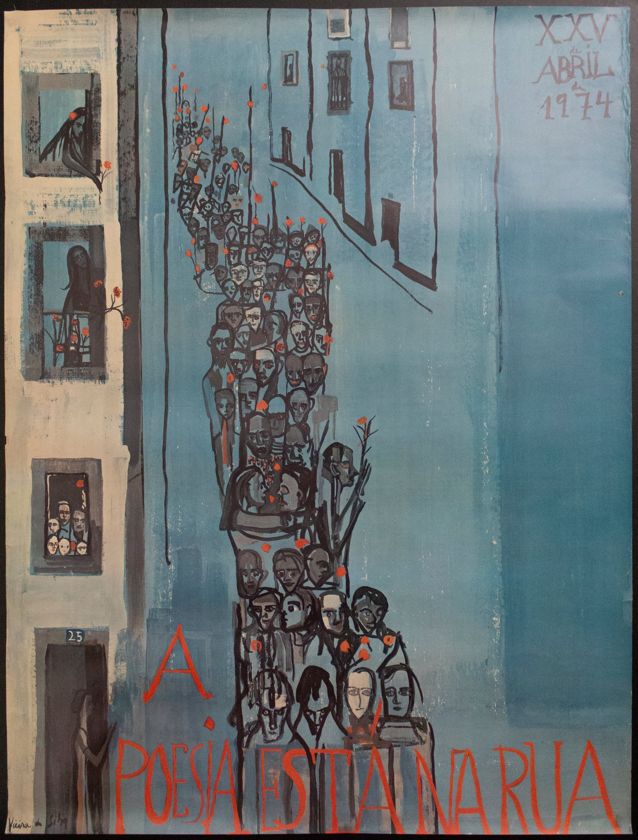 Maria Helena Vieira da Silva (Portugal), A Poesia Está Na Rua I [Poetry Is out on the Street I], 1974. Dear friends, Greetings from the desk of Tricontinental: Institute for Social Research. Fifty years ago, on 25 April 1974, the people of Portugal took to the streets of their cities and towns in enormous numbers to overthrow the fascist dictatorship of the Estado Novo (‘New State’), formally established in 1926. Fascist Portugal – led first by António de Oliveira Salazar until 1968 and then by Marcelo Caetano – was welcomed into the North Atlantic Treaty Organisation (NATO) in 1949, the United Nations in 1955, and the Organisation for Economic Co-operation and Development in 1961 and signed a pact with the European Economic Community in 1972. The United States and Europe worked closely with the Salazar and Caetano governments, turning a blind eye to their atrocities. Over a decade ago, I visited Lisbon’s Aljube Museum – Resistance and Freedom, which was a torture site for political prisoners from 1928 to 1965. During this time, tens of thousands of trade unionists, student activists, communists, and rebels of all kinds were brought there to be tortured, and many were killed – often with great cruelty. The ordinariness of this brutality permeates the hundreds of stories preserved in the museum. For instance, on 31 July 1958, torturers took the welder Raúl Alves from Aljube Prison to the third floor of the secret police’s headquarters and threw him to his death. Heloísa Ramos Lins, the wife of Brazil’s ambassador to Portugal at the time, Álvaro Lins, drove by at that moment, saw Alves’ fatal fall, and told her husband. When the Brazilian embassy approached the Portuguese Interior Ministry to ask what had happened, the Estado Novo dictatorship responded, ‘There is no reason to be so shocked. It is merely an unimportant communist’. 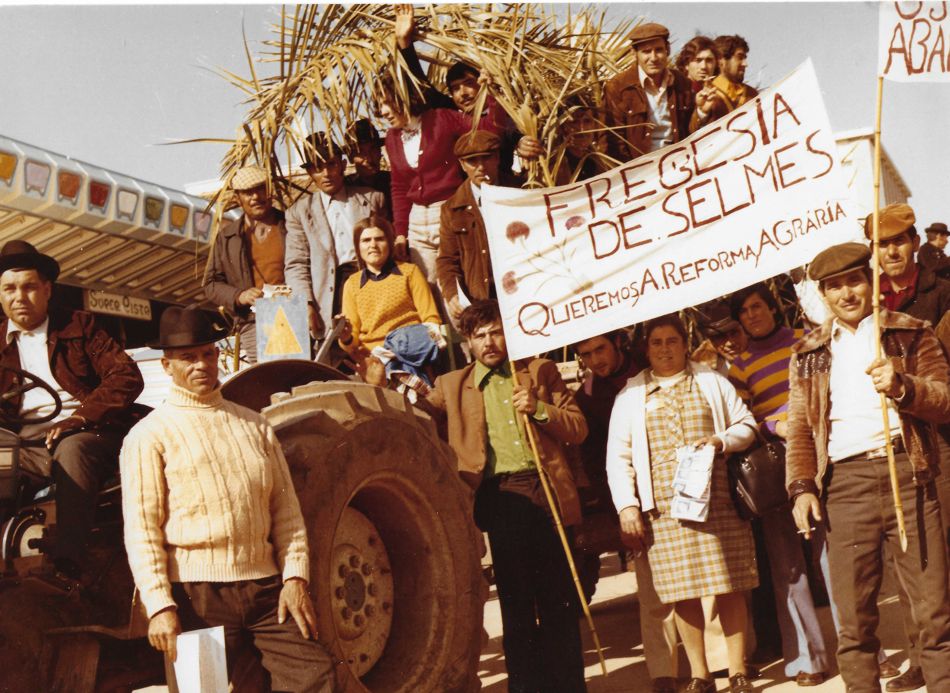 John Green (England), Peasants in Beja Demanding Agrarian Reform, 1974. It was ‘unimportant communists’ like Raúl Alves who initiated the revolution of 25 April, which built on a wave of workers’ actions across 1973, beginning with the airport workers in Lisbon and then spreading to textile workers’ strikes in Braga and Covilha, engineering workers’ strikes in Aveiro and Porto, and glass workers’ strike in Marinha Grande. Around this time, the dictator Caetano read Portugal and the Future, written by General António de Spínola who was trained by commanders of the fascist General Francisco Franco during the Spanish Civil War, led a military campaign in Angola, and was formerly the Estado Novo’s governor in Guinea-Bissau. Spínola’s book argued that Portugal should end its colonial occupation since it was losing its grip on Portuguese-controlled Africa. In his memoirs, Caetano wrote that when he finished the book, he understood ‘that the military coup, which I could sense had been coming, was now inevitable’. What Caetano did not foresee was the unity between workers and soldiers (who themselves were part of the working class) that burst through in April 1974. The soldiers were fed up with the colonial wars, which – despite the great brutality of the Estado Novo – had failed to quell the ambitions of the people of Angola, Cape Verde, Guinea-Bissau, Mozambique, and São Tomé and Príncipe. The advances made by the African Party for the Independence of Guinea-Bissau and Cape Verde (PAIGC), Front for the Liberation of Mozambique (FRELIMO), and People’s Movement for the Liberation of Angola (MPLA) were considerable, with Portugal’s army losing more soldiers than at any time since the eighteenth century. Several of these formations received assistance from the USSR and East Germany (DDR), but it was through their own strength and initiative that they ultimately won the battles against colonialism (as our colleagues at the International Research Centre on the DDR have documented). 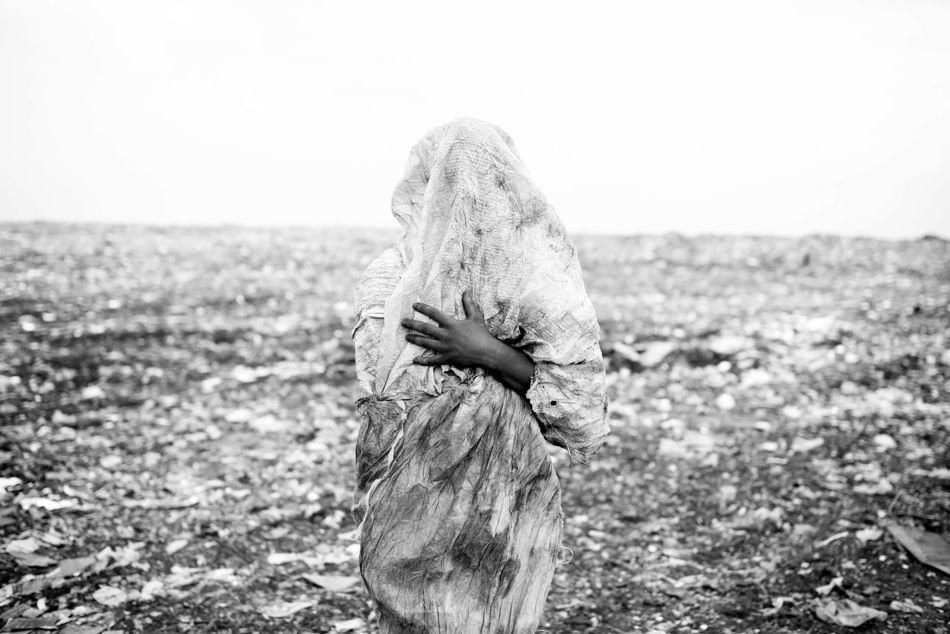 Mário Macilau (Mozambique), Bending Reality: Untitled (2), from The Profit Corner series, 2016. On 9 September 1973, soldiers who had been sent to Guinea-Bissau met in Portugal to form the Armed Forces Movement (MFA). In March 1974, the MFA approved its programme Democracy, Development, and Decolonisation, drafted by the Marxist soldier Ernesto Melo Antunes. When the revolution erupted in April, Antunes explained, ‘A few hours after the start of the coup, on the same day, the mass movement began. This immediately transformed it into a revolution. When I wrote the programme of the MFA, I had not predicted this, but the fact that it happened showed that the military was in tune with the Portuguese people’. When Antunes said the ‘military’, he meant the soldiers, because those who formed the MFA were not more senior than captains and remained rooted in the working class from which they had come. In December 1960, the United Nations General Assembly proclaimed the ‘necessity of bringing to a speedy and unconditional end colonialism in all its forms and manifestation’. This position was rejected by the Estado Novo regime. On 3 August 1959, Portuguese colonial soldiers fired on sailors and dockworkers at Pidjiguiti at the Port of Bissau, killing over fifty people. On 16 June 1960, in the town of Mueda (Mozambique), the Estado Novo colonialists fired on a small, unarmed demonstration of national liberation advocates who had been invited by the district administrator to present their views. It is still not known how many people were killed. Then, on 4 January 1961, a strike at Baixa do Cassange (Angola) was met with Portuguese repression, killing somewhere between 1,000 and 10,000 Angolans. These three incidents showed that the Portuguese colonialists were unwilling to tolerate any civic movement for independence. It was the Estado Novo that imposed the armed struggle on these parts of Africa, moving the PAIGC, MPLA, and FRELIMO to take up guns. 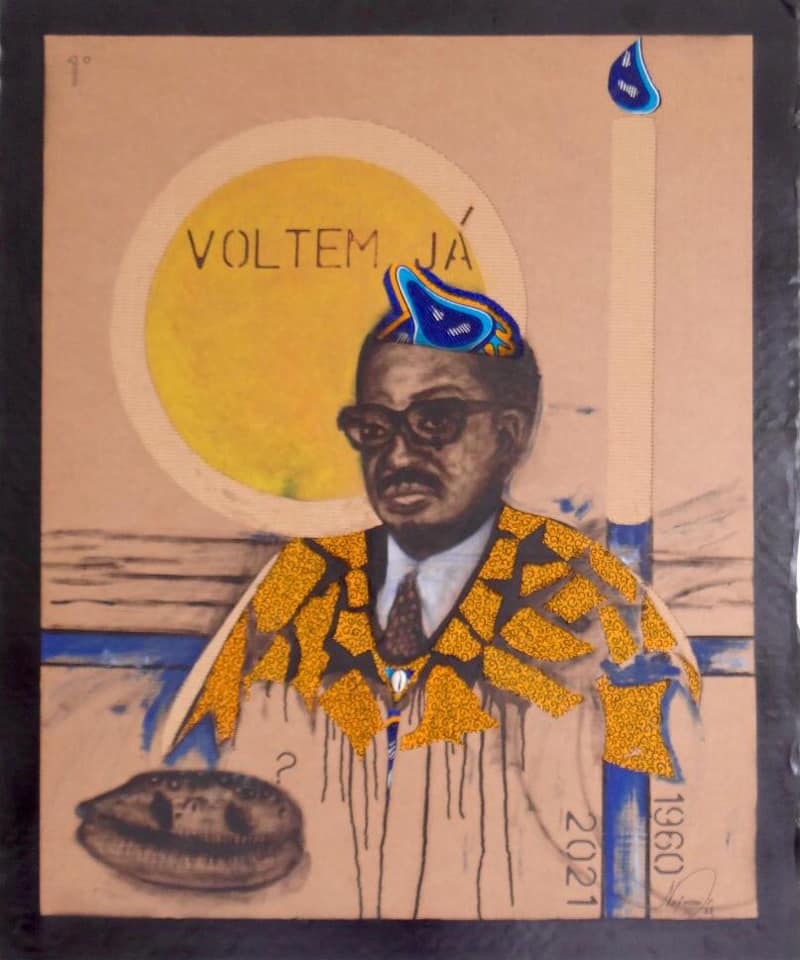 Nefwani Junior (Angola), É Urgente (Voltar) [It’s Urgent (to Return)], 2021. Agostinho Neto (1922–1979) was a communist poet, a leader of the MPLA, and the first president of independent Angola. In a poem called ‘Massacre of São Tomé’, Neto captured the feeling of the revolts against Portuguese colonialism: It was then that in eyes on fire now with blood, now with life, now with death, we buried our dead victoriously and on the graves recognised the reason for these men’s sacrifice for love, and for harmony, and for our freedom even while facing death, through the force of time in blood-stained waters even in the small defeats that accumulate towards victory Within us the green land of São Tomé will also be the island of love. That island of love was not just to be built across Africa, from Praia to Luanda, but also across Portugal. On 25 April 1974, Celeste Caeiro, a forty-year-old waitress, was working at a self-service restaurant called Sir in the Franjinhas building on Braancamp Street in Lisbon. Since it was the restaurant’s one-year anniversary, the owner decided to hand out red carnations to the customers. When Celeste told him about the revolution, he decided to shut down Sir for the day, give employees the carnations, and encourage the employees to take the carnations home. Instead, Celeste headed to the city centre, where events were unfolding. On the way, some soldiers asked her for a cigarette, but instead, she put a few carnations into the barrels of their guns. This caught on, and the florists of Baixa decided to give away their in-season red carnations to be the emblem of the revolution. That is why the 1974 revolution was called the Carnation Revolution, a revolution of flowers against guns. Portugal’s social revolution of 1974–1975 swept large majorities of people into a new sensibility, but the state refused to capitulate. It inaugurated the Third Republic, whose presidents all came from the ranks of the military and the National Salvation Junta: António de Spínola (April–September 1974), Francisco da Costa Gomes (September 1974–July 1976), and António Ramalho Eanes (July 1976–March 1986). These were not men from the ranks, but the old generals. Nonetheless, they were eventually forced to surrender the old structures of Estado Novo colonialism and withdraw from their colonies in Africa. 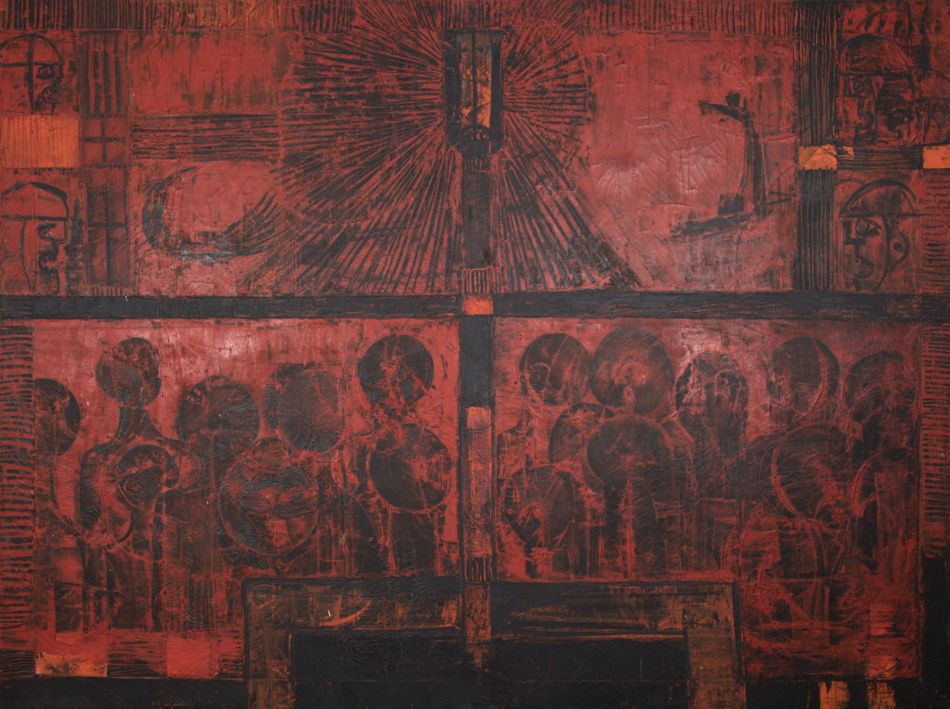 Bertina Lopes (Mozambique), Omenagem a Amílcar Cabral [Tribute to Amílcar Cabral], 1973. Amílcar Cabral (1924–1973), who was born one hundred years ago this September and who did more than many to build the African formations against Estado Novo colonialism, did not live to see the independence of Portugal’s African colonies. At the 1966 Tricontinental conference in Havana, Cuba, Cabral warned that it was not enough to get rid of the old regime, and that even more difficult than overthrowing the regime itself would be to build the new world out of the old, from Portugal to Angola, Cape Verde to Guinea-Bissau, Mozambique to São Tomé and Príncipe. The main struggle after decolonisation, Cabral said, is the ‘struggle against our own weaknesses’. This ‘battle against ourselves’, he continued, ‘is the most difficult of all’ because it is a battle against the ‘internal contradictions’ of our societies, the poverty borne of colonialism, and the wretched hierarchies in our complex cultural formations. Led by people like Cabral, liberation struggles in Africa not only won independence in their own countries; they also defeated Estado Novo colonialism and helped bring democracy to Europe. But that was not the end of the struggle. It opened new contradictions, many of which linger today in different forms. As Cabral often said as the closing words to his speeches, a luta continua. The struggle continues. Warmly, Vijay Author Vijay Prashad is an Indian historian, editor and journalist. He is a writing fellow and chief correspondent at Globetrotter. He is an editor of LeftWord Books and the director of Tricontinental: Institute for Social Research. He is a senior non-resident fellow at Chongyang Institute for Financial Studies, Renmin University of China. He has written more than 20 books, including The Darker Nations and The Poorer Nations. His latest books are Struggle Makes Us Human: Learning from Movements for Socialism and, with Noam Chomsky, The Withdrawal: Iraq, Libya, Afghanistan and the Fragility of U.S. Power. Republished from Tricontinental Institute Archives April 2024
0 Comments
Leave a Reply. |
Archives
July 2024
Categories
All
|
 RSS Feed