|
9/12/2023 Haiti, plunged into cycles of humanitarian crisis, rejects the possibility of new foreign intervention. By: Monyse RavenaRead Now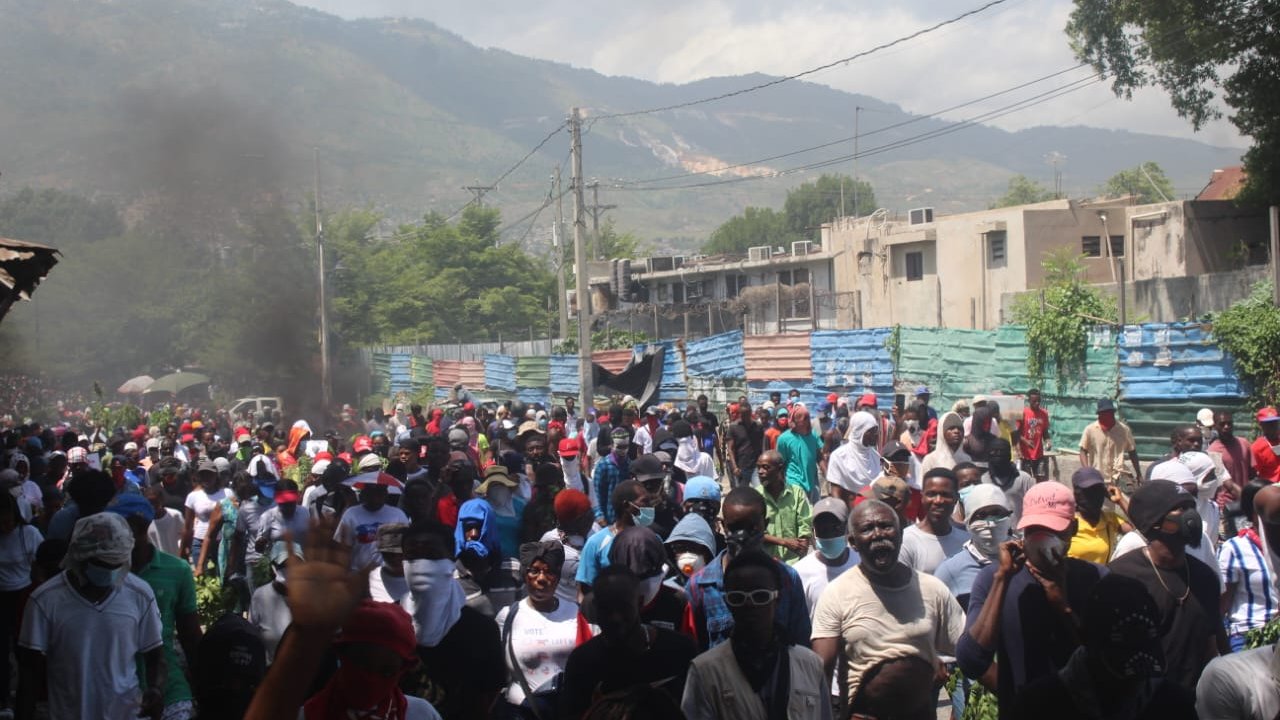 Movements propose transitional government and cooperation with the Global South to rebuild the country Brasil de Fato spent seven days in Haiti at the invitation of popular organizations and movements. During the visit, BdF spoke to over 20 human rights organizations and all were unanimous in stating: the escalation of violence in the Caribbean country is stimulated by agents outside the island, and will probably be the justification for a new military intervention—rejected by the country’s civil society—led by foreign forces and sanctioned by the United Nations (UN). Another common criticism from activists is the international press coverage of the country. Exuma Emmanuel, a communicator for Radio Resistance and the Haitian People’s News Agency, a community and popular web radio based in Port-au-Prince, is incisive, “The kind of international coverage given to Haiti has many negative effects for those who live here” he says. “One of which is to sell the image that it is one of the worst places in the world to live, and this also has an effect on Haitians living outside the country.” “Outside the country, Haitians are afraid to present themselves as Haitians. There are other political effects on Haiti, since independence, negative news has formed an image,” he adds. Camille Chalmers, economist, professor and representative of the Platform for Alternative Development in Haiti (PAPDA) asks, “How do people talk about the crisis in Haiti?” “The dominant discourse in the international press is always about wars, the need for humanitarian aid,” she says. “This discourse has been going on since the 19th century because the imperial powers never accepted Haitian independence. The country helped in many independences and the [other] countries were afraid of the Haitian revolution.” Camille also highlights the permanence and originality of the Haitian popular movement and its anti-imperialist consciousness. Increased violence and armed groups The situation in the country is complex, with an increase in violence driven by armed groups that now control more than 50% of the territory, as confirmed by the organizations. The most critical situation is in the capital, Port-au-Prince. Armed groups control several popular neighborhoods, often involving murders and kidnappings. According to Exuma Emmanuel, “the violence that has been encouraged wants to impose a new occupying force on the country.” “The weapons used by the armed groups in the working class neighborhoods come from the United States. The Haitian people are not just desperate, they are fighting,” says Emmanuel, who explains that the gangs control strategic areas, creating a climate of terror and preventing people from organizing themselves. According to a United Nations report on the situation in Haiti, violence intensified in 2023 and the number of murders recorded in the country increased by 21% this year, from 673 in the last quarter of 2022 to 815 between January 1 and March 31. The number of kidnappings rose by 63% in the same period, from 391 to 637. Cases of rape of women and girls are also among the main complaints of the organizations heard by Brasil de Fato. A report by Amnesty International, presented at the beginning of April, points out that 40% of the country’s population is in a food emergency, which corresponds to five million people going hungry. According to the UN, the Haitian authorities recorded 1,014 kidnappings in the country between January and June this year. Economic chaos Haiti has the third highest inflation rate among Latin American countries (behind Argentina and Venezuela), at around 30%, and a volatile exchange rate. Fuel prices have risen by 260% in two years and the country is facing a new migration crisis with a flight of skilled labor. The majority of the population has no access to drinking water, medical care or adequate housing. For Radio Resistance coordinator Reyneld Sanon, the international community is backing a “criminal government.” “Everything they do is to justify Haiti as a chaotic entity,” he says. Since the assassination of Jovenel Moïse in July 2021, the presidency has been vacant and there are no plans for new elections. After the president’s death, Ariel Henry was appointed prime minister. Popular organizations claim that his appointment was made through direct interference by the Core Group, made up of the embassies of Germany, Brazil, Spain, the USA, France, Canada, the European Union and the special representative of the Organization of American States. At the moment, there is no functioning parliament or higher courts in the country. “Montana Accord" A group of popular movements and human rights organizations are proposing the establishment of a transitional government as a way out of the crisis. The proposals have been systematized in the “Montana Accord,” which is opposed by the Core Group. The agreement was proposed in August 2021 by the Commission for the Search for a Haitian Solution to the Crisis. The group brings together non-governmental organizations, popular and religious movements, political leaders and intellectuals who met after Moïse’s assassination. The name Montana Group refers to the place where the group held its meetings, the Hotel Montana, in the capital Port-au-Prince. “The transition of power can be one of continuity or rupture, but the current government is illegitimate and illegal,” says Camille Chalmers on the challenge of the historic moment Haiti is experiencing. Neidyson Cèzaire, a communicator, producer and activist, rejects the possibility of a new foreign intervention. “International aid from Western countries has never helped a country to develop,” he says. “The way forward for Haiti is to prioritize South-South cooperation. Western countries hate Haiti, they want to make us pay for being responsible for breaking the world order of slavery.” Chalmers concludes by saying that “we need real solidarity. US imperialism is one of the actors driving the crisis. We do need to build international support networks, not military intervention.” Unlike the popular organizations and movements that work directly with the population, Prime Minister Ariel Henry asked for international military aid to fight the armed groups in October 2022 and has yet to receive a response. However, it is expected that at the next UN Security Council meeting on September 14 there will be statements and a possible determination on the issue. The Brazilian government has already shown interest in having the Brazilian Federal Police train the Haitian police, but is waiting for the Security Council to approve a multinational police force in the country. History and independence Haiti was the first colony in the Americas to gain independence and the only independence revolution carried out by Black enslaved people. The Haitian revolution began in 1791, when the then French colony was called Santo Domingo. After a long struggle, independence was proclaimed in 1804 and the country was renamed Haiti, a name of Indigenous origin. The Haitian revolution combined the struggle for independence from the metropolis with the struggle to free the enslaved. However, Haiti’s history in the 20th and 21st centuries has been marked by successive foreign occupations: the US occupation from 1915 to 1934; and the Duvalier military dictatorship, which lasted almost 30 years from 1957 to 1986. With the end of the dictatorship, the 1987 constitution brought several advances, including the establishment of Creole as an official language alongside French. There were two coup attempts against the progressive former president Jean-Bertrand Aristide, in 1991 and 2004. Also in 2004, the occupation by MINUSTAH, a multinational UN force commanded by Brazilian military personnel, began and lasted until 2014. One of its commanders was General Augusto Heleno, head of the security cabinet in Jair Bolsonaro’s government. Recent Haitian history also includes the devastating earthquake of 2010, which greatly inflamed the country’s social and economic crises, and Hurricane Matthew in 2016. “Each intervention had serious and interrelated consequences. We arrived in 2016 with an important cycle of demonstrations led by the peasants and which were harshly fought by the gangs,” concludes Chalmers. Another cycle of important popular demonstrations took place in 2022, protesting against Ariel Henry’s government and the increase in violence. BdF reporters tried to contact the UN secretary-general’s special representative for Haiti, but had not yet received a response by the time the report closed. This article was translated from an article in Portuguese originally published on Brasil de Fato. Archives September 2023
0 Comments
Leave a Reply. |
Archives
July 2024
Categories
All
|
 RSS Feed