 This 1886 engraving was the most widely reproduced image of the Haymarket massacre. It shows Methodist pastor Samuel Fielden speaking, the bomb exploding, and the riot beginning simultaneously; in reality, Fielden had finished speaking before the explosion. | Chicago Historical Society. CHICAGO—On the morning of Oct. 6, 1886, Albert Parsons, native of Alabama, whose brother was a general in the Civil War, rose in a Chicago courtroom to make the last speech of his life. He was facing his doom as one of the convicted co-called “anarchists,” one of the “detested aliens” who had been seized in the police frame-up following an explosion on Chicago’s Haymarket Square during a workers’ demonstration on May 4. Parsons spoke long and well. He was going back over his life, telling the remarkable story of how the boy who ran with the Texas trappers and Native American traders as a kid grew up to become a leader of industrial strikes and an agitator for a new social system. “The charge is made that we are ‘foreigners,’ as though it were a crime to be born in some other country,” he said. “My ancestors had a hand in drawing up the Declaration of Independence. My great great grand-uncle lost a hand at the Battle of Bunker Hill.” His speech then took an edge of defiant bitterness. “But I have been here long enough, I think, to have the rights guaranteed by the Constitution of my country.” Ringing up to the ceiling of the room which was to be his death chamber, the voice of this man, a printer in the shop of the Chicago Tribune and a labor organizer after the early days of the frontier, became deep with exaltation: “I am also an internationalist. My patriotism covers more than the boundary lines of a single state; the world is my country, and all mankind my countrymen.” Parsons was speaking against a force, a conspiracy that was determined to throttle him, and he knew it. But why was the state determined to see him dead? The 8-hour dayThe demand for an 8-hour workday was sweeping over America at that time as workers demanded relief from the 12-, 14-, or even 16-hour days that were the norm. On May 1, 1886, hundreds of thousands of workers launched a general strike—the first in the history of the United States—which saw demonstrations in all the big cities greater than anything America had ever seen.  Albert Parsons | Public domain, Wikimedia Commons But it was in Chicago where the movement reached its height. There, a small core of class-conscious organizers and agitators helped rouse a militant spirit not previously seen. 70,000 workers shut down the plants of that roaring city. At the head of the band of leaders stood the wiry and eloquent Parsons. The campaign dragged on for several days. On May 3, there was a bloody attack by the police against strikers at the McCormack Reaper plant. Six workers had been shot in the back, with at least one killed. A mass protest meeting was called to take place the next day at the Haymarket Square. A peaceful rally took place that evening, with speeches from Parsons and other labor leaders condemning what had happened the night before. A light rain began to fall as the meeting neared its end, and most people began to head home. Without warning, a force of some 200 police officers charged the square. A fight broke out between the cops and the crowd, and then, suddenly, a bomb was thrown. A number of police officers were killed by the explosion. Volleys of police bullets then plowed through the terrified and fleeing audience, killing at least four workers and wounding scores.  Flyer calling for a rally in the Haymarket on May 4, 1886. | Public domain, Wikimedia Commons No one knew who threw the bomb (and historians have never discovered to this day), but it didn’t matter. The news media of the entire country raged in a red-baiting pogrom which has hardly ever been paralleled. Working-class leaders and trade unions everywhere were targeted. The strategy was to smear the 8-hour movement with the fearful stigma of “alien anarchism” and to kill it. One prominent economist, with characteristic servility, declared the idea that workers should only be on the job for eight hours to be an “irresponsible demand of lunatics aimed at the basis of civilization.” The stage was set for the Haymarket frame-up. Parsons, along with several fellow organizers, were rounded up and charged with being an “accessory to murder.” Prosecutors eagerly followed advice given by the New York Times to “pick out the leaders and make such an example of them as would scare others into submission.” A Chicago newspaper was even more blunt, with editors writing, “The labor question has reached a point where blood-letting has become necessary.” The trial was a classic case of intimidation, perjury, and forgery. The prosecution quickly gave up any attempt to prove that the men charged had thrown any bombs. No, the defendants were guilty of a far greater crime. They had inculcated among workers a theory of social change and spread in America the fearful idea of class consciousness. Socialism on trialAs he faced the gallows, Parsons told the world that it was not just himself and the other defendants who were on trial, but rather the ideas of socialism and workers’ power. He declared to the judge, “Socialism is simple justice, because wealth is a social, not an individual product, and its appropriation by a few members of a society creates a privileged class, a class who monopolizes all the benefits of society by enslaving the producing class.” Knowing history would absolve the leaders at Haymarket, Parsons spoke his last solemn words to the court: “They lie about us in order to deceive the people, but the people will not be deceived much longer. No, they will not.”  The Haymarket Memorial, a statue by Chicago sculptor Mary Brogger, remains a pilgrimage site for workers from around the world. Here, it is officially unveiled on Sept. 15, 2004, in Chicago. | Chuck Berman / AP The Haymarket Memorial, a statue by Chicago sculptor Mary Brogger, remains a pilgrimage site for workers from around the world. Here, it is officially unveiled on Sept. 15, 2004, in Chicago. | Chuck Berman / APA carefully picked businessmen’s jury sealed their doom and garnered offers of a reward of $100,000 from a grateful “Citizens Committee” of big capitalists. On Nov. 11, 1886, Parsons, August Spies, Adolph Fischer, and George Engel (the latter two weren’t even present at the rally) were hanged at the Cook County Jail, victims of a cold-blooded frame-up. Over 100,000 people followed the bier to their graves at Chicago’s Waldheim Cemetery. When the Second International, a global organization of socialist and labor parties, was founded three years later in 1889, it declared that May 1st would permanently be known as International Workers Day, in honor of the Haymarket struggle. Thus was born May Day—a global day of struggle and celebration—right here in the U.S.A. This is an edited version of an article that originally appeared as “Haymarket Hangings Vain Effort to Halt American Labor,” in the Nov. 12, 1937 edition of the Daily Worker. AuthorMilton Howard was the pen name of Milton Halpern, a correspondent for the Daily Worker (a People’s World predecessor publication). He served in the U.S. Army in Europe during World War II and was among those who liberated the Nazi death camp at Dachau. He was later an editor for Masses and Mainstream and was subjected to government harassment during the McCarthy period. This article was first published by People's World.
0 Comments
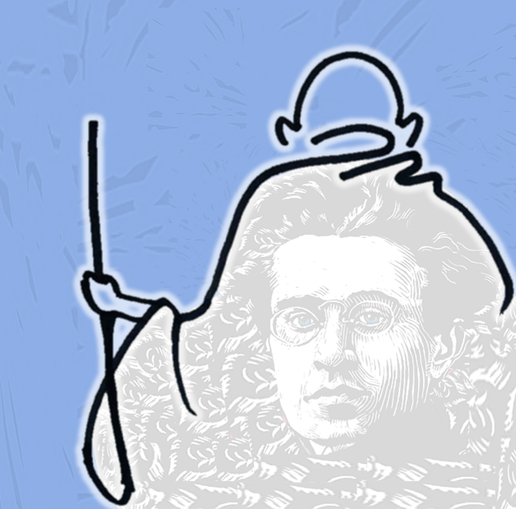 The worldwide campaign to inject experimental “vaccines” into every living person on earth is reaching a predictable resistance point after only 5 months. No sales job has ever been so pervasive, so rapid, so insistent since, well, since Hillary Clinton’s failed 2016 campaign spent 4 years blaming Russia for losing to Donald Trump, fire hosing at full blast a flood of bizarre conspiracies out of every possible media nozzle about hapless buffoons like Carter Page into brains that today zombie walk onward like a kind of undead permanent haze consuming your Aunt Josie. Now comes the shaming campaign, which will be targeted most heavily at the working class by a media machine so omnipresent George Orwell couldn’t have conceived it better. The working class is used to being sold a bill of goods concocted yesterday for the sole purpose of profit, then scolded for not buying the bill of goods. Refusing this bill of goods is entirely reasonable for countless reasons, not just typically anti-vax reasons. First, the working class possesses more public information about how long one’s penis stays hard from a Viagra television ad than about potential side effects (let alone long term) of COVID-19 “vaccines”. The FDA has waived nearly every roadblock that would fully inform any patient’s consent (among other waivers). In fact, the most any worker truly knows about these brand new, wholly experimental “vaccines” is their corporate identity. The Pfizer, The Moderna, The Astra Zeneca. Second, none of these “vaccines” claim to prevent infection. Not one. Here we see capital even exerting power over the understood meaning of “vaccine”. The word itself is completely meaningless at this point. Third, it’s entirely possible these suboptimal “vaccines” succeed mainly in providing a breeding ground for more infectious and more deadly variants to evolve, by putting the body’s own immune system in the back seat in favor of vaccine induced responses that are barely effective against not just infection with the original COVID virus, but totally powerless against variants. One scientist, a fellow named Geert Vanden Bossche, is even convinced that any mass vaccination campaign in the midst of a pandemic is a colossal catastrophic error that will eventually breed some super virus far worse than what we’ve seen to date. The working class has already seen such a dynamic with flu shots that don’t really work, and antibiotic over-prescription making antibiotics less effective over time. An oldie, but a goodie! Thus, in this “vaccine” campaign, now that we’ve reached the point people reasonably refuse it, we will soon see capital rolling out its coercive power because acquiesced consent is resisted. This brings us to Gandhi and Gramsci. Pour the coffee, grab a cannoli. Antonio Gramsci was a founder of the Italian Communist Party born in 1891 on Sardinia, the large Mediterranean island off the east coast of Italy. Unlike so many Italians of his era (like my great grandfather Anthony Russo, born a year earlier in Sicily), Gramsci did not make it to America. Instead, Gramsci grew up on Sardinia into a precocious, though always sickly, brilliant kid intent on revolutionizing Italy. You can visit his childhood home online here. 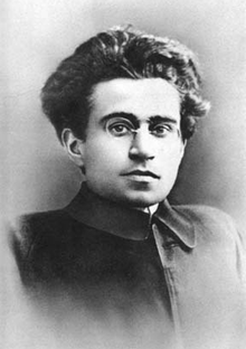 Antonio Gramsci, 1916 By 1926, only 35 years old, Gramsci had become so dangerous, Mussolini threw him in prison, where Gramsci slowly rotted to his death in 1937 at the age of 46. “For twenty years we must stop this brain from functioning,” Mussolini’s prosecutor declared. Alas, Gramsci’s brain did not stop. Despite the agony of constant sickness in a fascist jail cell, Gramsci wrote his Prison Notebooks, 3,000 pages of philosophic thought on every possible topic imaginable; an incredible feat. Those prison notebooks slowly emerged in translation to English in the 1950’s. Over time, Gramscian thought began to transform radical leftism, until today, it forms the bedrock of the rising 21st century left; Gramsci’s theory of “cultural hegemony”. Cultural hegemony is like wearing clothes. We do not walk around naked. Our “common sense” (a term Gramsci relies on) is to wear clothes. Similarly, we hold in the same spot in our brains the logic of markets, profit and loss, as if it is a cosmic truth; capitalism thus becomes as second nature to us as wearing clothes. Gramsci’s contribution is this consent vs. coercion. Capital does not coerce its power (though it holds such power in reserve); instead, it tricks us to obey the value system of capital by our own consent. Just as no one coerces us to wear clothes. We enforce being clothed, and capitalism, ourselves, without thinking, because both are cultural norms of behavior. This is Gramscian thought at its core; the idea that capitalism enforces itself (its “hegemony”) through the voluntary acquiescence of the masses to the value system of capital. America occurred to Gramsci in prison quite a bit. He wrote about us most toward his final years, 1934-1936, thus it’s a bit messy. “Americanism and Fordism” Gramsci called our world, focusing on the processes of production pioneered by Henry Ford’s assembly line. America, Gramsci thought, was creating a specific type of human, the capitalist human, who would fit into capitalism the way the guy with that particular bolt on the Model T fit into Ford’s assembly line. “Hegemony is here born in the factory”, Gramsci wrote of us. For a look at how this plays out in the discourse of the American left today, this 2017 Jacobin article is useful. In 1934, Gramsci observed with prescience that our peculiar development “has left the American popular masses in a backward state,” concluding that in America, “the fundamental question of hegemony has not yet been posed.” It still hasn’t been, but may soon be. Nonviolent war? How? To create a new value system we enforce ourselves by our own consent, Gramsci proposes a series of “war” metaphors. He splits “war” into “war of movement”, the traditional conception of military frontal attack, “war of position”, the seizing of ground for the purpose of holding it permanently, and, almost as an afterthought, “underground war”, when he wrote briefly of Gandhi, around 1930-1932. “Thus India’s political struggle against the English knows three forms of war; war of movement, war of position, and underground warfare. Gandhi’s passive resistance is a war of position, which at certain moments becomes a war of movement, and at others underground warfare. Boycotts are a form of war of position, strikes of war of movement, the secret preparation of weapons and combat troops belongs to underground warfare.” Gandhi, to the contrary, saw nothing “passive” or “underground” about civil resistance. Quite the opposite. “I for one have never advocated passive anything”, Gandhi says in this (suitable for training) set of clips from Richard Attenborough’s 1982 film of his life. Because orthodox Marxist doctrine of the time tended to rely on violence, Gramsci’s “war” metaphors applied to Gandhi reveal Gramsci grappling in his Prison Notebooks with the impotence orthodox Marxism imposes on itself by relying on violence to make change. Gramsci tries to fit Gandhi into this war metaphor, or that one. But after all, Gramsci’s entire theory is about ideas and value systems; consent not coercion. The great genius of Gandhi is the power of this simplicity. Saying “no”, nonviolently, is a direct strike into the heart of capital’s cultural hegemony, creating a new common sense, enforced by consent of all, not coercion by a few. Applying Gandhi to adjust Gramsci, we challenge capital’s cultural hegemony by actively (not “passively, nor “underground”) nonviolently disobeying it. As Dr. Martin Luther King knew, in Gandhi, the “praxis” of nonviolent civil disobedience is self evident. “Be the change you wish to see.” What’s this got to do with COVID? You will rapidly encounter the coercion capital holds in reserve to enforce itself if you refuse the “vaccine”. Capital will fight back. The full weight of capital’s cultural hegemony will rain upon you if its hegemony is threatened by refused acquiescence. Such a fight is precisely as existential to our value system as if instead of wearing clothes we all decided to go naked from now on – we would certainly meet coercion immediately upon being seen without clothing. That is the difficulty in saying “no” to capital’s cultural hegemony; it must be said constantly, loudly, daily, often publicly in the face of severe consequences from capital’s cultural hegemony struggling to survive our nonviolent assault upon it. It is here, in the consistency of saying “no” to capital’s hegemony, we may see Trotsky’s “permanent revolution”. War it most certainly is; saying “no” to capital’s cultural hegemony triggers Gramsci’s “war of position”, such as a boycott, or “war of movement” such as a strike, often both, simultaneously, and much else in response from capital’s coercive power. Such a commitment demands constant struggle, hard work, suffering, and pain. Violence is easy and quick. Nonviolence is anything but. Gandhi is correct that “truth and love” always win, but as any (good) Christian knows, loving your enemy, your neighbor as yourself, every single day, is an endless path, whose journey is often its only earthly reward. All these forces will be evident once you refuse a COVID “vaccine”, including the ultimate result inherent to the theory of nonviolence. If your nonviolent civil disobedience is just (or at least reasonable, as refusal to take the COVID vaccine most certainly is), and based in “truth and love” as Gandhi’s theory requires, coercive attacks against your disobedience of unjust hegemony will only backfire against the unjust value system your disobedience rejects, growing a new cultural hegemony despite (and in response to) the coercion of the few. The new value system supporting your saying “no” will inevitably stand victorious over the coercion of the unjust old, building a new hegemony destined to enforce itself by the just consent of all of us. Such change happens, and can only happen, one person at a time. AuthorTim Russo is author of Ghosts of Plum Run, an ongoing historical fiction series about the charge of the First Minnesota at Gettysburg. Tim's career as an attorney and international relations professional took him to two years living in the former soviet republics, work in Eastern Europe, the West Bank & Gaza, and with the British Labour Party. Tim has had a role in nearly every election cycle in Ohio since 1988, including Bernie Sanders in 2016 and 2020. Tim ran for local office in Cleveland twice, earned his 1993 JD from Case Western Reserve University, and a 2017 masters in international relations from Cleveland State University where he earned his undergraduate degree in political science in 1989. Currently interested in the intersection between Gramscian cultural hegemony and Gandhian nonviolence, Tim is a lifelong Clevelander. Midwestern Marx's Editorial Board does not necessarily endorse the views of all articles shared on the Midwestern Marx website. Our goal is to provide a healthy space for multilateral discourse on advancing the class struggle. - Editorial Board |
Archives
June 2026
Categories
All
|
 RSS Feed