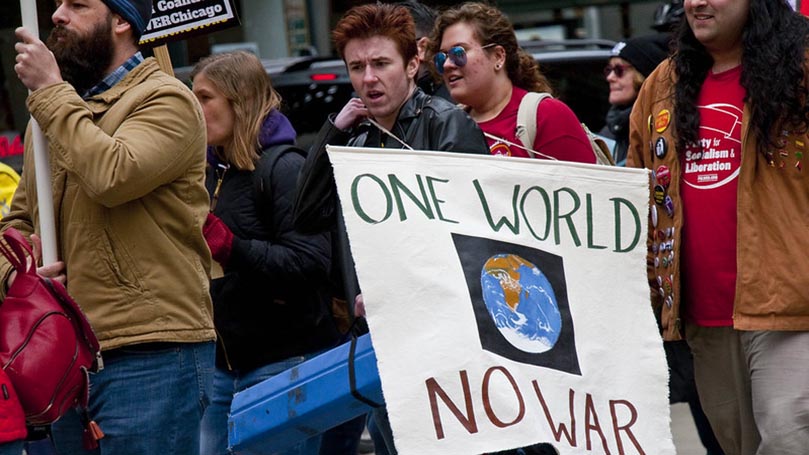
 To mark twenty years since the 9/11 attacks on the World Trade Center and Pentagon, recent media have been saturated with commemorations, recollections, and reflections. “9/11 changed everything” is a common refrain, with the event serving to divide recent history to “before” and “after.” Much is made of the large number of people who were not old enough to remember the horror and fear of that day, seen as a defining moment of a generation. The trauma of loss experienced by so many individuals is a focus, along with the persistent health problems that first responders are still experiencing two decades on. Mostly, these reflections zero in the emotional, personal, and individual. James Poniewozik, a New York Times television critic, reviews this year’s coverage and finds that the documentaries this year are very much like the coverage produced at the ten-year mark: There are wrenching interviews with survivors and with those whose loved ones died; uplifting stories of rescues and agonizing stories of those who perished in the attempt; footage of the conflagration, chaos and shock, as seen on morning newscasts and in the ash-blanketed streets; images of the first responders and volunteers digging through wreckage. That critic asks, “Is 9/11 a day or is it an era?” and laments the lack of films that look beyond the day. Among those that do, the best is Spike Lee’s four-part documentary NYC Epicenters: 9/11 2021½, which combines individual New Yorkers’ experiences with criticism of government messaging from George W. Bush to Donald Trump (here called “President Agent Orange”). But even that documentary treats 9/11 as a beginning point and doesn’t open the question of what came before. What 9/11 UnleashedIt’s easy to feel the “before” and “after” of 9/11 for those who remember it. It did seem to “change everything,” setting off consequences that had a profound impact, well beyond the initial losses of life. Almost immediately Congress passed the Authorization for the Use of Military Force, with Representative Barbara Lee casting the sole no vote. Almost a million people died as a direct result of the forever wars launched in 9/11’s wake by the Bush/Cheney administration. In October 2001, the U.S. passed the USA Patriot Act, giving government broad powers of surveillance and detention. Furthermore, Islamophobia spiked immediately. Four incidents of anti-Muslim violence were reported in the four months before 9/11; in the four months after, 96 such incidents were reported. After 9/11, Islamophobia became a guiding principle of official policy (Nguyen 2005), with an immediate round-up and detention of 1,200 Muslim, Arab, and South Asian men; FBI visits to 11,000 more; and a registration system requiring men from certain countries to register with the government — almost 300,000. Surveillance of the Muslim population has spiked, especially in New York City, where the Police Department has spent more than $3 billion since 2006 on license-plate readers, facial recognition software, mobile surveillance vans that have X-ray capabilities, etc. “Flying while Muslim” became a difficult, sometimes humiliating, experience. 9/11 ushered in the era of internet-propelled conspiracy theories, starting with the 9/11 “Truthers,” whose film Loose Change was the internet’s first viral video. Even Spike Lee’s documentary about 9/11 originally gave credence to these theories. In the years after, this path merged with Islamophobia in the “Birther” conspiracy and the Islamophobic violence set off years after 9/11 by Donald Trump. We need to step back and ask: Is the way that the story is usually told, concentrating on the events of the day as experienced by individuals, the best way to understand 9/11? Why do some details get included in the narrative, while others are excluded? What messages does the narrative send, and whose political interests does it serve? A historical materialist approach recognizes official historical narratives as cultural productions that serve the interests of the ruling corporate class and the politicians it has cultivated in government. These narratives are some of the “ruling ideas” developed by the intellectuals of the ruling class to reflect and perfect “the illusion of the class about itself,” as Marx and Engels put it in the German Ideology. Historical narratives that reflect ruling ideas deflect attention from the material basis of social change, and instead view events as isolated and disconnected from their social, political, and economic contexts. Of course, they are also constructed to see the ruling class as blameless victims of fate, deserving of the power that they wield in society. How did the Official Narrative Begin?One of the first exhibits about 9/11 set the tone for the way the story has been told for years after. The Smithsonian launched “September 11: Bearing Witness to History” in 2003. The exhibit emphasized “individual pain and resilience” but rarely addressed any of the social and political antecedents that led to that day, according to political scientist Amy Fried (2006). The curation staff reported that they deliberately tried to construct a “non-political exhibit,” using media clips and images, while introducing as little interpretation as possible. In the process, though, they ended up producing an exhibit with very clear political messages, according to Fried. For example, the post-9/11 roles of George W. Bush and Rudy Giuliani were exalted, their rise treated as one “of individuals who are transmuted from their prior, less exalted condition.” The exhibit lasted only four months and was shut down before the 2004 election got underway, but this first exhibit reportedly pleased the U.S. Department of Justice and the FBI specifically. Political sociologist Patricia Leavy (2007) shows that the war hawks of the Bush administration, and those in media who sometimes inadvertently supported them, crafted a narrative of 9/11 specifically suited to their purposes, that is, justifying the so-called war on terror. This narrative was solidified with four practices: naming the event (we know it as 9/11), saturation coverage of the event (this year we saw the same footage again), the use of superlatives (stressing its disconnection from history), and “selective use of historical metaphors” (comparisons to Pearl Harbor for example were used to make the U.S. “war on terrorism” seem a defensive one). Repeatedly calling it “senseless” made a deeper understanding seem permanently out of reach. A dichotomy was stoked that removed all nuance, contrasting the “terrorists” and the “patriots,” the villains and heroes, and echoing George Bush, those with us and those against us. This narrative, Leavy said, carried over into other aspects of the conservative agenda, even the anti-choice campaign. Leavy describes one bumper sticker from an anti-choice group that appeared in the years after 9/11, showing smoke billowing from the twin towers and the slogan “Every year 3,200 people are murdered by the TERROR of abortion.” The focus on the horror of the day, its “senselessness” and “evil,” served to hide a more materialist approach, which looks at the event in the broad, interconnected context of resources, people, and production. It diverted attention from access to and control over oil resources, hid U.S. complicity in propping up authoritarian dictators, and looked the other way while bankers’ greed led us into the Great Recession of 2008. Alternative NarrativesCounter-narratives that challenge the official history were rare but not absent, and they were, for the most part, decisively policed. Rapper KRS-One recounted his childhood memory of being chased out of the financial district where the World Trade Center was located. Cops, he said, pushed him toward the subway and told him to return to his own neighborhood and “leave the rich white folks alone” (Simko 2015). For reasons like that, KRS-One said, African-Americans “cheered when 9/11 happened.” Immediately and roundly denounced for being “in solidarity with Al-Qaeda,” he quickly walked back the tone-deaf comments and was still explaining himself a dozen years later. Even more vitriolic was the silencing of Ward Churchill, a Native American academic who lost his job as a professor of ethnic studies at the University of Colorado Boulder following outrage over a bombastic essay he wrote entitled “‘Some People Push Back’: The Justice of Roosting Chickens.” Churchill’s essay puts the 9/11 attacks into its context, arguing that it was a counter strike in a long war the U.S. and the West in general have waged against the people of the Middle East, from Lyndon Johnson’s assistance to Israel in displacing Palestinians, through George H. W. Bush’s systematic bombing of Iraqi water purification infrastructure, which contributed to the deaths of a half-million Iraqi children. Churchill claims that there were few ways to push back against a system of oppression that is carried out in the clean and seemingly innocent confines of Wall Street offices. He used a term for these technocrats, “little Eichmanns,” that had been used since the 1960s. But this was the phrase that was repeated in the news media, and a fierce backlash against Churchill led to his dismissal from the university faculty. Recognizing the danger posed by the narrative that justified a “war on terror” instead of a more appropriate targeted law enforcement action in response to the attacks, the CPUSA convened a Peace and Solidarity Conference in Chicago early in 2002, and called out the Bush administration’s use of 9/11 to cover for their ambitions for war: With the nation in a state of shock after 9/11, the administration was all too willing to take advantage of our collective sorrow and quickly move towards an aggressive policy of retaliation and war. It is not only the looting of the public treasury to fund this unending war, nor the dangerous assault on our basic democratic freedoms in the pursuit of ‘security,’ that we are organizing to stop. It is not only the brutal destruction of Afghanistan and the direct killing of over 3,500 Afghani civilians to which we demand an end. . . . We also call for an end to the very military doctrine now being pursued that threatens to catapult all of humanity into nuclear annihilation. This analysis sadly remained valid for the next two decades, when over 100,000 Afghans died in the “forever war” that followed. With the emphasis on the “senselessness” of 9/11 and the reluctance of exhibit curators and op-ed writers to view the events within the context of the global political economy in which it emerged, it is no wonder that young people interviewed recently by the New York Times called on their teachers to do a better job of explaining why it happened, including “a bit more of . . . the history of the U.S. in the Middle East.” 9/11 was set into motion by decades of U.S. and Western imperialist policies that denied people the right of self-determination; an early example was in 1958 when the U.S. sent 15,000 armed forces into Lebanon in 1958 to prop up Maronite Christian President Camille Chamun. Chamun was unpopular with Lebanese people, but he was cooperating with the West in preventing the Arab unity that Gamal Abdul Nasser of Egypt was promoting. The U.S. has been involved in the region ever since. People will commemorate 9/11 — it’s natural to revisit events on important anniversaries — but we need to view it as one point in a dynamic history of material political-economic conditions and multiple global actors and strive for deeper understanding of the event and its causes in world history. We need to view narratives embedded in documentaries and public exhibits critically, and not “take every epoch at its word and believe that everything it says and imagines about itself is true” (Marx & Engels 1970, 67). Sources Amy Fried, “The Personalization of Collective Memory: The Smithsonian’s September 11 Exhibit.” Political Communication 23 (4) 2006, 387–405. Patricia Leavy, “Writing 9/11 Memory: American Journalists and Special Interest Groups as Complicit Partners in 9/11 Political Appropriation.” Journal of Political and Military Sociology 35 (1) 2007, 85–101. Marx & Engels, The German Ideology. International Publishers, 1970. Also in Marxists.org. Tram Nguyen, “We Are All Suspects Now”: Untold Stories from Immigrant Communities after 9/11. Beacon Press, 2005. Christina Simko, The Politics of Consolation: Memory and the Meaning of September 11. Oxford University Press, 2015. Image: Charles Edward Miller (CC BY-SA 2.0). AuthorAnita Waters received a Ph.D. in sociology from Columbia University and is retired from the faculty of sociology and anthropology at Denison University in Granville, Ohio. She’s the author of two books and many articles about Caribbean politics and other topics, and is a member of the National Committee and the Chair of the Ohio District of the Communist Party USA. This article was first produced in CPUSA. Archives October 2021
0 Comments
 This is the foreword to the new edition of Marika Sherwood’s Claudia Jones: A Life in Exile (Lawrence Wishart, 2021). Too often, a revolutionary life appears free of tedium. Revolutionaries emerge from whatever page or screen we discover them on seemingly fully formed. Their lives unfold as a series of events that continually evidence an iron-clad political commitment to building a livable world and securing freedom for all oppressed people. Because of this romanticized picture, the gulf between our lives and theirs expands. It is hard to imagine that they ever really existed at all — harder still to grapple with the true complexity of that existence. They remain ghosts, die righteous, too soon or vindicated. In an effort to recover them, we begin to name the turning points: a critical speech or event that helps us trace the growth of their political concerns and aspirations. With this historical material, we piece together a political trajectory, taking into account their experiences, influences and ideas. The archive is a treasure trove. It enables us to reconstruct what we think we know about their personal lives, providing a glimpse of close friendships with other political actors and artists; it keeps us guessing. What is hidden is the bureaucracy of living: the question of how the revolutionary survived monetarily, who they loved, how they worked and the intricacies of the relationships they formed along the way. In this way, Claudia Jones’ reputation precedes her. She is omitted from certain parts of the Communist Party of Great Britain’s history and narratives of the radical left during the 1950-1990s in part because she challenged their failure to acknowledge the plight of colonial subjects, or to integrate an understanding of race as a modality through which class is lived into their critique of capitalism. Jones made herself both a threat and a nuisance. She was unsatisfied with a Communist Party that claimed to offer the worker emancipation while refusing to recognize Black workers, and Black women workers especially, as co-collaborators in that vision. “Rediscovered” by Buzz Johnson in the 1980s, what we know about Claudia’s life we know through the process of excavation. Archivists have pieced together the details of her expulsion from the US under McCarthyism, her life in prison and her political organizing in the UK from her papers, political speeches and the memories of those she touched. Though insufficient, excavation seems fitting for Claudia. It makes sense that we can only know her through other people because hers was a life lived for others, mirroring her belief in a core feminist principle: collective liberation. We only have scraps of her autobiography, but like all those whose lives are defined by struggle, she always had one eye on tomorrow. In surviving pages of her autobiography, included in Sherwood’s Claudia Jones: A Life in Exile, she writes: “Tonight I tried to imagine what life would be like in the future … on the broad highway of Tomorrow, despite craggy hills and unforeseen fullies, I am certain that mankind will take the high road to a socialist future.” She was surer of this than anything else: “My certitude for this broad future has never matched my certitude for my personal fortunes.” An Internationalist Out of NecessityJones’ life was one of service; one lived in the pursuit of dignified existence, in search of the promise of the communist horizon. On this side of the temporal ledge looking back, we ask: do you remember Claudia Jones? Perhaps it is better to ask: how do we remember Jones and the women who emerged from her legacy, in ways that articulate their persistence against hegemony, against militarism, against the misery of the economic base and ideological superstructure that continue to shape the way we live? In her treatise “An end to the neglect of the problems of the Negro woman!” published in 1949, she wrote in the spirit of the Marxist tradition, “The bourgeoisie is fearful of the militancy of the black woman, and for good reason.” Jones understood her own power and the menacing potential of political consciousness. Throughout her life, her position as a communist was no doubt contentious, no doubt alienating, but always the basis of her political endeavors. Indeed, Claudia’s leadership, organizing work and recruitment strategies were so threatening to the state that she was put under surveillance, imprisoned four times and finally deported from the US to Britain in 1955 for her affiliations to the Communist Party of the USA. A revolutionary life often involves risks to personal freedom and safety. Jones’ imprisonment and the long-lasting connections she forged with other political prisoners illustrate the consequences of principled resistance. In many ways, her strategy was simple: to give the worker the tools needed to understand their position under extractive capitalism. Becoming a member of the Communist Youth League in 1936, Jones’ years in the CPUSA were spent honing an analysis of the position of the Black woman worker; building a framework to understand her standing in the party as well as the conditions and confinement of her wage under capitalism. She found a way to articulate the historical circumstances that led to Black people’s illegibility under the category “worker” and thus their widespread exclusion from trade union affairs. It is not an understatement to claim that Jones expanded Marxist-Leninist notions of super-exploitation in order to apply them to the condition of Black workers, including women, in the colonies and the imperial core. She developed an anti-imperialist analysis of racialism that clarified its origins in the colonial project. Jones’ staunch anti-imperialism contoured her liberatory work; she began several initiatives to organize formerly colonized peoples in the UK, affirming a political consciousness that eschewed borders. She was determined to understand how workers across the world could unite. Despite the grand nature of her political vision, the problem of citizenship marked her life. Jones’ location was determined by which nations she could enter and what permissions they gave her to travel. One might argue that she was an internationalist out of necessity; being so forcefully expelled from the US and curtailed in her travels due to the denial of a passport by the British state, what allegiance could someone like her have had to the nation or the fictions that uphold it? Alongside her commitment to internationalism came an insistence that the Communist Party of Great Britain provide a vision of liberation that articulated how the worker’s struggle was inseparable from the struggle against imperialism. When she represented Vauxhall and Tulse Hill at the 25th Congress of the CPGB in 1957, she pressed that, “Colonial, and particularly colored peoples in Britain will also want to know what policy the Party Congress advances to meet the special problems facing them in the present economic situation – the same monopoly capitalists in Britain who exploit the British working class, but who super-exploit the colonies.” When her “comrades” branded those in the colonies “backward” she struck back, arguing: The ‘backwards’ people of China and the backward people of Czarist Russia were the first to throw off the old regimes, and are now going forward with the most advanced ideology … whilst the technically advanced peoples in the Western bourgeois democratic tradition are still steeped in the mire of backward imperialist ideology. The anti-imperialist struggles of the backward Afro-Asian nations, from Egypt to Ghana, are today leading the anti-imperialist ideological struggle. Thus, whilst Claudia was admonished by some sects of the Communist Party in the UK, her name was known across the world. The struggle took her to the USSR, to China; she had comrades in Ghana, South Africa and across the African continent. Upon her death, Tang Ming Chao of the China Peace Committee wrote, “Comrade Jones was a proletarian internationalist. Her whole life was that of a revolutionary and militant fighter.” The Soviet Women’s Committee remembered her as “a tireless fighter for the triumph of the brightest ideals, and peace and friendship among nations.” She left echoes and traces everywhere. LIBERATION IS THE WORK OF MANY HANDSThere is a tendency to downplay Jones’ political tenacity in biographies of her life — to remember her solely as “the mother of carnival” is to do her a disservice. Her presence and memory looms large; what is clear is that she touched people across a myriad of political spheres and, in doing so, changed their conception of what was possible to demand for themselves and others. Friends remember her as an orator, capable of isolating, distilling and then elucidating a problem. Trinidadian actress Corinne Skinner-Carter remembers how, “She pulled out the things in people that they thought could never be done,” always framing analysis in terms that could be widely understood. She skillfully reminded comrades that editorials in the West Indian Gazette — the newspaper she helped to found — were not “a treatise or a legal argument” but were intended to be understood by everyone. Claudia recognized the areas where her work and organizing abilities would be most constructive and moved strategically, using her knowledge and skill as a journalist as a means of radicalization. The West Indian Gazette’s seven-year run is perhaps one of the greatest attempts at diasporic mobilization and political education in recent history. It is important to note that with others, Jones managed its finances and editorial output, in the face of threats from the Klu Klux Klan, fascists marshaled by Oswald Mosley, and amid a backdrop of constant threats against her life. When the CPGB became a dead end in 1958, Jones set her sights on organizing against the color bar. She mobilized hundreds, including artists and community leaders, to take up the fight against the Immigration Act of 1962, in the wake of race riots in Notting Hill in 1958 and the murder of Kelso Cochrane in 1959. Her wide array of friends and acquaintances — Paul and Essie Robeson, Pearl Prescod, A. Manchanda, Elizabeth Gurley-Flynn, Amy Ashwood Garvey, George Lamming, Ben Davis — and brief encounters with the likes of Martin Luther King, Pablo Picasso and Mao Zedong tells us something about the plurality of her political mission. Claudia Jones understood that the work of liberation is the work of many hands and that a political life without space for joy, creation, music and artistry was incomplete. Her work with others establishing the UK’s first Caribbean carnival must be understood as an extension of her political love for people, for the Caribbean community and a dynamic Black culture that continues to evolve. Claudia’s Caribbean Carnival Committee began in response to the riots of the late 1950s and part of its proceeds went towards the fines imposed on Black youth harassed by the police. Contemporary political movements have much to learn from her imaginative response to state violence and her ability to temporarily transform the treacherous conditions of post-war Britain into a space capable of sustaining Black life. Jones is rarely remembered as an artist in her own right. Her political practice survives in her poetry, which, more so than any speech or diary entry, best captures her belief in the fraternity of peoples and their ability to love, protect and provide for one another. To Puerto Rican nationalist, Blanca Canales, in an unpublished poem entitled “For Consuela, Anti-fascista,” she wrote: It seems I knew you long before our common ties—of conscious choice In 1964, on a plane to Peking, she wrote: Change the mind of Man Claudia’s poetic voice is infused with a radical determination to name the structures that exploit, oppress and restrict us, and then to destroy them. She understood, like Black feminist writer and scholar Toni Cade Bambara, that the role of the artist is to make the revolution irresistible by any and all means necessary. Poetry was another arena in which to hone and express her liberatory desire, to tap into the affective realm of political imagination — what freedom would feel like. Among her friends were artists, performers and writers, many wary of her political discipline but drawn to her skill for translation, for shape-shifting and for illustrating connections between race, gender and class, between art and emancipation, between the individual worker and the means of production that were there for the taking. A Life Lived in StruggleClaudia Jones: A Life in Exile offers a refreshing approach to Claudia’s life. It is a book of memories of her time in the UK that is littered with holes. There are gaps, omissions, archival material that is contentious, hints at what is yet to be recovered. All of it highlights Claudia’s strange magic, the ability to live many lives in a single body. It goes beyond an account of her life in terms of location and action and instead attempts to recreate the general mood of her political work and her relationships with others. In a non-linear and fragmentary way, it elucidates the conditions that make a revolutionary and the mess we make of remembering them. Many will know that Claudia is buried to the left of Karl Marx but not that she suffered debilitating illness, including persistent heart problems linked to tuberculosis throughout her most active political years. This fact is important; her life and work exist in the context of a world determined to kill her, in part by blocking access to financial and medical resources that might have extended her life. Many know her work as a journalist, founder of The West Indian Gazette and key member of the Caribbean Carnival Committee, but not as a poet and a communist. Though we can run our fingers along the threads she sewed that extend into the moment I am writing this, many do not know that Claudia died in relative poverty, alone. Even those in closest proximity to her, who loved her unendingly, claim that she kept them at arm’s length. Perhaps the task is not to try and know Claudia Jones in her entirety, as if such a thing were possible. Perhaps the task is to understand how the political promise she dedicated her life to lives on through others and can live on in us too, if we take seriously the promise of the communist horizon. This book prompts reflection on how unglamorous a life lived in struggle can be. It suggests that to remember Claudia is to commit ourselves to defending life against all those systems that kill us prematurely, just as she did. AuthorLola Olufemi is a Black feminist writer and organizer from London. She is author of Feminism Interrupted: Disrupting Power (Pluto Press, 2020) and co-author of A FLY Girl’s Guide to University (Verve Poetry Press, 2019). She was shortlisted for the 2020 Queen Mary Wasafiri New Writing Prize in Fiction and is currently researching for a PhD with the Stuart Hall Foundation. This article was first produced by Roar Magazine. Archives October 2021 10/1/2021 A conversation between Günter Gaus and Rudi Dutschke. Translated with comments by Vince K.Read Now A conversation between Günter Gaus and Rudi Dutschke[1]Original broadcast date: December 3rd, 1967. Rudi Dutschke, born March 7th, 1940 in Schönefeld (East Germany), died December 24th, 1979 in Arhus (Denmark). Bio[2]Dutschke completed his Abitur in 1958 and trained as an industrial clerk. He refused to serve in the National People’s Army. Later, he studied sociology in West Berlin and joined the Socialist German Student Union (SDS). Dutschke soon became a leading figure in the Extraparliamentary Opposition (APO) and in the student movement. He gave countless interviews, talks, and essays. In April of 1968, serious riots followed in the wake of an assassination attempt against him. These riots mainly targeted the Springer Press, which was seen as complicit in this act of violence because of its previous reporting on the APO. Dutschke later became a lecturer in Arhus, where he died from the late consequences of his gunshot wound. This interview was broadcast December 3rd, 1967. Gaus: This evening, you will see an interview that I conducted with Rudi Dutschke a few weeks ago. Rudi Dutschke is 27 years old, he left East Germany some time ago for political reasons, and he is currently a student of sociology at the Free University of Berlin. He is the most eminent spokesman for a movement of radical students who not only want to reform West Germany’s colleges and universities but also seek to upend the entire social order as we know it. These students are a small minority. The great uproar that precedes them cannot obscure this fact. The overwhelming majority of German students is likely still apolitical. Most of them are not even interested in higher education reform to the extent that we should want them to be. And within that minority of students who take an interest in these bitterly-desired, overdue reforms, Dutschke’s followers are still quite a small group. Should this be any reason not to concern ourselves with him? Dutschke and his friends must admit that their style of argumentation occasionally makes it difficult to see them as serious conversational partners. In my view, this should not prevent us from making sense of what these young revolutionaries want to be – what they consciously desire to be – in a time when one can no longer take the idea of revolution seriously. One asks what these young revolutionaries really have in mind. I think this is the reason why an interview with Rudi Dutschke has value. This will not have as much to do with concrete references to current events as with the general principles that guide Dutschke’s thinking. These are the principles he is attempting to impose on our society. With that, we welcome you to our program: “On the record – Rudi Dutschke.” Mr. Dutschke, you would like to transform the social order of the Federal Republic of Germany. According to you, everything must be changed from the ground up. Why? Dutschke: Yes – let us start by going back to the year 1918. That was when German councils of workers and soldiers first secured the 8-hour working day. In 1967, our blue-collar and white-collar workers alike have been spared a measly four to five hours of work per week. And this despite a colossal development of productive forces, a development of technical achievements that could theoretically bring about an equally-colossal reduction in working hours. In the interest of maintaining the established system of rule, this historically-actualized reduction in working hours has been put on hold in order to maintain a state of unconsciousness. This unconsciousness stands in connection with the length of the workday. Here is an example: after World War II, the two German governments spoke incessantly about unification. Over twenty years later, we have no unification. Instead, we have systematically received a series of regimes that one may call institutionalized lying instruments, in a manner of speaking. These are instruments of half-truth, of distortion – the people are not being told the truth. No dialogue is being established with the masses, no critical dialogue that could explain what is happening with our society. Now that the economic miracle[3] has come to an end, why has there been no progress on the issue of unification? One speaks of ‘humanitarian concessions’ while referring to nothing other than the maintenance of political rule. Gaus: Mr. Dutschke, why do you believe that the changes you’re looking for cannot be achieved by working with the existing parties? Dutschke: There has been a long tradition of parties: social-democratic, conservative, liberal. Without going into too much historical detail, we have had a very clear development of parties since 1945, the result of which is that they are no longer instruments for raising the consciousness of all the people in our society. They are now merely instruments for stabilizing the prevailing order; they make it possible for a particular layer of the apparatus of party functionaries to reproduce themselves within their own framework, and thus the possibility that upward pressure and upward attainment of consciousness could prevail qua party institution has already become impossible. I think that many people are no longer willing to participate in these parties. Even those who still vote are ill at ease with the parties that exist. And… build another two-party system, and it’s over for good.[4] Gaus: We’re about to touch on your conceptions for a political society, and we will certainly have more to say about that. For now, I’d like to know what sets you apart from the prevailing political system. If one studies what you have written and said thus far, Mr. Dutschke, one concludes that the opposition embodied by you and your friends in the SDS[5] is not only extraparliamentary, but also anti-parliamentary. This was my impression, at least. One question: do you agree with this finding? Do you believe that the parliamentary system is unusable? Dutschke: I regard the existing parliamentary system as unusable. That is, we have no representatives in our current parliament who express the interests of the population – their actual interests. Now, you might ask: what actual interests? But there are in fact demands, even within the parliament. There are demands for unification, for securing jobs and public finances, for an economy that can bring everything into order. Those are all demands, and the parliament is responsible for fulfilling them. But it can only fulfill them by establishing a critical dialogue with the public. Well, there is currently an absolute division between the representatives in the parliament and the people, who are being kept in a state of disempowerment.[6] Gaus: For the moment, we have both agreed to make a record of your assertions before we begin discussing them. Please tell me: how would your ideal society organize, manage, and govern itself? Dutschke: The society we strive for is the result of a drawn-out process,[7] which means that we cannot make grand sketches of how the future will look. We only can say that it will have its own structuration that differs from the current one in principle. Gaus: How so? Dutschke: In the sense that under the current conditions, we have elections every four years, and we have the opportunity to affirm the existing parties. We have ever fewer chances to choose new parties, and thus fewer alternatives to the prevailing order… Gaus: The NPD[8] is one counterexample. Dutschke: The NPD is not a counterexample – its emergence is inseparable from the unease towards existing parties on one hand and the end of the reconstruction period (uncritically: the so-called economic miracle) on the other hand. Both factors have enabled the advent of the NPD. But this does not mean that the NPD has no chance of winning majorities among the masses… Gaus: Let’s return to your ideal conception of society, which you want to construct politically. Dutschke: The fundamental difference is that we’ve begun to establish organizations that differ from traditional party structures. For one, there are no active career politicians within our ranks. We have no party apparatus. The needs and interests of participants in this institution are represented, whereas the parties contain an apparatus that manipulates the interests of the people rather than expressing them. Gaus: When your revolutionary movement becomes large enough and adapts to the sort of apparatus that naturally belongs to large organisms, how do you want to avoid that? Dutschke: That is an assumption on your part; I mean, there is no natural law stating that an evolving movement must have an apparatus. It depends on the movement and whether it can join the various levels of its development with the changing levels of consciousness. To put it more precisely, when we succeed in structuring this drawn-out transformation as a process of attaining consciousness among the individual members of the movement, we will achieve the conditions that make it impossible for the elites to manipulate us. That there is a new class… Gaus: You assume that the human being is absolutely capable of education, that human beings can become better. Dutschke: I assume that the human being is not condemned to remain subject to a blind interplay of historical coincidences. Gaus: People can take history into their own hands? Dutschke: They have always done so. They simply haven’t done so consciously yet. And now they must finally do so consciously – they must take control of history. Gaus: How do these new human beings govern themselves, who leads them, how do they determine who leads them, and how do they vote their leader out of office? Dutschke: They lead themselves – and this self-organization doesn’t mean that I am letting strangers decide things for me. When I say that people have always made history for themselves, albeit not consciously, this implies that if they were to do so consciously, the problem of elites and apparatuses assuming an independent existence would not arise. The problem consists in recalling elected officials and in having the ability to do so at will, and also in being conscious of the need for a recall. Gaus: Which basic characteristics need to be ‘excised’ from human beings so that they can achieve what you’re expecting from them? Dutschke: Not a single one. It’s just that the repressed characteristics must finally be set free. I am referring to the repressed capacity of mutual aid, the ability for people to transform their understanding into reasoning, and also their ability to understand the society they live in rather than being manipulated by it. Gaus: How do you and your friends want to bring about this level of consciousness within humanity? Dutschke: We’ve started to develop a method by which an education on social facts in the whole world and in one’s own society are paired with actions. By mediating and pairing this education – a systematic enlightenment – with what is happening, with all the daily events that are repressed in the newspapers, the radio broadcasts, and even on television; there are 122 countries in the world… when you open the BILD newspaper, you see one country at most, and you don’t even see what is happening in this country. This is a phenomenon not of information overload but of the systematic suppression of information and the non-structuring of information that is given. We want to break this apart. We want to share actual news about what is happening in the world, to enlighten people, and to lead campaigns that produce a new public sphere that takes note of this information, understanding that the existing public sphere is not the only option. Gaus: What distinguishes your program of “revolutionary enlightenment” and your political goal of remodeling the world from the earlier revolutionary movements? What’s the difference? Dutschke: I would say that the decisive difference is the historical situation we’re working with. In earlier epochs, revolutionaries worked mainly within the framework of the nation-state. Our work today deals with world-historical conditions in a very real sense. The Federal Republic of Germany can by no means be called a nation-state; we find ourselves in a system of international relationships. We are in NATO. Our populace has no idea what this means for the future. In 1970, one half of the world population will possess only one sixth of their labor value in the form of goods.[9] Revolutionaries in various continents are working to alleviate their misery. We are stuck in this web, and we need a world market that doesn’t constantly impoverish one half of the world, producing even more conflicts in the process. This has to be dismantled, this is what we find ourselves in, and in this respect, we differ fundamentally from various situations… Gaus: The communist revolution was supposed to be international, at least in theory. Dutschke: Yes, and it couldn’t manage that in real history. When the Communist International was beginning to form in 1919, of course the idea of an international class struggle existed. But really, there wasn’t even a true movement in the various continents… Gaus: Do you believe that the nation-state has been overcome across the world as an obstacle to such an international movement? Dutschke: The nation-state has not been overcome as an obstacle. It is trapped in the human consciousness. The problem lies in eliminating this ideological obstacle, in making this international mediation visible – both the way we are embedded in it and the way we can get out of it. Gaus: But that’s the same problem that the communists had in 1919. Dutschke: But they wouldn’t have been able to solve it back then. We can solve it today with help from telecommunications and other forms of global networking. Gaus: Va bene. Mr. Dutschke, I’m assuming that the consciousness of people in highly-industrialized states today is determined by an insight into the futility of revolutions. Note well: these are industrialized states, not developing countries. The two great European revolutions, the French and the Russian, have undoubtedly transformed political and social relations, but the practically Edenic ‘end stage’ of each (the long-term goal) was never attained. The revolutionaries were frozen in their tracks, sometimes struck by dreadful side effects. Mr. Dutschke, what makes you think that your revolution will be different, that is, more complete? How will you stop your long-term goal from vanishing in the distance before you reach it? Dutschke: We know the conditions under which the Russian Revolution faltered.[10] It’s a historical problem; we have an explanation for why it didn’t work. Why Lenin’s theory of the party appeared as a notable roadblock in 1921. Why the lag in industrialization in Russia was a condition for this failure. These are factors that we can name. There is no guarantee that we won’t fail in the future. But if a free society is unlikely, that’s all the more reason to work hard to create a historical possibility for it, even if success is not a given. It’s a question of human will whether we’re able to succeed, and if we don’t succeed, we’ve wasted one period of history. Maybe the alternative is barbarism!  Gaus: Now that’s the point I’d like to address, Mr. Dutschke: on the way to your long-term goal, however humanitarian and well-intentioned that goal may be, it may happen that you have to take highly inhumane measures. To avoid interruptions along the march to your distant paradise, there is no way you’d be able to avoid the possibility of having to construct prisons and concentration camps. Dutschke: That’s what minority revolutions had to contend with. The difference from previous revolutions is also the fact that our process of revolution will be a very long one, a long march. During this long march, either the problem of becoming conscious will be raised and then solved, or we will fail. Gaus: If I understand correctly, your revolution will develop in very long stages, and each of these stages will only be completed once humanity has reached the level of consciousness necessary for that stage.[11] But once this has been done, there is no need for prisons or concentration camps. Is that correct? Dutschke: Yes. That’s the precondition for doing away with prisons as prisons. Gaus: How long is the march? Will you get there in 1980? Dutschke: You see, there’s one data point in particular. Back in 1871, there was the Paris Commune… Gaus: Yes; that’s an exemplar for you! Dutschke: An exemplar for us. The dominion of producers over their products. No manipulation, regular elections and recalls, and so on… Gaus: I know. Of all the accompanying phenomena, it was the decisive one… Dutschke: The decisive model for the future, one we must keep reaching for. But the length of this fight won’t be a deterrent for us. It will take a long time, but many people are already leading the fight, and not only from within the established institutions. Gaus: We’ll eventually get to discussing the size of your movement. First, I’d like to ask another question. Mr. Dutschke, you were born in 1940, and I believe the key distinction between your generation and those who are currently in their 40s and 50s is that you, the youth, haven’t come to the realization over the past several decades that ideologies have been depleted. I mean to say that your generation is ideologically capable. Do you accept this generational difference? Dutschke: I wouldn’t think of it as a generational difference; I would say that there are a few grounding experiences. But these aren’t necessarily a generational difference. Grounding experiences can be processed in a variety of ways. To me, the key difference would lie in this variety of approaches. And so before 1914, there was certainly a grounding experience, but it wasn’t directed against the political institutions. We, however, do direct ourselves against them. Gaus: Still, I would argue that every ideologically stamped politics of our day, in our industrialized states, is fundamentally inhuman. It forces people to follow a route that is mapped out in advance so that later generations may be better off. Dutschke: No, nothing is being mapped out in advance. The act of mapping out is precisely the hallmark of the established institutions, which force people to accept something as fact. Our starting point is the self-organization of individual interests and needs, this is the form of the problem of… Gaus: But this presupposes a rise in human consciousness. At the very least, you have to convince people to accept this rise in consciousness. People won’t undertake it voluntarily; you must bring them to it. What will you do if someone says they’d rather sit at home every evening in peace, watching crime shows on TV, instead of letting Mr. Dutschke and his friends ‘enlighten’ them? Dutschke: We do not claim to be raising the consciousness of the whole population. We know that for now it’s possible to enlighten minorities that historically have the chance of becoming majorities. As of today, we are still few. But that doesn’t exclude the possibility that more and more people – especially now at the end of the so-called economic miracle, with many international events on the docket that have the power to raise consciousness – will perhaps see our insights as the correct ones. Gaus: I’d like to make two comments on that. Firstly: how do you – as a minority revolution – plan to avoid having to repress majorities if you ever come to power? How do you avoid the danger that other revolutions have been subjected to, according to your own definition? Dutschke: Nowadays, only right-wing minorities can win, not left-wing ones. A right-wing minority could win in Greece.[12] But there will be no chance for left-wing minorities to win in the organized late capitalism of today, where the international counterrevolution has already built all the necessary conditions for avoiding minority revolutions. That’s good, though, that’s all right. Gaus: This means that the counterrevolution saves you from the danger… Dutschke: … of becoming like the Bolsheviks. Gaus: I understand. And a second question along those lines: what gives you the confidence to assume that people who are distraught by recessions, economic decline, and unemployment in places like the Federal Republic will listen to your appeal? You’re telling them: “You must begin to understand yourself and your situation better.” Why should they choose this rather than the more comfortable solution offered by leaders of parties like the NPD? They don’t ask people to learn anything; they just have a ready-made prescription. Dutschke: They don’t have any ready-made prescriptions to offer. They only offer irrational and emotional forms of appearance.[13] Gaus: That’s the danger I’m speaking of. Dutschke: Yes, that’s the danger, but danger is precisely the starting point of our work. In the process of doing our work, we are continually reducing the chances that powerful NPD-like leaders will be able to captivate the masses. Instead, we are improving the chances that awareness can increase, perhaps as the starting point for left minorities in the sense of teaching the majority. This is currently not the case. Gaus: Mr. Dutschke, the bourgeois German youth of the “Great Peace of 1914” – as I like to call it – were so tired of the prevailing conditions of the era that they called for a molten bath[14] in the proverbial sense, which they ultimately got at Langemark.[15] Today, your circle of friends is calling for two, three, many Vietnams.[16] Out of this will emerge the New Man who saves the world. Is this a parallel? Dutschke: No, that isn’t a parallel. That’s the call of the revolutionaries in the Third World, in the underdeveloped world. This is our call: get out of NATO now so that we don’t end up in this “molten bath” ourselves. That is, if we are still complicit in 1969, this means that among other things we will continue participating in the international counterrevolution in 1970-71, which has no choice but to crush movements in the Third World, and this includes Latin America, Africa, and Asia. America is no longer able to crush revolutionary social movements all on its own; Greece is now on the verge of doing the same.[17] Sooner or later – and this isn’t far away – the Federal Republic will be mired in this too if it continues to recognize NATO as the ultimate constituent of its political authority. Gaus: So, you brush off the possibility that some of your supporters are merely bored of the welfare state and are following you for that reason? Dutschke: For us, boredom can be a starting point for political consciousness. But this is boredom made aware: why are we bored, what bothers us about the state, what can be improved, what needs to be abolished. This is how boredom becomes consciousness. And this is how a politically productive power against our society is formed. Gaus: Mr. Dutschke, you hail from the region of Brandenburg, you’ve lived in East Germany, and as a student you were a member of the youth division of the Evangelical Church, which was occasionally suppressed with force in the GDR. You once described yourself as being influenced quite a bit by Christian socialism (at least that’s how I read it), and you even had the mettle to refuse military service in the National People’s Army. If it were necessary, would you fight for your revolutionary goals with a weapon in your hand? Dutschke: The clear answer: if I were in Latin America, I would fight with a weapon in my hand. I am not in Latin America; I am in the Federal Republic of Germany. We are fighting so that weapons never have to be used. But that isn’t up to us. We aren’t the ones in power. People are not aware of their own destiny. And so, if we don’t exit NATO by 1969, if we are mired in international conflicts, we will certainly resort to weapons while the Federal Republic’s troops are fighting in Vietnam, Bolivia, or elsewhere. If that’s the case, we will also be fighting in our own country. Gaus: That’s what you want to do? Dutschke: Who was it that conjured up this misfortune? Not us; we were the ones who tried to avoid it. It’s up to the prevailing powers to avoid this future misfortune and to develop political alternatives. Gaus: Why don’t you step out of politics? Wouldn’t that be a better expression of pity for the poor devils for whom these terrible times are looming? Why don’t you rather say, “we can’t change it, just let it go?” Dutschke: We can change it. We aren’t hopeless fools of history, incapable of taking destiny into their own hands. They’ve tried to convince us for centuries that this is all we are. Many historical signs point to the fact that history itself is not an endless roundabout where the negative side always triumphs. Why should we stop just before this historical possibility and say: “Let’s step out now, we’re not going to make it… The world is going to end sooner or later.” Quite the opposite. We can give shape to a world that has never been seen before, a world that knows no war or hunger, and we can make that happen across the whole planet. That is our historical possibility. Why step out there? I’m no career politician. We are simply people who don’t want the world to continue down its current path. That’s why we’ve been fighting, and that’s why we’ll continue to fight. Gaus: And if there are people who wish to step out, will you force them to stay? Dutschke: No one is fighting alongside us without doing it out of their own awareness. As for those who conjured up all this misery… the degree of violence has been determined by the other side, not by us. And that’s the point of departure for our own estimation of the role of violence in history. Gaus: If I were able to interview Lenin in 1907, or better yet, in 1903 – before the first Revolution – wouldn’t he have made arguments very similar to yours? Dutschke: No, I don’t think so. Lenin certainly couldn’t have made arguments like these. He was lucky enough to have a clear (or relatively clear) picture of class society and a proletarian class ready to be set into motion. We don’t have this picture. We can’t have one because our process is much more complicated, longer, and more difficult. Gaus: That’s correct. But in one point, he may have had similar arguments, namely in the fact that the goal of his revolution was making the world a peaceful place. Dutschke: It is certainly a goal of socialism, while it exists, to create a world where war has been eliminated. Gaus: Yes. So, Lenin would have made arguments like yours in this point. Dutschke: Only in the continuity of international socialism, which began long before Lenin. Gaus: Correct. And you say that you won’t follow the same path as Lenin and his revolution because you never want to repress majorities as a minority. Dutschke: We can never take power as a minority, and we don’t want to. That’s our big opportunity. Gaus: That’s true. What led you away from the evangelical basis for your first social-political engagements, namely your membership in the youth division of the Evangelical Church? Dutschke: Religion really played a major role for me. I think it’s a fantastic explanation of the essence of human beings and their possibilities. But this fantastic explanation must be actualized in real history. And so, that which I understood in the past as a Christian now plays a part in my political work, which may include realizing peace on earth. If you want to put it that way. Gaus: You’re still a Christian? Dutschke: What is a Christian? These days, Christians and Marxists agree on these crucial questions such as peace, and they share a virtually emancipatory interest. We are fighting for the same goals. The priest in Columbia who’s at the forefront of the guerillas, fighting with a weapon in his hand, is himself a Christian![18] And the revolutionary Marxist elsewhere is also one… Gaus: But what role does the transcendental play for you? Dutschke: The “God question” was never a question to me. The most critical, historically grounded question was this: what was Jesus actually doing back then? How did he want to change his society, and what methods did he use? That was always the key question. The question of transcendence is for me a historical one as well.[19] How to transcend the current society, how to create a new framework for a future society. Maybe that’s a materialistic form of transcendence… Gaus: Do you think that compassion is the mainspring of your political activity? Dutschke: I don’t think compassion is the single most important thing. I think there’s not only a historical law of mutual conflict, but maybe also a historical law of mutual aid and solidarity. One mainspring of my political activity seems to be making this law a reality so that people can really live with one another as brothers and sisters. Gaus: You study at the university in West Berlin. What has disgusted you the most about the conditions in Berlin and in the Federal Republic? Dutschke: Yes… maybe it’s the inability of the parties to show me something I’d find attractive. By that I mean something that relates to me, something that engages me. But that’s the sick thing about our parties. They can’t lay bare the interests and needs of party members, let alone those of the members of society at large. To work together in relating to people, engaging with them… Gaus: In all honesty, now you’re just complaining about the lack of a social utopia. Dutschke: Yes – I do understand that. Not just social utopia, but rather the inability of the parties to use that which they call politics to work out something that affects the people. Why are election rallies so boring? Why are there elections that differ in no way from the elections at Stalinist party conventions? Why is there an aspect of elections that amounts to nothing more than: “Yeah, that’s just an event one attends on a certain day…” It’s meaningless for the individual person because he knows that this election does not decide the fate of the nation. He has already agreed to this swindle, to be sure, but he knows that it’s fundamentally a swindle. Gaus: But one may grant that he’s alive after being overburdened for such a long time. Dutschke: He hasn’t been overburdened. Gaus: I would say that he was overburdened in a terrible way until 1945. Dutschke: We can even name the reasons why the parties of the 20s and 30s failed, the SPD and the KPD. We can say why it was possible for the NSDAP to steer the masses in the direction of fascism and to develop the germ forms of anti-capitalism into fascism, which is the culmination of anti-Semitic perversion. We can explain that…  Gaus: As a result of a thoroughly-ideologized politics. And what concerns me with your desires is their ideological basis. Dutschke: No, not an ideologized politics, but certain principles of political activity. Not the development of the autonomous activity of the masses, but rather the Führer principle and the terroristic pressure imposed on all people. Those were the key components of fascistic action. But these are the key components for our group: autonomous action[20], self-organization, developing the people’s initiative and awareness, not having a Führer principle… Gaus: We agree that you’re speaking of your intentions… Dutschke: And of what may already be visible in rudimentary ways. Gaus: … whether they will be realized, only time will tell. How big is your following in West Berlin and in the Federal Republic? Dutschke: In West Berlin, we have about 15 to 20 people who are really working hard. That doesn’t mean that they’re career politicians, but they are devoting all their time, activity, and studies to this work of raising awareness. Gaus: Something about that is blatantly unjust. You say that these 15 people are devoting all their labor to political education, and I have a lot of respect for that. You say that this is a requirement for your movement. But then you say that they aren’t career politicians. That’s unfair to career politicians. Dutschke: Yes, but we have known for centuries what career politicians have done… Gaus: How do career politicians differ from these 15 people, of whom Rudi Dutschke is a member? Could you name a prime example? Dutschke: When you talk about the career politician as an ideal type – say, for example, a Kennedy or a Rathenau or whoever else – those are people whose material and financial basis, their material reproduction, etc. have been absolutely secured for their entire lives thanks to family tradition. Gaus: You can’t say the same for Erich Mende.[21] Dutschke: I didn’t mention him. Gaus: But he was a career politician. Dutschke: He was a career politician. But all these career politicians, especially someone like Mende, are characterized precisely by never having attempted to combine the concept of career politics with the concept of historical truth and the need to always tell their constituents where they stand. What is actually going on, what can be improved… Gaus: I think Mende would dispute that. Dutschke: I think so, too. Gaus: So, how big is your following beyond those 15 people? Dutschke: You see, we have about 150 to 200 active members. An interesting comparison might be made with the Black Power Movement in America. They have 90 members who are highly committed and maybe 300 to 400 active members. When we’re talking about these relative numbers – 15, 150, 300 members in West Berlin – since the SDS doesn’t constitute the movement, we could maybe say that the most conscious part of our movement consists of four to five thousand truly engaged university students who take part in educational events and campaigns, who are ready to face consequences for participating. Gaus: How many people in the Federal Republic could you bring out onto the streets for a demonstration against Vietnam, against America’s policies on Vietnam… Dutschke: We aren’t a Leninist cadre party. We’re a completely decentralized organization, and that’s a big advantage, but that also means that I can’t say who we’d be able to mobilize across the Federal Republic from today to tomorrow. I can only say that it happens very quickly for us because we’re decentralized and are always able to set the movement into motion. People are always ready to participate, and we don’t need to coerce them. It’s a voluntary matter. Gaus: You need a longer start-up time; you need to win people over. Once you’ve won them over, how many people can you get out onto the streets? Dutschke: In West Berlin, we can get about five to six thousand people onto the streets overnight. Now, what party in the Federal Republic can count on four to five thousand conscious people? Wouldn’t that be interesting… Gaus: Who’s financing you? Where do you and your friends get the money for your campaigns? Dutschke: Of course, there’s always the suggestion from places like the Springer Press that our people are somehow financed by the East.[22] Gaus: I didn’t say that. Am I allowed to mention that explicitly? Dutschke: Yes, you do need to mention it. This prejudice is passed along from the top down again and again, and I think it’s absolutely untenable. We reproduce our finances by our own effort. We have membership dues, and we receive donations from liberals and leftists who feel somewhat alone within the party apparatus, those who are afraid and feel guilty, reinsurers, people who are sympathetic to our cause. They all give us donations. That’s how we’re able to keep our heads above water. Look at the difference compared to career politicians – we have recourse to that which is fundamentally our own. These people are ready to participate. Gaus: Has Augstein ever donated?[23] Dutschke: Augstein has certainly donated. Gaus: I’ve heard that you don’t want to establish a party for the 1969 elections; you don’t want to participate as a party. What do you plan to do during those elections? Dutschke: If we’re still allowed to do anything at that point – there’s no guarantee that things will stay the same by then – we’ll try to use the elections to show that nothing will change in this country through voting. Our activities during the elections should give us the possibility of expanding our base through awareness processes and actions, and we will not transfer this potential to existing institutions but to our own institutions, our political clubs, our small, tentative approaches to self-organization. We will try to direct it there and maybe create something like a subculture, a counter-milieu, and that should involve creating a total state of cohesion where people are able to live better. This even includes doing certain things as a group, having our own facilities, whether those are cinemas or other establishments. There we will meet one another, educate one another; there we will get to know young workers in both the professions and the trades, and we will have political discussions and prepare for future campaigns. That is our path, and it goes on outside of the existing institutions. Gaus: Allow me to ask one last question, Mr. Dutschke. Would you be willing to provoke the established powers of the Federal Republic to such an extent that you’d be put in jail? Dutschke: I’ve already been to jail, and no one in our group is afraid of that possibility. It doesn’t mean much anymore when we’re apprehended during demonstrations, charged, and put in jail. The next day, there are always 100, 200, 300, maybe even more confessions from other friends who were also participating. That way, the individual never feels isolated as an individual. It’s not the way it was in the past, where someone could be held captive by the bureaucracy, by the executive authority of the state, and then be broken down. We’re no longer afraid to accept the possibility of imprisonment. There’s no alternative for us in our fight; imprisonment is simply part and parcel of it all. If it has to be that way, we’ll accept it, but it won’t stop us from continuing our fight. Notes [1] Original broadcast of “Zu Protokoll” can be found here: https://youtu.be/SeIsyuoNfOg [2] Sentence fragments rephrased for clarity. [3] The Wirtschaftswunder – an economic boom in West Germany that began during the reconstruction era of the 1950s. Dutschke uses the term facetiously. [4] Ellipses indicate pauses and interruptions in the original interview transcript. Gaus’s characteristic interview style is conversational, allowing for false starts and incomplete formulations. This translation attempts to convey the original meaning of Dutschke’s statements, though some of them have been rephrased for clarity. [5] The Socialist German Student Union, not to be confused with Students for a Democratic Society (US). The German SDS was formerly associated with the Social Democratic Party of Germany (SPD) before it became an independent extraparliamentary organization in 1961. [6] The German Unmündigkeit here suggests that the people are considered incapable of making independent, adult decisions (mündig sein). Dutschke seems to imply that the public is being treated as children. [7] Herbert Marcuse agreed with Dutschke’s notion of a “long march through the institutions.” By this point, he was already considered the patron philosopher of the German and American student movements. Marcuse’s One-Dimensional Man (1964) was widely read throughout the 1960s. [8] The National Democratic Party of Germany, a neo-Nazi party formed in 1964. The prevailing order Dutschke speaks of is an unchallenged grand coalition (große Koalition) consisting of the two largest parties: the CDU/CSU and the aforementioned SPD. At its height, the grand coalition controlled over 90% of the Bundestag. [9] The transcription of this sentence is somewhat ambiguous. However, Dutschke’s point is that a large portion of the world’s population is not compensated for its labor, which is exploited primarily by the countries belonging to NATO. [10] Dutschke critiques some features associated with the Soviet Union and its genesis, including vanguardism and socialism in one country. This is evident in his later remarks on Lenin. [11] Gaus is alluding to the Hegelian concept of sublation (Aufhebung). [12] In 1967, a right-wing military junta had already taken power in Greece at the time of this interview. [13] Erscheinungsformen in German. Dutschke is using a term found in Marx’s writing, where exchange-value is the “form of appearance” of something distinct from it. [14] In this context, the German Stahlbad is an idiom along the lines of a “baptism of fire.” [15] The Belgian village of Langemark was the site of early German gas attacks during World War I. The ensuing bloodbath was used as a patriotic fable in Nazi Germany and was the namesake for a Belgian division of the Waffen-SS. Gaus suggests a parallel between the reactionaries and Dutschke’s group. [16] A reference to Che Guevara’s “Message to the Tricontinental.” [17] The Greek junta received support from the US following the precedent of the Truman Doctrine. [18] Dutschke is most likely referring to Camilo Torres, who was killed in combat a year before this interview. [19] Dutschke’s theological positions are somewhat ambiguous. According to his diaries, he seems to have believed in the resurrection of Christ, but here he is primarily interested in the social and historical dimension of Christ’s ministry as a prototype for the revolution. See also: Dutschke, Rudi. Die Tagebücher: 1963-1979. Edited by Gretchen Dutschke, Kiepenheuer & Witsch GmbH, 2015. [20] Rosa Luxemburg’s concept of spontaneism had a strong influence on Dutschke. [21] Former Vice Chancellor of West Germany and leader of the laissez-faire Free Democratic Party during most of the 1960s. Mende was also a former soldier. [22] This is a tongue-in-cheek statement. At the time, the Springer Press was a conservative publication critical of the student movement at large. [23] Rudolf Augstein, founder of the magazine Der Spiegel. Translated with comments from:Vince K is a Minnesota-based PhD student whose research interests include urban studies, social control, surveillance, and theories of alienation. Outside of academia, he has seven years of experience as a professional translator in various countries. Archives October 2021 10/1/2021 BOOK REVIEW: BYZANTINE PHILOSOPHY by Basil Tatakis. A Marxist Analysis - Reviewed by Thomas RigginsRead Now This book is one of a kind. Tatakis published it in French in 1949 and it had to wait well over fifty yers before an English edition appeared. The wait was worth it. This is the only book in English that covers the development of the history of philosophy and its intersection with Christianity during the entire course of the history of the eastern half of the Roman Empire from the fall of Rome and the western half of the Roman Empire (476 A.D.) to the fall of the eastern in 1453 A.D. Americans and Western Europeans are familiar with our local history-- Rome falls, then the Middle Ages dominated by Latin Christianity (Catholicism), the Renaissance, Reformation, and modern times. Our way of looking at politics and religion was born out of this sequence. Marxism, is in fact, the logical outgrowth of just this history. It is sometimes difficult to understand other types of Marxisms, i.e., I mean those that have developed in the non-Western European context. Think of “Marxism with Chinese characteristics” or “the Juche Principle.” What we learn from Tatakis’ book is that a different Christianity (Eastern Orthodox) and a different philosophical development was taking place in the Greek speaking half of the Roman Empire surviving in the Mediterranean world throughout the entire period we in the West associate with our Middle Ages. The eastern world, dominated by Constantinople (the second Rome), retained its high level of civilization to the end. Its culture forms the background of Russia and other East European cultures. If we want to understand Soviet Marxism we may have to look at it through the lenses of Byzantine philosophy rather than just assimilating it to the Western tradition. Even if this turns out not to be the case, this book is still a good read and opens up a world most of us have missed out on with our parochial education. Tatakis seems not to have a secular outlook, but this rarely intrudes in his history. Early in the book we can see the coming fight between philosophy and religion (Christianity) – that is, between reason and faith. Two great schools of early Christianity were duking it out in the first couple of centuries of the Christian era – one in the great city of Alexandria, the other in Antioch. Alexandria stood for mysticism and a dogma “inaccessible to human reasoning” while Antioch stood for a non-mystical analysis of religious texts just as one “would scrutinize any human text, thus,” Tatakis says, “the reader falls into the trap of scientific rationalism.” Well, we certainly wouldn’t want that to happen! Antioch lost this fight – the eastern Romans remained mystical by and large. (Note: Byzantium was the name of the little town upon which Constantinople was built so the eastern Romans are called, by us, “Byzantines” – they called themselves “Romans”). In the chapter on the sixth and seventh centuries we come across a bad attitude developing in Christianity that we can see is still with us. This is that “revelation” is better than our human type of “observational knowledge” and therefore “every advance in human thought” is viewed “as promoted by the devil.” Technology was OK (needed for warfare) but science as a way of explaining the world was neglected. Nevertheless, there were some philosophers who tried to carry on the classical tradition of rational thought while being Christian at the same time (an impossible task). John Philoponos is especially important as his works on Aristotle, along with Aristotle, were translated into Syrian (and later into Arabic) and he was “an important agent in the formation of Syrian-Arabian philosophy.” We all know that the Arabs had a great and flowering civilization while we in the West were flea ridden barbarians – but they got it from (and added to it) the Greeks of the eastern Empire. The next chapter covers the eighth, ninth and tenth centuries. A new attitude to government developed – called “Caesaropapism” – that is, the emperor, not the pope (or in this case the Patriarch) runs the show. This reversed a 300 year tradition initiated by the thinker Themistios who taught that “virtue and piety cannot be coerced”. He convinced the emperor Valens (r. 364-368) of this and Valens allowed “everyone the freedom of choosing whatever religion he liked.” The good old days. Caesaropapism was eventually defeated by the Church. A work called “The Epanagogy” was adopted (ninth century) “which stated that the emperor, as the executor of the law, becomes the common bond for all the subjects and distributes rewards to all with perfect objectivity and according to their merits. In the Patriarch [of Constantinople], the image of the living Jesus [the Pope wouldn’t like this], being that he is committed in a profound sense to truth in acts and speech, resides the right of interpretation.” In later times the Russians adopted this work and “it became the standard from which [they] regulated their political and ecclesiastical life.” Substitute “the party” for “the emperor” and “General Secretary” for “Patriarch” and “Marxism-Leninism” for “Jesus” and maybe we can see the cultural background upon which Soviet Marxism was built-- maybe. Since the emperor and the Patriarch tell us all that we need to know and do (which self love should make us want to accept) this leads “to the responsibility of not allowing heretics to prevent one’s salvation.” The defenders of the faith are noted for “fanaticism and inflexibility.” We should note that east Roman philosophers in the eighth century, by concentrating on the study of the classical Greeks and their culture, laid the foundations for what would become the Renaissance in Italy. There was always contact between the Latin West and Greek East and westerners were always coming to study at the great schools and universities in Constantinople. The East was always ahead of the West, however. In the chapter on the eleventh and twelfth centuries we meet Michael Psellos (1018-1096) who wrote about the philosophy of Plato and became “the promoter of philosophical movement in Byzantium, an initiative that continued from the 11th through the 15th century and was disseminated by Plethon [c.1360-1450] and Bessarion [1403-1472] to the Italy of the Renaissance and then to the rest of Western Europe.” Tatakis ends this chapter by saying, “it is not enough to say that in the 11th and 12th centuries speculative thought in the Latin West runs on the same track as it did in Byzantium. We must acknowledge that in all of the essential points of this intellectual movement, Byzantium led the way.” We will end this review with the chapter on the last three centuries with some comments about George Gemistos Plethon who came to live in Italy. Plethon was very advanced and definitely put philosophy in the first place ahead of religion. In “his most important work, The Laws,... [he says] philosophical thinking... reveals the naked truth to the spirit that has been liberated from dogmatism and compels the person, every person, to accept it ‘with one accord and with the same spirit.’ The position of the enlightenment philosophers would not be very different.” We should feel some solidarity with Plethon even 550 years on as, Tatakis says, he believed “happiness emanates from the organization of the state” and in his memoirs, he “emerges... as the forerunner and anticipator of many socialist and other modern concepts.” Does this sound like “From each according to his abilities to each according to his work”: I mean his view that “the right to wealth is proportional to the services each person renders, a principle that secures social justice and elevates the value of labor.” A fundamental principle of Marxism re the lower stage (Socialism) of Communism. I certainly hope we won’t have to wait another 550 years to see this come about! BYZANTINE PHILOSOPHY by Basil Tatakis translated by Nicholas J. Moutafakis Hackett Publishing Co., 2003. 424pp. AuthorThomas Riggins is a retired philosophy teacher (NYU, The New School of Social Research, among others) who received a PhD from the CUNY Graduate Center (1983). He has been active in the civil rights and peace movements since the 1960s when he was chairman of the Young People's Socialist League at Florida State University and also worked for CORE in voter registration in north Florida (Leon County). He has written for many online publications such as People's World and Political Affairs where he was an associate editor. He also served on the board of the Bertrand Russell Society and was president of the Corliss Lamont chapter in New York City of the American Humanist Association. Archives October 2021  LOS ANGELES — One of the most powerful and wealthy TV-film industry associations, the Alliance of Motion Picture and Television Producers (AMPTP), has refused to make any counter-offers to the International Alliance of Theatrical Stage Employees’ (IATSE) recent bargaining proposals. International President of IATSE Matt Loeb said, “We are at a critical juncture.” The negotiations at this point in time are now stalled. IATSE this week updated its membership on the contract negotiations. It was not good news. Management refuses to move on the union’s core priorities such as improvised working conditions, streaming residuals, and a living wage. Management has made it clear: it will not be responding to any of the union’s counter-proposals.  This action is a very dangerous and convenient stalling tactic by management. It is also an insult to the membership. Does management want a strike? Are they preparing for a lockout? Do they want a total shutdown of the industry? It appears that management is now focused on using its wealth and power to put pressure on the IATSE leadership and membership to accept a status quo contract designed by and for management. It will not work. IATSE is united and its members are not backing down even as management is digging in, hoping to break the will of the union’s membership. This week IATSE called for a strike authorization vote. The action is now fast and furious. A strike authorization vote could come as soon as Oct 1 with a decision one way or another by Oct 4. A nationwide strike authorization vote of yes, and followed by a strike, will shut down the entire industry. Let’s be clear. No one wants a strike, especially one of this magnitude. A strike will stifle the economy, hurt many members and their families, force the union to spend money to protect its membership, and result in worse relationships with the corporate side of the industry. But management is leaving the union members no other option. It’s a last resort. AMPTP is a mega-corporation and includes members such as Paramount Pictures, Sony Pictures, Universal Pictures, Walt Disney Studios, Warner Bros, studios like Netflix and Amazon, to name a few. In typical corporate arrogance, one industry insider made the comment that IATSE members “have it pretty good.” Not often mentioned is the fact that management is looking at the bottom line. AMPTP has earned record profits. One of the most profitable sectors is streaming media. If management forces a strike, IATSE will not back down. A historic strike will send shockwaves throughout the industry. IATSE has made a good faith effort to address outstanding issues. Management has decided to stall negotiations. They have forced the issues and the union has heard them loud and clear. A strike authorization is only the first step, but a powerful one. Let’s see if management listens. AuthorDavid Trujillo is a member of the National Writers Union, a playwright, writer, and community activist. David Trujillo es miembro de la Unión Nacional de Escritores, dramaturgo, escritor y activista comunitario. This article was produced by People's World. Archives September 2021 |
Archives
June 2026
Categories
All
|
 RSS Feed