|
9/10/2021 On 9/11, It’s Time for a Reckoning and Reflection of Decades of Failed U.S. National Security Policy. By: Katrina vanden HeuvelRead Now A reckoning with America’s failed national security policy is long overdue. Our calamitous misadventures in the Middle East and the global financial collapse of 2008 dramatically exposed the bankruptcy and failures of the bipartisan establishment consensus. Yet while citizen movements have begun to transform domestic politics, they have been virtually invisible when it comes to foreign policy. It is time, as we mark the 20th anniversary of 9/11, to challenge what has been a remarkably narrow debate in this arena. One widely touted hope was that, after Trump, the United States might return to its previous role as “the indispensable nation.” We should not fall for it. Our national security policies failed Americans long before Trump. The failures are particularly manifest in our wars without end, exemplified by the debacle in Afghanistan, which President Biden was right to finally exit from, albeit in the war’s 20th year. The global war on terror, however, continues and generates more terrorists than it kills. The official National Security Strategy (NSS) statements of the Bush, Obama, and Trump administrations all committed the United States to maintaining a military so powerful that it cannot be challenged anywhere. The last NSS statement from the Trump administration declared that “revisionist powers” (Russia and China), not terrorists, were the major threat to our national security. The United States has also embarked on a renewed nuclear arms race—mostly with ourselves. While President Biden has been seen as an antidote to Trump’s America First foreign policy by immediately rejoining the Paris climate agreement and the World Health Organization, analysts’ doubts about his commitment to internationalism remain. The steady militarization of U.S. foreign policy has hampered our ability to address real security concerns that are threatening not just our own people but the entire planet, from catastrophic climate change to a global economy rigged to foster extreme inequality, which corrupts democracy here and abroad. Our bloated military budget already constitutes 39 percent of the entire world’s military spending, even as vital domestic imperatives are starved for funds. President Biden has rightly been criticized by liberal Democrats in Congress for proposing to increase the defense budget (and myopically criticized by their Republican and centrist Democrat colleagues for not increasing it enough). Seldom has the need for a new course been more apparent. An alternative, commonsense security policy first requires a rejection of the notion that the United States is faced with a choice between isolationism and the old elite consensus. Progressive reform would begin by discarding the notion that America is uniquely permitted to use force. We would do well to recognize that, while we are a global superpower, it is in the U.S. interest to defend international law. We can best bolster our security by respecting the law, not holding ourselves above it. Once these principles are widely established, U.S. leadership can take action to roll back our failed interventions. Limiting the U.S. military role will require more, not less, international cooperation as well as far more active diplomacy. New regional balances of power will inevitably be forged, and they should be welcomed rather than reflexively considered a threat to American interests. Biden has made strides with his foreign policy, but the bar was set awfully low by his predecessor. It will take the American people to hold leaders accountable to a higher standard. It would be wise also to ground our policy on a more realistic view of the challenges we face. So far, there is limited hope that Biden has the opportunity to better cooperate with Russia. The widespread campaign to portray Russia as a menacing global threat is deeply wrongheaded. For all Vladimir Putin’s bluster, in 2018, he cut the Russian military budget. His policies, no doubt, express Russian resentments fed by provocative U.S. actions after the end of the Cold War, which included extending NATO to Russia’s borders, in violation of promises made by the administration of President George H.W. Bush; ignoring Russian warnings against trying to incorporate Georgia and Ukraine into NATO; and helping to inflict on Russia the shock therapy economic policy of the 1990s, which created and enriched the Russian oligarchs, impoverished millions, and looted the country’s treasury. It would benefit us to seek to reengage Russia, a necessary partner in key areas, and revive efforts to limit the nuclear arms race and reduce tensions on Russia’s borders. Moreover, a renewed Cold War narrows the space for democratic forces and strengthens the hand of a repressive state and the influence of nationalist voices—on both sides. China, on the other hand, is an emerging global power, a mercantilist dictatorship that has had remarkable success in lifting its people out of poverty. Its leaders seek to extend their economic influence as they consolidate China’s leadership position in emerging technologies and markets. Trump abandoned the strategic neoliberalism of his predecessors, replacing the Trans-Pacific Partnership with threats of an ill-advised trade war against China, while gearing up the U.S. military presence in the South China Sea. Biden has predictably continued the trade war against China. But it is not in the U.S. interest—nor do we have the resources—to dominate a modern Chinese military on that country’s borders. Our allies and the other nations in Asia have reasons of their own to counter growing Chinese power, and they would be better equipped to do so if they could rely on consistent U.S. diplomatic support rather than militarism and bluster. While China’s growth has been impressive, there are serious questions about its structural imbalances and its strength moving forward. Washington should prepare for the problems posed by China’s weakness rather than those potentially caused by its growing assertiveness. The transformation of America’s global economic strategy is essential to any effective security project. The neoliberal approach—the so-called Washington Consensus—has generated rising inequality and faces increasing resistance, both domestic and international. To create an economy that works for working people, there is work to be done to transform that model here and abroad. If we were to free ourselves from endless war, the United States would be better able to focus on real security imperatives, chief among them the growing destructiveness of climate change. There is growing awareness and support for the belief that working with other nations will enable a much faster transition to an economy free of fossil fuels. Business as usual is not just a threat to our national security; it’s a threat to our very existence. America’s security would be far better served if, instead of acting as the military cop on the global beat, we helped to mobilize and partner with allies in humanitarian operations. Globalization and climate change are generating severe dislocations and the spread of more diseases such as COVID-19. International cooperation has brought remarkable successes in this area, and when the United States has been involved, our efforts have not only strengthened our alliances, but protected Americans from the disruptions posed by massive refugee movements and deadly plagues. Our security is best served when we provide a model for the values we champion. It is time, therefore, to focus on strengthening our democracy and economy at home. The greatest threat comes not from interventions by Russia or other foreign actors, but rather from the flood of dark money into our elections, the cynical efforts to suppress votes, and the gerrymandering of electoral districts. China’s mercantilist policies have run up record trade deficits that have surely undermined U.S. wages. Yet it was not their policies, but ours—engineered by multinational corporations and banks that rigged the economy for their own profit—that allowed this to happen. Sensible reforms like these already enjoy broad support among the American people. Americans have no desire to police the world. The country elected Biden’s predecessors—one Democratic and one Republican—in part because they promised to focus on rebuilding America at home. Their failure to live up to those promises reflects the influence of the military-industrial-academic complex and an elite national security establishment, both of which remain wedded to permanent war and global surveillance. Leaders who lay out a foreign policy of restraint and progressive realism will find a receptive public, but we can’t afford to wait. This country desperately needs a fierce and energetic citizen intervention—a movement that demands both a reckoning and a change in course. Our democracy may be corrupted, but the American people can still call our leaders to account and challenge entrenched interests. AuthorKatrina vanden Heuvel is the editorial director and publisher of the Nation and is president of the American Committee for U.S.-Russia Accord (ACURA). She writes a weekly column at the Washington Post and is a frequent commentator on U.S. and international politics for Democracy Now, PBS, ABC, MSNBC and CNN. Find her on Twitter @KatrinaNation. Archives September 2021
0 Comments
 On July 9, 2021, the government of Rwanda said that it had deployed 1,000 troops to Mozambique to battle al-Shabaab fighters, who had seized the northern province of Cabo Delgado. A month later, on August 8, Rwandan troops captured the port city of Mocímboa da Praia, where just off the coast sits a massive natural gas concession held by the French energy company TotalEnergies SE and the U.S. energy company ExxonMobil. These new developments in the region led to the African Development Bank’s President M. Akinwumi Adesina announcing on August 27 that TotalEnergies SE will restart the Cabo Delgado liquefied natural gas project by the end of 2022. Militants from al-Shabaab (or ISIS-Mozambique, as the U.S. State Department prefers to call it) did not fight to the last man; they disappeared across the border into Tanzania or into their villages in the hinterland. The energy companies will, meanwhile, soon start to recoup their investments and profit handsomely, thanks in large part to the Rwandan military intervention. Why did Rwanda intervene in Mozambique in July 2021 to defend, essentially, two major energy companies? The answer lies in a very peculiar set of events that took place in the months before the troops left Kigali, the capital city of Rwanda. Billions Stuck Underwater Al-Shabaab fighters first made their appearance in Cabo Delgado in October 2017. For three years, the group played a cat-and-mouse game with Mozambique’s army before taking control of Mocímboa da Praia in August 2020. At no point did it seem possible for Mozambique’s army to thwart al-Shabaab and allow TotalEnergies SE and ExxonMobil to restart operations in the Rovuma Basin, off the coast of northern Mozambique, where a massive natural gas field was discovered in February 2010. The Mozambican Ministry of Interior had hired a range of mercenaries such as Dyck Advisory Group (South Africa), Frontier Services Group (Hong Kong), and the Wagner Group (Russia). In late August 2020, TotalEnergies SE and the government of Mozambique signed an agreement to create a joint security force to defend the company’s investments against al-Shabaab. None of these armed groups succeeded. The investments were stuck underwater. At this point, Mozambique’s President Filipe Nyusi indicated, as I was told by a source in Maputo, that TotalEnergies SE might ask the French government to send a detachment to assist in securing the area. This discussion went on into 2021. On January 18, 2021, French Defense Minister Florence Parly and her counterpart in Portugal, João Gomes Cravinho, talked on the phone, during which—it is suggested in Maputo—they discussed the possibility of a Western intervention in Cabo Delgado. On that day, TotalEnergies SE CEO Patrick Pouyanné met with President Nyusi and his ministers of defense (Jaime Bessa Neto) and interior (Amade Miquidade) to discuss the joint “action plan to strengthen security of the area.” Nothing came of it. The French government was not interested in a direct intervention. A senior official in Maputo told me that it is strongly believed in Mozambique that French President Emmanuel Macron suggested the Rwandan force, rather than French forces, be deployed to secure Cabo Delgado. Indeed, Rwanda’s armies—highly trained, well-armed by the Western countries, and given impunity to act outside the bounds of international law—have proved their mettle in the interventions carried out in South Sudan and the Central African Republic. What Kagame Got for the Intervention Paul Kagame has ruled Rwanda since 1994, first as vice president and minister of defense and then since 2000 as the president. Under Kagame, democratic norms have been flouted within Rwanda, while Rwandan troops have operated ruthlessly in the Democratic Republic of the Congo. A 2010 UN Mapping Project report on serious human rights violations in the Democratic Republic of the Congo showed that the Rwandan troops killed “hundreds of thousands if not millions” of Congolese civilians and Rwandan refugees between 1993 and 2003. Kagame rejected the UN report, suggesting that this “double genocide” theory denied the Rwandan genocide of 1994. He has wanted the French to accept responsibility for the genocide of 1994 and has hoped that the international community will ignore the massacres in the eastern Congo. On March 26, 2021, historian Vincent Duclert submitted a 992-page report on France’s role in the Rwandan genocide. The report makes it clear that France should accept—as Médecins Sans Frontières put it—“overwhelming responsibility” for the genocide. But the report does not say that the French state was complicit in the violence. Duclert traveled to Kigali on April 9 to deliver the report in person to Kagame, who said that the report’s publication “marks an important step toward a common understanding of what took place.” On April 19, the Rwandan government released a report that it had commissioned from the U.S. law firm Levy Firestone Muse. This report’s title says it all: “A Foreseeable Genocide: The Role of the French Government in Connection with the Genocide Against the Tutsi in Rwanda.” The French did not deny the strong words in this document, which argues that France armed the génocidaires and then hastened to protect them from international scrutiny. Macron, who has been loath to accept France’s brutality in the Algerian liberation war, did not dispute Kagame’s version of history. This was a price he was willing to pay. What France Wants On April 28, 2021, Mozambique’s President Nyusi visited Kagame in Rwanda. Nyusi told Mozambique’s news broadcasters that he had come to learn about Rwanda’s interventions in the Central African Republic and to ascertain Rwanda’s willingness to assist Mozambique in Cabo Delgado. On May 18, Macron hosted a summit in Paris, “seeking to boost financing in Africa amid the COVID-19 pandemic,” which was attended by several heads of government, including Kagame and Nyusi, the president of the African Union (Moussa Faki Mahamat), the president of the African Development Bank (Akinwumi Adesina), the president of the West African Development Bank (Serge Ekué), and the managing director of the International Monetary Fund (Kristalina Georgieva). Exit from “financial asphyxiation” was at the top of the agenda, although in private meetings there were discussions about Rwandan intervention in Mozambique. A week later, Macron left for a visit to Rwanda and South Africa, spending two days (May 26 and 27) in Kigali. He repeated the broad findings of the Duclert report, brought along 100,000 COVID-19 vaccines to Rwanda (where only around 4 percent of the population had received the first dose by the time of his visit), and spent time in private talking to Kagame. On May 28, alongside South Africa’s President Cyril Ramaphosa, Macron talked about Mozambique, saying that France was prepared to “take part in operations on the maritime side,” but would otherwise defer to the Southern African Development Community (SADC) and to other regional powers. He did not mention Rwanda specifically. Rwanda entered Mozambique in July, followed by SADC forces, which included South African troops. France got what it wanted: Its energy giant can now recoup its investment. AuthorVijay Prashad is an Indian historian, editor, and journalist. He is the chief editor of LeftWord Books and the director of Tricontinental: Institute for Social Research. He is a senior non-resident fellow at Chongyang Institute for Financial Studies, Renmin University of China. He has written more than 20 books, including "The Darker Nations" and "The Poorer Nations." His latest book is "Washington Bullets," with an introduction by Evo Morales Ayma. This article was produced by Globetrotter. Archives September 2021 9/10/2021 What Next After 20 Years of War in Afghanistan? Anatol Lieven on the U.S. Legacy and the Taliban’s Rise. By: James W. CardenRead Now On Monday, August 30, at 3:29 p.m. Eastern Time, a C-17 transport plane took off from Hamid Karzai International Airport in Kabul, Afghanistan, signaling the end of America’s longest war. It was a war that took the lives of at least 48,000 Afghan civilians, 2,461 U.S. service members, 66,000 Afghan national military police, and 1,144 NATO allied service members. The Cost of War Project at Brown University estimates that the post-9/11 wars launched by the United States have resulted in nearly 1 million killed and more than 38 million people displaced, with the U.S. government having spent $6.4 trillion and rising. For a learned perspective on what has been unfolding in Afghanistan, I turned to interview Dr. Anatol Lieven. Lieven is a senior research fellow on Russia and Europe at the Quincy Institute for Responsible Statecraft. He was formerly a professor at Georgetown University in Qatar and in the Department of War Studies at King’s College London. From 1985 to 1998, Lieven worked as a British journalist in South Asia, the former Soviet Union and Eastern Europe, and covered the wars in Afghanistan, Chechnya and the southern Caucasus. James W. Carden: Let’s begin with the people who launched the suicide attack on the airport on August 26. Who are the Islamic State in the Khorasan Province, or ISKP? Anatol Lieven: They are a pretty motley bunch. The first thing to note is that they’re not Arabs. ISKP was not founded by and their leadership is not made up of Arabs who’ve moved to Afghanistan from the Middle East. So they’re not, in that sense, an offshoot of ISIS. Instead, they’re one of these local movements which has taken the name of ISIS. They’re made up of three main elements. The first are Pakistani, mainly Pashtun militants belonging to the Pakistani Taliban who were driven over the border back into Afghanistan by the Pakistan Army when it launched its offensive to crush the rebellion in Pakistan in recent years. The second major element are international fighters in Afghanistan, often from the former Soviet Union: Chechens, Dagestanis, Uzbeks, together with some Arab fighters who fled from Iraq and Syria. The third element are defectors from the Afghan Taliban who defected for one reason or another, sometimes because they were angered by Taliban negotiations with the West or by Taliban promises not to support international jihad. But the main thing you should know about ISKP is that they are committed to continuing international jihad. They’ve always made that absolutely clear, and indeed they have to, because their membership is made up of people who for obvious reasons are committed to continuing the terror campaigns in the former Soviet Union and in Pakistan. ISKP is also ferociously sectarian and anti-Shia and in recent years launched a string of dreadful attacks on Shia hospitals, schools and markets in Afghanistan and in Pakistan as well. They’re closely linked to sectarian terrorist groups in Pakistan, which have been widely alleged in turn to be supported by Saudi Arabia. So, they are a variety of hard men, if you like, who really want to use Afghanistan as a base for international jihad. There has been a very fierce rivalry between ISKP and the Afghan Taliban for power and major battles between them. And in fact when I was last in Afghanistan, I was told that there had been de facto cooperation between the Taliban, the Afghan government forces and the U.S. Air Force against ISIS. So that’s where ISIS is coming from in Afghanistan. JWC: In 2011, you wrote a very well-received book on the region called Pakistan: A Hard Country, so I guess I’d like to understand more about the role that Pakistan has played in the American defeat, and their relationship with ISKP and their continuing role in supporting international terrorism. AL: Well, the Pakistani role is extremely, extremely complicated. People keep asking me: Why did Pakistan play a double game over Afghanistan? And my reply is they didn’t play a double game. They played a single game, which was a Pakistani game. They pursued what they took to be Pakistan’s national interests, which unfortunately conflicted with our own or what we thought were our own in Afghanistan. What Pakistan has done pretty consistently all these years has been to give shelter to the Afghan Taliban. The Afghan Taliban is made up of Afghans, chiefly of Pashtuns closely related to the Pashtuns of Pakistan, who make up about a fifth of the population and live in the border areas. And they have been consistently sheltered by Pakistan. And the reason for that is twofold really. The first is that Pakistan wanted a force in Afghanistan that would be responsive to Pakistan’s interests and wishes, and above all would never side with India against Pakistan as previous Afghan regimes had done. This was also based on the analysis, which I have to say has turned out to be accurate, that we would fail in Afghanistan—that the West would not stay the course and that we would leave sooner or later. So that’s the first reason. The second reason, and this has been totally obscured by most of the Western media. What people there [in Pakistan] kept saying to me is, “look, in the 1980s, an outside Western imperial force, the Soviet Union, occupied Afghanistan. And everybody from our own government to America, Saudi Arabia, everywhere, told us that it’s our duty to support the Afghan resistance against this, in the name of Islam. So we supported them. Now we have another outside, white imperial force occupying Afghanistan. And you tell us that it’s our duty to fight against the Afghan resistance and to support the puppet government in Kabul? Well, frankly, to hell with that, we will do what we always did. We will support our Afghan brothers in fighting against an alien, imperial occupation of their country.” So what has to be understood is that the Pakistan government, including some within its own ranks and in parts of the army, were presiding over a population—at least in northern Pakistan—which was tremendously supportive of the Afghan Taliban. And when [Pervez] Musharraf, the then-military dictator, in 2003-2004 made a very limited attempt under American pressure to crack down, not on the Afghan Taliban as such, but on international fighters, such as the Arabs, Chechens and others affiliated with the Taliban in the Pakistani border areas, this set off a rebellion which lasted for 15 years. And it still goes on in the form of ISIS in Afghanistan, and has cost more than 60,000 Pakistani civilian lives, 5,000 military dead, thousands of police, five generals, and so on. Benazir Bhutto, a two-time prime minister of Pakistan, was assassinated in 2007, as a result of that. And this illustrates the degree of support for the Afghan Taliban that you also have in sections of society. But then it gets even more complicated because eventually, and after considerable hesitation, the Pakistan Army cracked down very hard indeed on the Pakistan rebels who call themselves the Pakistan Taliban while continuing to shelter the Afghan Taliban. And one of the reasons why you now have this bitter division between ISIS in Afghanistan and the Afghan Taliban is that the Afghan Taliban sided with Pakistan against the Pakistani Taliban. And while they didn’t exactly fight them, they did a great deal to keep certain areas of Pakistan quiet and prevent them from joining the Islamist revolt. So Pakistan is basically very happy that the Taliban have won in Afghanistan, but expects them to go on fighting hard against ISIS because ISIS are mortal enemies of the present Pakistani state. And all I can say is if that sounds complicated, it is complicated. I think part of the problem with American and indeed British policy in that part of the world is that if you’re not prepared to study and deal with extreme complexity and with continual changes of allegiance—if you’re not prepared to cope with that—well, then you should not be operating in Afghanistan because it’s a complicated place. JWC: Is there a difference between the Taliban of 2001 and the Taliban of 2021? AL: I think with regard to their international behavior, we can believe their guarantees, for two reasons. The first is that they’re not fools. And they’ve said this to me themselves—not the top leadership, obviously, but low-level Taliban have told me, “we’re not idiots; we know what happened to us as a result of 9/11. We were running Afghanistan, we conquered most of the country, we’d set up our state and then 9/11 kind of ruined it all for us. We’re not going to do that again, don’t worry.” But the second and more important point is that they’ve made this promise, not just to America and the West; they’ve also made it to Russia, to China, to Pakistan, to Iran. And all of these countries have a deep stake in opposing international terrorism. International Sunni Islamic terrorism threatens all of those countries in different ways. The Taliban cannot afford to alienate their entire neighborhood. If they do that, their regime really will not last and they will be totally isolated and not just economically. Remember, they have no access to the sea. But also, you will then have a return to the 1990s in which Russia and Iran will support opposition movements within Pakistan, and within Afghanistan, against them. So I think you can trust them on that. You can also trust them on cracking down on the heroin trade, which they’ve also promised to do, because they’ve done that before: In 2000 and 2001, they did it with the hope of getting international recognition. So on those issues, you can trust them. Domestically, however, it’s a much more open question, because there you have really hardline ideologues who are determined to reintroduce the kind of Islamic Emirate that existed before September 11. JWC: Let’s turn to the American government’s role in the defeat. In a recent piece for the Quincy Institute for Responsible Statecraft, you wrote that American generals like H.R. McMaster, who served as President Donald Trump’s first national security adviser: “systematically misinformed multiple administrations, Congress, and the American people about the real state of the Afghan forces that they had created… The most important question Americans need to ask in the wake of the fall of Kabul is… what it is about the U.S. system that allowed these lies to pass with too little challenge.” I’d like your own thoughts on that. How do you think they got away with lying, as you say, systematically for two decades? AL: Well, this isn’t just a matter of my opinion. Indeed, this is thoroughly documented in the reports of the Special Inspector General for Afghanistan Reconstruction and as revealed in the Afghanistan Papers, in the Washington Post. So all of this is now a matter of record. I think it’s really two things. First, I suppose we might have some sympathy with the military in that militaries don’t like to lose and they don’t necessarily want to go to war in the first place. And I suppose to be charitable to them, one might say that they were lying to themselves as well as to the rest of us, which is possible. I think it is also critical to understand military promotion structures as well. This was a campaign carried out in a profoundly, almost dilettantish way by people whose whole instinct was to get back to Washington, to crawl up another rung of the military promotion ladder, and to do that you have to be working on huge weapons programs directed at China or Russia, which are totally irrelevant for Iraq or Afghanistan, but are very relevant indeed to the American military-industrial complex and Congress. Afghanistan was treated with a profound lack of real interest and professionalism. One must in no way excuse the American and British publics, the media and Congress, because as one of my colleagues pointed out, if you look at the main American news channels, in the whole of 2020, between them, they mentioned Afghanistan an average of five times on their lead news programs that year. So if the public and the media and Congress are not going to look seriously into what’s going on, then the generals will get away with telling people what they think will cover their own backs. AuthorJames W. Carden is a writing fellow at Globetrotter and a former adviser to the U.S. State Department. Previously, he was a contributing writer on foreign affairs at the Nation, and his work has also appeared in the Quincy Institute’s Responsible Statecraft, the American Conservative, Asia Times, and more. This article was produced by Globetrotter in partnership with the American Committee for U.S.-Russia Accord; the interview with Anatol Lieven has been edited for clarity and length. Archives September 2021  In 2005 the French celebrated the 100th birthday of their most famous 20th century thinker – Jean-Paul Sartre (1905-1980). The National Library in Paris mounted a major exhibition dedicated to his life and works. You can still find online the New York Times article reporting the event ("To Honor Sartre, France Buffs A Pedestal the Writer Rejected" by Alan Riding). Although Sartre had a rocky relationship with the French Communist Party he considered himself a "Marxist" of sorts. I can’t say that Riding’s article is always informative. Take this observation, for example, regarding Sartre’s image as a "Left Bank intellectual." "Even for many French people, his embrace of Communist causes placed him on the wrong side of history." This was at a time when a fourth of the French were voting for Communists, so it's also true that many French people (and not only the French) think he was on the right side of history. Those causes, by the way, were for world peace, anti-racism, anti-imperialism, and freedom for the colonial peoples. Whatever may have happened to Communism – these were (and are) the right causes. As for "causes," we can learn something from Sartre when we reflect on his statement that "if I ask myself ‘Will the social ideal as such, ever become a reality?’ I cannot tell, I only know that whatever may be in my power to make it so, I shall do; beyond that, I can count upon nothing." You can’t be on the wrong side of that. Riding observed that Sartre’s reputation was approaching that of the great French pantheon of Voltaire, Hugo and Zola. But Riding showed his true colors when he stated that as "political visionaries," Raymond Aron ( 1905-1983) the conservative pro-US cold war intellectual, and Albert Camus (1913-1960) "stand taller because their view of freedom was untainted by association with Stalinism or Maoism." Guilt by association! While Camus couldn’t bring himself to back the right of the Algerians to throw the French out, Sartre risked his life (he survived a bomb plot) speaking out against French repression in Algeria. So much for standing tall! Camus died young, while he was still developing, so I don’t want to be too judgmental about him. But Aron was a typical conservative. He supported the so-called "Free World." He is dead so I don’t know how he would think about the "freedom" we tried to bomb the people of Iraq, Afghanistan, and others into having. Riding asked "is Sartre remotely relevant today?" He seemed to think not. But this is a difficult question. He seemed to base his judgment on the fact that Sartre was no longer fashionable or as fashionable as he once had been. This is a different question from relevance. Sartre was both a popular writer and a philosopher. His big philosophical tomes (Being and Nothingness; The Critique of Dialectical Reasoning) were never best sellers. He articulated a philosophy of human freedom known as "existentialism" and tried to hook this up with Marxism. I think as long as there is a struggle to attain a more just and free world, and as long as society is dominated by class struggle and exploitation, serious people will find Sartre’s philosophy relevant even if they do not ultimately accept it. Riding briefly outlined some of Sartre’s politics but his readers will get the wrong impression from his presentation. He wrote that Sartre played no political role until after the liberation of Paris and that he "cheerfully" produced his plays and books during the German occupation after having been a prisoner of war for "a few months." The implication was that Sartre did not do his duty. Riding failed to mention that Sartre did have a role in the Resistance during the occupation. He ended up with a minor role because the Resistance was practically run by the Communist Party and Sartre was unwilling to commit himself, as pointed out by Thomas Baldwin (The Oxford Companion to Philosophy) to the Party or to the followers of Charles de Gaulle (1890-1970). After the war no one thought Sartre derelict in his duty. Riding next wished to put Sartre "in the dock." "Placed in the dock today," he wrote, Sartre would face two charges: between 1952 and 1956, he was a fellow traveler of the French Communist Party, albeit breaking with it after the Soviet invasion of Hungary in 1956." The charges should be amended if Baldwin’ article is correct. Sartre was more than a "fellow traveler." According to Baldwin, Sartre was a member of the French Communist Party having joined during the Korean War. While he left the Party over the 1956 Hungary issue, his final break with it did not occur until 1968. [This does not appear to be accurate as most bios of Sartre (and the consensus of Sartre scholars) maintain he was never a member of the French Communist Party--tr] What about this first charge. Only a typical right-wing anticommunist Know Nothing would want to put Sartre in the dock on this charge. Throughout France and Italy the Communists were extremely popular in the years before the invasion of Hungary. Europeans knew to whom their liberation from Hitler and his Nazi armies was due. We Americans like to say we saved the French, that we defeated the Nazis, etc., and carry on as if we should get most of, or even all the credit. You would think it was the Battle of the Bulge that decided the war. But 80% of the German forces were in the East confronting the Soviets. That is where the war was won. D-Day was a mopping up operation in comparison. Throughout Europe everyone knew it was the Communists who were the main force in the resistance movements against the fascists. For Sartre, who had committed himself to anti-imperialism, to peace, and to the working class as the most progressive class in society, it was only natural that he should support the Party. The second charge was that in the years 1970-1974 he "supported French Maoists." This is a bogus charge, and Riding should have known it. It was Voltaire, one of Sartre’s fellow pantheon members, who said "I disapprove of what you say, but I will defend to the death your right to say it." And Riding said Sartre’s "counsel" could claim "he was defending their right to exist more than their views." Riding reported on four more of Sartre’s positions – on which "time favored him." Independent intellectuals can often mess up – even with good intentions – and Sartre was no exception. I say this because I think he made errors in two of the four positions mentioned by Riding. But first the positive. One, he was one of the first to support the right of Algeria to independence. This took a lot of courage as French fascists tried to assassinate him for being so outspoken, Two, he was an opponent to the US war against the Vietnamese people. Riding could have elaborated a bit here. Sartre co-chaired (with Bertrand Russell) the International War Crimes Tribunal that exposed the acts of war crimes in Asia by the US (still, as usual, going on throughout the world.) Now the negative. Three, he went to Cairo in 1967 and made a speech on the right of Israel to exist. That was all well and good but he should have also called for the creation of a Palestinian state.* But this was before the 1967 war and the take over of the West Bank and the true nature of Zionism was not so clear to many European intellectuals. Finally he broke with Fidel and Cuba (1971) over the perennial question of "persecution" of dissidents. I can only say that Sartre was too shrill. He forgot that the full force of US imperialism was (and still is), as far as possible, being directed against Cuba and in order to survive it is only natural for the Cubans to take corrective action against those they perceive as helping the US against them internally. Sometimes Voltaire has to take a back seat until we can create the conditions to seat him front row center. He had two other worthy actions according to Riding. He stood with the students in May 1968 and, near the end of his life, he supported the demand that Vietnamese boat people be given refuge in France. One should also note that he refused, in 1964, the Nobel Prize in Literature. Riding quotes him: "a writer should refuse to be allowed to be transformed into an institution." With the collapse of the Soviet Union progressives around the world were forced to rethink the Marxist tradition. Sartre wrote, "I consider Marxism the one philosophy of our time which we cannot go beyond and.… I hold the ideology of existence and its ‘comprehensive’ method to be an enclave inside Marxism, which simultaneously engenders it and rejects it." Whether Sartre is relevant or irrelevant will depend on how interested students of the future are in engaging with his thoughts on Marxism. *This sentence reflects what was considered the 'progressive' position at the time by the global communist and socialist movement. Midwestern Marx accepts Israel is an apartheid racist state. AuthorThomas Riggins is a retired philosophy teacher (NYU, The New School of Social Research, among others) who received a PhD from the CUNY Graduate Center (1983). He has been active in the civil rights and peace movements since the 1960s when he was chairman of the Young People's Socialist League at Florida State University and also worked for CORE in voter registration in north Florida (Leon County). He has written for many online publications such as People's World and Political Affairs where he was an associate editor. He also served on the board of the Bertrand Russell Society and was president of the Corliss Lamont chapter in New York City of the American Humanist Association. Archives September 2021  As a Cleveland Browns fan, love hate relationships come second nature. Pain of indescribable severity is rarely, but certainly, broken by great joy, and the joyous moments while few, redeem it all. Just as in every family, most of us have a few relatives we have to love (a father, mother, sibling), yet truly despise, where the few happy moments make the far more numerous painful ones disappear, a compromise necessary just to carry onward with life. Love is that way; very demanding of forgiveness, in pursuit of redemption. Love of country is no less demanding, no less reliant on forgiveness. No one’s country is perfect. Makes me wonder if Jackson Hinkle is a Browns fan, or had a similarly detestable relative, or maybe he’s just American, where love of country can only truly exist in the face of great anger and shame. This week, Hinkle made the rather vanilla declaration “I’m a Marxist Leninist. I’m an anti-imperialist. I’m an American patriot”, before being arrested engaging in nonviolent civil disobedience on the steps of the US Capitol Building to advocate rent forgiveness in the midst of an ongoing pandemic. Down came the condemnations from the prancing posing permanently pointless “left”, who can abide neither American patriotism nor nonviolence. During Occupy Wall Street (another nonviolent patriotic movement utterly ignored by today’s left), Hinkle’s sort of open patriotism was de rigeur - Occupy was festooned with red white and blue (as was the First International in 1864), even anarchists carried American flags with their own symbols put onto it. Talk of hatred and violence within Occupy was where the FBI set up shop to destroy Occupy, surrounding such dead ender self-loathers with six figure budgets, dozens of agents, NSA wiretaps by the terabyte, and endless patience to wait until violent hate helpfully morphed into violent act, only made possible with FBI money. This trap, where redemption and love are mocked and derided in favor of impotent rage pointing in no discernable direction, is what is known as a “honey pot”, collecting flies who stick to it then end up in federal prison, instead of threatening capital in the imperial core. Aside from tricking the left into playing the FBI’s game, capital has long been well aware that neutering the American left is always best done by the left itself assuming the posture most guaranteed to isolate it from the American working class - violence and a self-loathing hatred of your own country. Who wants to be around self-loathing haters? Who are violent? No grandmother pushing a baby in a stroller is ever going to support anything like that, ever. Without that grandma, you have no movement, no mass line, no cultural hegemonic change, no revolution, nothing. You only have a petulance the FBI thanks you for providing. Mao would know this, Lenin, Che, Fidel, all of them. More importantly, so would the long line of radical American leftists of whom today’s ultra leftoids know precisely nothing. Not a single “leftist” condemning Hinkle’s patriotism knows who August Willich was, or Mathilde Anneke, or Franz Sigel, or Carl Schurz, or Włodzimierz Krzyżanowski, or Peter H. Clark, or Paul Robeson. They might (barely) know who Lucille Ball was in order to hate her because she was on American TV, but certainly not that Lucy was a member of the Communist Party. One of American imperialism’s greatest triumphs worldwide has been this complete erasure of American socialism’s leaders, thinkers, writers, artists, organizers, agitators, even freers of slaves. So thorough is this erasure, today’s American “leftist” is nothing more than an aesthetic, not even American at all, a putter on of fancy dress manufactured abroad, only celebrating, meme-ing, glorifying, studying, elevating and following people who aren’t American. This fills capitalists with delight. Our contributor Yanis Iqbal in his piece condemning Hinkle’s patriotism concludes that “the American identity is completely hollow.” Well, if your understanding of American identity is the same as Joe McCarthy’s or Donald Trump’s, sure. That’s a very hollow America. The gaping hole in global socialism is where patriotic American socialists have been erased. Cancelled, if you will, by “leftists,” who purposefully ignore all that does not fit a caricature planted in their minds by capital. Not coincidentally, this void in global socialism, or “hollow”, is right where capital wants it; in the imperial core. If there is no patriotic American left, there will be no global revolution against capital in its imperial core. We patriotic American socialists have a special responsibility to fill that gaping hole, with love of our country positioned against capital’s exploitation of it. (Yes, Yanis, the American working class has been exploited, too. If you’d like to see what “hollow” actually looks like, I’ll walk you around Cleveland to show you what capital hollowed out my entire life.) The good news is we have a towering mountain of radical leftism in American history none of us knew was even there until we dug through the history that American capital made certain we were never taught. Here at Midwestern Marx, we endeavor to fill that hole. Patriotically. Go Browns. AuthorTim Russo is author of Ghosts of Plum Run, an ongoing historical fiction series about the charge of the First Minnesota at Gettysburg. Tim's career as an attorney and international relations professional took him to two years living in the former soviet republics, work in Eastern Europe, the West Bank & Gaza, and with the British Labour Party. Tim has had a role in nearly every election cycle in Ohio since 1988, including Bernie Sanders in 2016 and 2020. Tim ran for local office in Cleveland twice, earned his 1993 JD from Case Western Reserve University, and a 2017 masters in international relations from Cleveland State University where he earned his undergraduate degree in political science in 1989. Currently interested in the intersection between Gramscian cultural hegemony and Gandhian nonviolence, Tim is a lifelong Clevelander. Archives September 2021 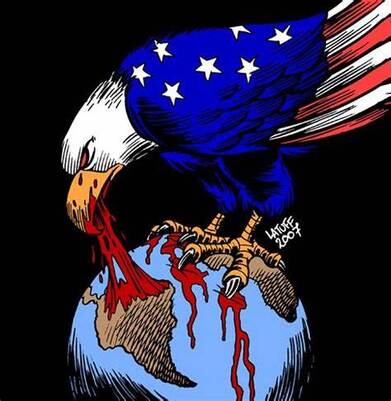 On September 6, 2021, Jackson Hinkle, a former candidate for San Clemente City Council, said, “I’m a Marxist-Leninist. I’m an anti-imperialist. I’m an American patriot.” A statement like this is based on a number of politico-theoretical errors. Patriotism - and nationalism - is a reflection of a specific material reality; it always appears as a derivative ideology which draws its meaning from the power bloc that appropriates it and deploys it towards its own objectives. In metropolitan formations of advanced capitalism, the concrete content of nationalist ideology was foundationally defined by the Westphalian peace treaties of 1648. European nationalism emerged as a non-secular majoritarian concept, invoking Christian tropes and cultivating hatred toward domestic minorities. Externally, it was characterized by colonial conquests. Westphalian arrangements were preceded by Spanish conquistadores’ pillage of the New World’s enormous gold resources. Within months of the Westphalian treaties, Oliver Cromwell’s army confiscated most of Ireland’s territories. Acute inter-imperialist rivalry between major European nation-States resulted in bloody wars, which regularly destroyed distant lands. Internal oppression of specific cultural groups and external subjugation of Third World people continues to shape and sustain the imperial idioms of metropolitan nationalism. These influences are expressed in the three types of labor aristocracies which exist in the majority of Global North countries. First, the settler-colonial labour aristocracy is established through the denial of self-determination to those populations residing on indigenous land seized by the settler population. Secondly, the native labour aristocracy is established through systematic discrimination against immigrants, who act as visible targets of colonial and racist discourses. Third, the metropolitan labor aristocracy is established through value transfer from the dependent countries, which helps in co-opting sections of the working class. Taking into account First World nationalism’s regressive foundations - imperialism and racism - it is doubtful whether socialist politics can gain anything useful from the utilization of patriotic themes. Left nationalism can easily slide into national chauvinism because multiple layers of workers in rich countries have no objective interest in anti-imperialist socialism; the adoption of a massive policy of genuine redistribution of wealth between the affluent nations and the poorer nations may not seem as monetarily attractive as the prospect of parasitically living off the vast surplus value produced by the super-exploited proletariat of the Global South. Insofar that there is no material basis for robust internationalism in the imperial core, the subjectively practiced forms of leftist patriotism can degenerate into mere demands for the redistribution of imperialist wealth. While traditions of patriotic socialism are present in imperialist countries, they don’t constitute a proper historical memory to function as the full-fledged scaffold for a mass movement. Third World nationalism, in contrast, assumes a primarily popular character because its originary conditions were marked by a liberatory fight against the state of subjugation imposed by bourgeois nationalism. Unlike Euro-Atlantic patriotic cultures, nationalism in the colonized countries was unifying, inclusive and secular as it identified a common enemy in colonialism and promised to end the poverty, hunger and misery unleashed by it. Since the imperialist opponent was extremely powerful, a strong emphasis was laid on the crucial need to forge ties with other national liberation movements. Thus, international solidarity emerged organically from the difficult realities of struggle. Instead of superimposing patriotic tinsels on the socialist agenda, leftists in the Global North should try to develop a revolutionary praxis which makes their fellow citizens aware of their role in perpetuating the system of imperialist capitalism. As the direct and indirect beneficiaries of imperialist capital accumulation on a global scale, First World people should be the last ones to erase the devastating ravages of neo-colonial robbery. They can and must recognize that their primary responsibility, by virtue of their situatedness in imperial territories, lies in challenging the role of their governments in undermining the development of the Global South. Americans, as people who live in the imperialist heartland, carry an even greater responsibility for initiating a politics of anti-imperialism. However, such a political programme can be realized only when it is understood that the American identity is completely hollow, structurally built on native genocide, racist oppression and imperialist destruction. AuthorYanis Iqbal is an independent researcher and freelance writer based in Aligarh, India and can be contacted at [email protected]. His articles have been published in the USA, UK, Canada, Australia, New Zealand, India and several countries of Latin America. Midwestern Marx's Editorial Board does not necessarily endorse the views of all articles shared on the Midwestern Marx website. Our goal is to provide a healthy space for multilateral discourse on advancing the class struggle. - Editorial Board Archives September 2021  Congress President Maria del Carmen Alva, Lima, Peru, 2021. | Photo: Twitter/ @Politica_LR She is leading a smear campaign against President Castillo in which extremist and fascist groups are taking part. Free Peru lawmaker Kelly Portalatino on Sunday filed a motion of censure against Congress President Maria del Carmen Alva, accusing her of creating political instability by promoting a coup against President Pedro Castillo. "I filed a motion of censure against Alva because of her repudiable, anti-democratic statements asserting that 'The streets ask for a presidential vacancy.' This aims to delegitimize the Executive Branch and justify a coup,” said Portalatino. The leftist lawmaker warned that the Congress president is leading a smear campaign in which extremist and fascist groups are taking part. “In these moments of crisis, a cordial, intelligent, and democratic coordination is needed between the Executive Branch and the Congress to achieve laws and public policies that can help the millions of Peruvians who are living in poverty and extreme poverty. The current Congress president, however, does not guarantee that,” Portalatino said.  Although Alva denied she is calling for a coup, the Free Peru lawmaker Guillermo Bermejo stressed that her statements have precisely that sense if one considers the actions that the Peruvian far-right has been deploying to obstruct the work of the Castillo administration. "Without the slightest embarrassment, she says that the streets are asking for a presidential vacancy. No ma'am, the streets ask you to let us rule and make changes. The streets ask the coup plotters disappear," Bermejo tweeted. He also urged the political opposition not to demand that the ruling party solve "in one month the disaster that 30 years of neoliberalism left" in Peru.  AuthorteleSur This article was produced by teleSur. Archives September 2021 9/8/2021 Nicaragua Launches Plan to Fight Poverty and Promote Human Development. By: Teri Mattson & John PerryRead Now Featured image: A local market in Malecón, Managua. Matyas Rehak/Shutterstock. Ivan Acosta is Nicaragua’s minister of housing and public credit, with responsibility for key aspects of government planning. In July, he presented the country’s new “National Plan for the Fight against Poverty and for Human Development.” This builds on the achievements of Nicaragua’s Sandinista government since it returned to power in 2007 and sets out how they will continue if Daniel Ortega’s government is returned at November’s elections. Ivan Acosta is currently subject to personal US sanctions, along with many other Nicaraguan government officials and their family members. Codepinks’s Teri Mattson spoke to the minister in a Zoom call and asked him to explain the plan and its background. The Sandinista government regained power in 2007. What conditions did it find when it returned to office? We need to remember what state the country was in at that time, something largely ignored in public debate. The truth is that when President Ortega returned to the presidency on January 10, 2007, he took charge of a country of blackouts, with electricity cut off daily. Nicaragua had turned its back on its rural communities and on its Caribbean coast, on its indigenous people and its people of African descent. There was no public acknowledgement of the autonomous peoples in government policies. Campesinos (peasant farmers) and other producers had been left behind due to the privatization of the National Bank. No funding was being provided, no credit. There were no rural roads. In many places there was no energy and no drinking water; social indicators such as infant mortality and maternal mortality rate were terrible. Those 16 or 17 years of neoliberalism in Nicaragua after 1990 brought privatization of public services. In terms of education, the country was reduced to having only four grades in primary school. The healthcare system was also privatized. It was a country with no social programs, a lack of public investment and only 50% of the country with electricity, and even then with frequent blackouts because capacity to generate electricity was so limited. Out of the 2,000 kilometers of roads only 30 percent were in reasonable condition. There was a great deficit in telecommunications. The country’s poverty figures became the worst in Latin America. Just from 2002 to 2005, general poverty rose from 45 to 48.3 percent and extreme poverty reached 17 percent. This small country was heading in the wrong direction. Poverty was worsening and the neoliberal government was proud because they said that this would bring foreign investment. But there were not enough jobs and public investment barely reached $270 million annually. There were no government resources, not even to provide primary school children with a glass of milk. So, the neoliberal model was a disaster and we put an end to that on January 10, 2007. Fortunately, we didn’t face a pandemic in 2005 or 2006 because it would have been very difficult to deal with such a situation given how public services had been destroyed. How did things begin to change after 2007? It’s important to talk about what the government of Nicaragua, under the leadership of President Comandante Ortega, has done to change the country’s situation. So, in the first place, all social and public services have been de-privatized, to ensure free education and health care. Then, public and economic policies need to center on the poorest. The main priority has been the fight against poverty and extreme poverty. Successful public policies are not only those which make the economy grow or the foreign reserves grow or which ensure macroeconomic stability, but also those which ensure that most people’s situation improves on a daily basis. Comandante Ortega’s government has more than doubled the kilometers of new road that have been built, vital for access to rural areas. But we also ensured that 85 percent of roads are in good shape and we are now the country with the best roads in Central America, even though we have the smallest economy. From 2007, we began to build the most modern health care system in Central America by investing in technology, hospital infrastructure and physicians and healthcare staff. We also made rapid progress in providing water and sanitation. We went from 60 to 91 percent in urban sectors in terms of drinking water services. And we went from 30 to 57 percent, in terms of sanitation. Those are issues which are relevant for people’s lives, not only for the political and business minorities, but for the large majority. I think that the most important change in direction by Comandante Ortega was making public education free at the primary, secondary and university levels. As from January 10, 2007, we ensured that 100,000 students went back to school by providing free education. We also invested in rural communities: we created 275,000 bonos productivos for women members of families in rural areas (the process by which they were helped to raise chicken, cattle and pigs). We developed the zero usury program and granted more than 1,300,000 credits to women to help reduce the gender equality gap. The government also had extraordinary success in reducing the maternal mortality rate: it fell by 67 percent. We went from 95 women who died per 100,000 births to 35. Those were huge challenges; by tackling them, the country became more equal. There was greater economic participation. We managed to increase livestock production by 75 percent and agricultural production by 85 percent. The size of the economy went from $6.5 billion to $13.7 billion in the span of ten years. But what’s most important is how this growth was employed. We reduced general poverty from 48.3 to 24.9 percent and extreme poverty from 17.6 to 6.9 percent. These are extraordinary figures. This was achieved with social and political stability, consensus and dialogue, in a decade characterized by social, political and economic progress that benefitted everyone. With so much social and economic success during those first ten years, how do you interpret the violent anti-government actions which hit the country in April 2018? We concluded that 2018 was an expression of hate by some minorities given the progress the country was experiencing. The failed coup d’etat had an impact that was equivalent to 52 hurricanes like Hurricane Iota that hit us in November 2020. The damage was so great that the failed coup attempt caused Nicaragua more severe damage than the global pandemic has done. Take a look at the figures: $24 billion damage against $4 billion. So, it’s been six times more damaging and it especially hit the country’s poorest people. So, that was the context for how we developed The National Plan Against Poverty & To Promote Human Development. What are the goals of the new plan? The aims are summarized this chart. We have 12 objectives which basically express our hopes to fill the remaining gaps in our social and economic program. We’ve made progress, but we still need to reinforce our efforts to fight against poverty and to eradicate extreme poverty. No society should have extreme poverty (people living on less than $1.25 per day). What are the most important issues? Well, definitely macroeconomic stability, something that we have to continue working on. We are a country that has managed to develop solid and sustainable public finances, improving our balance sheet, reinforcing our reserves, having sustainable public debt, and laying the groundwork to attract more private investment to create the jobs that the country needs. We also aim to improve the basic conditions for development by providing people with electricity, by building roads and bridges, by accelerating the provision of water and sanitation to the population, by ensuring strategic investment for the ports in the Caribbean, by attracting investment for a new railroad (and we hope that it can be electrical), with investment in tourism in the Pacific coast. We are fostering the agricultural livestock industry to create jobs, and at the same time we continue working on healthcare and education and to strengthen our gender equality strategy. How is the Nicaraguan government tackling the gender gap? We are proud that this year the country is among the world’s top five countries in gender equality – according to the World Economic Forum. Only four Nordic countries did better but we need to invest even more in bridging the gender equality gap and strengthen women’s role because the country needs it. Women are 52 percent of the population and if they do not have equal participation then it will be more difficult to develop the country. Also, we need to tackle the rural-urban gap and the gap between the minorities and the majority. We need to bridge all these gaps and create equality so that the country can develop faster and to do it in a balanced way. Is climate change affecting the rural-urban gap and migration to urban centers? Another strategic aim is tackling climate change. We believe that we need to better manage our water resources, and we need to reforest as this is vital for the country’s future. But we have to do this intelligently because the change agents are the more than 300,000 rural producers. We’ve noticed that positive effects in tackling climate change derive from successes in fighting rural poverty and in transforming the agricultural and livestock sector. If the rural sector becomes wealthier than that will be harmonious with nature because they can produce more in better ways, and that translates into better water, better forests, more diversification so that the rural economy can work better. That is essential. How are you addressing the needs of indigenous and afro-descendent minority communities on the Caribbean Coast? I am from the Caribbean Coast myself. We have a strategy to make the Caribbean Coast a special development area given that it has always aspired to be the connection point between North America, South America and Europe. But we are one of the few countries which have a Caribbean Coast with no ports. So, we are planning the construction of a port near Bluefields that will allow for the development of a region almost twice the size of El Salvador. We have recognized 23 indigenous territories and the Caribbean region is receiving investment it has never seen before: electricity, road connections, airports, hospitals to serve remote municipalities, rural energy (mainly solar) and water and sanitation to all municipalities. I think this is a great act of historic justice by the country towards the ethnic minorities who had been excluded for a long time until the 1979 Sandinista Revolution. How do private investment and foreign investment advance Sandinismo? The country has taken a leap forward in the design, management and implementation of projects from bilateral and multilateral development financing, to the point where Nicaragua is the most recognized country by multilateral banks in terms of its accountability and use of funds. We’ve had enormous results. You can see them in reports by the World Bank, the Inter-American Development Bank, the Central American Bank for Economic Integration, and the European Investment Bank. We have an incredible record. If a country manages well, designs well, uses money well, and is accountable, then the number of projects grows rapidly. One example is that it has only taken eight years to bring electricity to the remaining half of the country, and it was the hardest job because we’re talking about remote rural areas. We’ve made similar progress in terms of roads, investment in production, and drinking water. This creates a virtuous cycle because if a country performs well and creates a positive impact this is very important for foreign direct investment. If a business person comes from Australia or New Zealand, he or she doesn’t know the country so they look at the most important economic indicators and the level of competitiveness of the country: whether the roads are in good condition or not, whether taxes are competitive or not, and if the country and the government are investing enough resources to make the country more competitive and attractive. So probably the business person takes a look at the IMF for central bank indicators, takes a look at the macroeconomic stability, fiscal discipline and the sustainability of economic and financial policies. He or she will also, surely, look at the legal safety and investment safety of any project they are contemplating. In this way we’ve achieved important investments in mining and renewable energy as well as general investments in the agricultural sector. We also have one of the most successful systems of free trade zones in Latin America. It has doubled the number of jobs in the last few years, so we think that public investment together with macroeconomic stability and good economic indicators help investors to trust Nicaragua. But there is another variable in Central America: the Northern Triangle and on into Mexico is probably the most violent region of the world which is not at war. So, in Nicaragua you find a place that’s good for investment, with low crime rates and the safest country in Central America. Is this why the Nicaragua economy remained open during the COVID-19 pandemic? The decision to keep the economy working back in April 2020 was the result of several different factors. In the first place, Nicaragua is a country which has a large, dispersed rural community, where the risk of infection is low, in many places with no dense urban areas. The second factor is a social and economic one. There is a large popular or informal economy in which people live on a daily basis from what they can earn in the markets, farms or in the transport sector; therefore, closing the economy would paralyze their livelihoods. The third element had to do with the fact that if 99.9% of countries decided to close then we didn’t have to because we wouldn’t receive people from abroad, and the fourth element had to do with the fact that we had strengthened the healthcare system. You can take all the necessary measures: social-distancing, hand washing, wearing masks, but if your healthcare care system is not strong (something seen in many developing countries) it can collapse. Since 2007 we had invested enormously in new hospitals and extra staff working in health care. People had access to healthcare at their doorstep. Great changes were made. A voluntary health network was formed which made five million household visits to the country’s 1.3 million homes when the pandemic began. We made sure we had the ICUs, the ventilators, but also made sure that the country, apart from not getting the virus, could get the resources needed to continue working. We were ready and we probably have the best family and community healthcare model in Central America. There are Caribbean countries with great healthcare systems, but we have the best one in terms of its response because our healthcare system centers on the epidemiological issues that many countries have ignored. There may be good hospitals which are great at treating strokes or cancer, but they have left their epidemiological policies aside as if it were something from the previous century. Apparently we were right because a few months later all the other countries started opening their economies bit by bit. So, we managed to reduce the loss of GDP forecast by the IMF of between 11% and 14% to only two percent. We’ve had extraordinary results. We’re probably the Latin American country with the lowest number of virus cases and with the lowest fatality rate. We are quickly reactivating our economy. We are now recovering by five percent more than what was forecast for 2021. I think that the producers linked to agricultural exports should be given credit because we continued to export coffee, sugarcane, meat, seafood and beans to Central America. If the economy doesn’t work we won’t have resources to continue reinforcing the healthcare system. Nicaragua is 80% food sovereign. How has this contributed to the National Plan? Our production policies reinforce exports, food security and making progress towards food sovereignty. In Latin America, even though many countries have an agricultural industry, Nicaragua is one of the countries in which most of what’s on the table is produced nationally. Nicaragua is similar to Mexico in the sense that people eat rice, beans, meat and chicken in large quantities. Plantains as well. All of that is produced here: 80% of consumption is produced nationally. But what’s important is to increase productivity so that we can fulfill the needs of the local market and also reach the markets in neighboring countries as is the case of our beans, our milk, and our cheese because that is what creates wealth for the rural producers and for the country. We are the biggest meat producer in Central America and I think that in the future Nicaragua will be one of the benchmarks due to the quality and the safety of our meat. The southern United States, specifically Florida, is a great consumer of Nicaraguan meat. If we increase productivity, if we provide good technical assistance, that will ensure food sovereignty but also allow us to reach more markets in Central America, Mexico, the United States and Canada. That’s why we talked about a Caribbean port because we don’t sell much to Europe. We’re also on the Pacific and we don’t sell much to Asia. We also don’t export much to South America. Therefore, we want to achieve greater productivity in the agricultural sector, ensuring food security and sovereignty. You can watch the entire conversation with Minister Ivan Acosta here: WTF is Going on in Latin America: Nicaragua Alleviates Poverty HYPERLINK “https://youtu.be/yabonl-motM”& HYPERLINK “https://youtu.be/yabonl-motM” Promotes Human Development AuthorIntroduced to Mesoamerican Anthropology and Archaeology in the sixth grade, Teri's lifelong passion for Latin America has inspired 35 years of travel throughout the region. The last few years include organizing and/or participating on political and social justice delegations to: Cuba, Ecuador, Guatemala, Haiti (April '16)*, Honduras, Mexico, Nicaragua and Venezuela (June ‘13, July '15, Dec. '15, May '16, Oct. '16, Mar. ‘18, May ‘18, Mar. ‘19)* This article was published by Orinoco Tribune. Archives September 2021 9/8/2021 Privatising the NHS does not depend on a Trade Deal with the US, It’s been happening for years. By: Paul KnaggsRead Now Privatisation of our NHS is bad for patients, bad for staff and completely flies in the face of the founding principles of our NHS but that’s never stopped successive governments before. Privatisation’ is a politically charged term without a precise definition. In Britain, it is associated with the sell-off of nationalised industries and utilities as we witnessed under Margaret Thatcher, John Major, David Cameron and Nick Clegg with Royal Mail. This classic model involved whole enterprises being moved into private ownership through the mass sale of shares. But historically this is only one manifestation of privatisation. There are others forms of privatisation… Realising that privatisation of the NHS would be severely unpopular, the Thatcher Government instead started a programme of outsourcing. This continued and expanded under Blair and New Labour, it has been a constant policy for governments of all colours with no one willing or having the vision to break the chain. This has been accelerated over the last ten years. Since the passing of the Health and Social Care Act in 2012, the NHS in England has been forced down a route of increased marketisation and privatisation – and the Government has accelerated its aggressive outsourcing to private firms during the COVID-19 pandemic. Cronyism and outsourcing has defined this government’s response to the pandemic, from the “VIP lane” for personal protective equipment (PPE) to suppliers with connections to the Tory party to the privatised track and trace system so flawed it was described by Sage as only being of “marginal impact”. The existence of a separate channel for politically connected firms wanting to supply personal protective equipment (PPE) has been the source of sustained criticism, with a number of companies linked to Conservative MPs and friends of ministers receiving major government contracts. Civil servants found themselves “drowning” in bids for Covid contracts that failed to meet due diligence standards after the government created a “VIP lane” for politically connected suppliers. The evidence disclosed as a result of a legal action brought against the government by the Good Law Project shows the controversial scheme resulted in a deluge of non-credible offers to supply personal protective equipment (PPE), some of them recommended by MPs and ministers. The government repeatedly refused to reveal which companies were awarded public money after having their bids assessed through the VIP lane, citing “commercial confidentiality”. In open court, lawyers acting on behalf of the Government admitted it had breached the law by persistently failing to publish details of COVID-19 contracts.  The chairman of the healthcare company awarded over 5million is the former business partner of the Health and Social Care Secretary’s mother and stepfather If the government’s pandemic response is left unchecked it will shape the future structures of the NHS, procurement and public scrutiny. This cronyism has clearly been seen in the Covid procurement contracts, which has functioned as a giant slush fund for Tory friends and donors. It was shown when the then health secretary, Matt Hancock, acted unlawfully by failing to publish multibillion-pound Covid-19 government contracts within the 30-day period required by law, a high court judge has ruled. The judge, Mr Justice Chamberlain, ruled the failure to do so breached the “vital public function” of transparency over how “vast quantities” of taxpayers’ money was spent. The judgment was a victory for the Good Law Project (GLP), a crowdfunded not-for-profit organisation that is making a series of legal challenges related to the government’s procurement of protective personal equipment (PPE) and other services during the pandemic. Not only were they knowingly in breach of the law, but explosive emails read to the High Court reveal that Number 10 asked civil servants to delay publishing PPE contracts even further in order to suit their news agenda. The government openly breaching the law for their own political expediency may no longer surprise us, but it is a worrying sign indeed for our democracy. Again tasked with rolling out millions of coronavirus tests, the then health secretary, Matt Hancock, opted for a centralised system using private firms. The business consultancy, Deloitte, was handed a contract to help run testing through local drive-in and walk-in test sites, with swabs being sent for analysis at a network of national laboratories, many also outsourced. Serco was also handed a deal to run contact tracing, subcontracting work to other firms as well. These are just small parts of the sum, the NHS is a ‘cash cow’ for pharmaceutical companies and now family and friends of Tory MPs and peers. This outsourcing is being carried out with minimal oversight, governance or transparency. There is no ability to scrutinise these deals and public money is haemorrhaging from the Treasury while a health and care system in desperate need of investment and resources is ignored. Urgent action is required to protect the NHS and ensure public money is spent in a responsible manner. In the long term, the health service must be protected and returned to being a genuinely publicly funded, publicly provided and publicly accountable system. Some of the most lucrative contracts received by firms such as PwC and Deloitte since the pandemic began Since the onset of the pandemic, the government has spent tens of millions of pounds on management consultants to help it manage elements of the Covid-19 response, from the much-criticised NHS test-and-trace programme to buying PPE. The UK’s largest consulting firms have been paid more than £100m to advise the government on its response to the coronavirus pandemic, according to a string of delayed disclosures from Whitehall in recent weeks. A huge amount of public money has been spent on consultation, a number of the consulting contracts have also come under fire over the services provided. The Finacial Times reported a total of 106 contracts worth £109m have been agreed upon between various government departments and consulting firms such as PwC, Deloitte and McKinsey since March, as civil servants scrambled for support to source personal protective equipment, set up test and trace programmes and acquire thousands of new ventilators as the pandemic gathered pace. The NAO – which examined whether government procurement followed due process – found examples of contracts, some for hundreds of millions of pounds, being awarded without basic documents that would normally be drawn up to protect against the misuse of public funds. Bids from companies referred by a political connection to the scheme were taken more seriously, according to the NAO, with suppliers in the high-priority channel viewed as having been “pre-sifted for credibility by being referred by a senior credible source”. The Department of Health and Social Care (DHSC) accounted for 90% of the £18 billion worth of contracts issued up to August, according to the report. Michael Gove and Dominic Cummings were both drawn into the debacle after the spending watchdog said officials failed to consider potential conflicts of interests involving companies linked to them. The National Audit Office revealed that officials had signed contracts for hundreds of thousands of facemasks which turned out to be unusable – wasting hundreds of millions of pounds. It’s true the NHS will always be “free at the point of entry“, how else will the government justify the vast amounts of public money needed to maintain the NHS, it’s who, where and what happens to that money that matters. That’s how we get short-changed that’s privatisation through the back door. The great PFI heist Tony Blair and Gordon Brown saw Private Finance Initiatives as a way to deliver infrastructure projects without huge capital expenditure There are many reasons the NHS will always be within the public domain none more so than the why it is used to milk money into the Bankers pockets, we can thank ‘The great PFI heist’ Thanks to Blair and Brown the PFI debt for the British taxpayer on the last count in 2018 was more than £300bn for infrastructure projects, with a value of £54.7bn. To put it into perspective, the PFI debt is four times the size of the budget deficit used to justify austerity, guess what, that dept has never and will never go down. Sir Howard Davies, chairman of the Royal Bank of Scotland (RBS), made an astonishing admission on BBC1’s Question Time when he stated that private finance initiatives (PFI) had been a “fraud on the people”. Beyond seemingly populist rhetoric, the real story of PFI reveals that RBS alongside other global banks, notably HSBC, were instrumental in what Sir Howard has effectively labelled a great heist. Youssef El-Gingihy writing in 2018 stated: “Of course, PFI was not always a toxic brand. In 1997 it appeared to be New Labour’s magical solution to chronic underinvestment in public services in the wake of Thatcherism. As Alan Milburn – the former Labour Health Secretary described by Private Eye as an “almost maniacal convert to PFI” – put it: “It’s PFI or bust.” The argument went that Labour had inherited public services in such a diabolical state of neglect that there was no alternative to the private financing of whole swathes of infrastructure. It was a persuasive argument that seduced many. The Blairite Third Way would somehow square the circle by delivering new schools, hospitals, roads, railways and prisons without the debt or inefficiency of the public sector. It seemed too good to be true yet those who dared to question the orthodoxy du jour were swatted away. PFI deals insulated the lenders and equity investors from the risk that any future government may renege on the original agreements or seek to renegotiate them. This has meant that irrespective of the extreme budgetary constraints on local authorities and NHS Trusts, as well as the shrinking amount of money available for schools, hospitals and social care, they are still required to make annual payments to the PFI companies. As early as 1999, Richard Smith, editor of the British Medical Journal, denounced it as “PFI: Perfidious Financial Idiocy” in an editorial revealing that repayments would be exorbitant. In the same year, Professor Allyson Pollock and colleagues published a paper sounding the alarm over the potentially disastrous consequences of PFI debt and the financialisation of public services. And in a 2004 long read for Private Eye the late Paul Foot exposed the seedy underbelly of its history. Now the unheeded prophecies of the Cassandras have come true. Vivek Kotecha is Research Officer at the Centre for Health and the Public Interest, states in his article for the London school of economics: “These guaranteed payments provide PFI companies and their lenders with substantial returns in the form of profit and interest which are in excess of returns on projects with similar risks. They also lock public authorities into contracts for 25-30 years for cleaning and facilities maintenance services, and sometimes require that they make payments for buildings which are no longer needed. The ultimate end point for dealing with the legacy of these deals in the public sector is therefore to reduce the cost of the debt repayments, end excess profiteering, and allow public bodies to break the contracts. The Case for a Public Option for the Drug IndustryGreater democratic, public control over the research, development, production, and sale of medicines would help the government fulfil its obligations to ensure the right to health for all. It would also be consistent with, and reinforce, the principles of the NHS. Delivering universality and equity in accessing medicines is crucial to ensuring that our public healthcare system is accessible for all. And it could increase the amount of secure, high-quality jobs in our economy. The amount of public money spent on R&D should not only see a return on the product but profits too. UK spending on Covid vaccines hits nearly £12bn, Cost does not cover future multiyear programmes for jabs, according to the National Audit Office. The UK invested hundreds of millions in the research to produce the vaccine any investor would surely have expected a return on future profits. Of course, we must also look at Jeremy Corbyn’s plan when has Labour Party Leader, he announced Labour’s plans to put “public health before private profit” by ensuring that pharmaceutical companies make vital drugs available at prices that the National Health Service can afford. Jeremy Corbyn stated a Labour government would establish a state-funded generic drug manufacturer to make life-saving medicines affordable to all, he said that private drugs companies will be required to keep prices down as a condition of receiving public funding for research. It’s doubtful we will ever see policies like that again, the reality is the NHS will always remain a public institution how else will the Olicharchy and big Pharma feed from the public purse We can almost guarantee that won’t be in Starmer’s little policy pot. Neither will any proposals to build state-owned pharmaceutical companies. A good place to fight and win back the NHS is with ‘We Own It!’ LINK HERE AuthorPaul Knaggs is an Editor, founder, Labour Heartlands, Labour Party member and activist. Citizen journalist, Ex-British Army combat veteran. Drifting towards Revolutionary socialism. Fighting a constant struggle with dyslexia that's overcome with a burning desire to speak out against the corrupt political system and the social injustices it creates. Advocate for Free speech and open, accountable, democracy. This article was produced by Labour Heartlands. Archives September 2021 9/7/2021 Tony McKenna-The War Against Marxism: Reification and Revolution (2021). Reviewed by: Fouad MamiRead Now Ever wonder how to domesticate an explosive theory while pretending you are refining it? McKenna’s The War Against Marxism elucidates such a ‘domestication-as-refining’ without falling into conspiracy theories. He carefully examines the texts of self-purported Marxists and shows in a razor-sharp analysis how the war against Marx’s methodology has been ragging in academia for almost a century now. It is not a tautology to observe that apart from actual wars between classes and nations, there exists underneath a terrible war of ideas. Upon closer scrutiny, McKenna finds that self-professed neo-Marxists and post-Marxists have succeeded in disfiguring Marx’s ideas, rendering them both anachronistic and innocuous for the powers that be. The damage – for that is how it should be qualified according to the author – is carried out often by catapulting class struggle through several stylistic and thematic maneuvers, reifying the historical totality and rendering Marxism a purely theoretical abstraction divorced from reality. McKenna starts with what he labels as the founding fathers of critical theory, often introduced in philosophy manuals not only as neo-Marxists but as the anti-fascist ‘luminaries’: Walter Benjamin, Theodor Adorno and Max Horkheimer. Underneath their rhetoric of updating Marx’s ideas for the realities of the early-to-mid twentieth century, McKenna tracks in their approach a Nietzschean disenchantment with ordinary people. Uncontrolled consumption on the part of the masses spells a false consciousness, a situation that explains how a ‘culture industry’ is behind the infuriating reproduction of generic individuals. Without focus on the predominant mode of production, these thinkers strike at the universalist drive and logic of the enlightenment. McKenna deems that critique of universalism abstract because it refracts the egalitarian propulsion of modernity and seeks to stifle it. With the three theorists, the author finds a nostalgia for a world order where the undeserving masses knew their place in the world and acted accordingly. In a second theoretical move, McKenna finds the ‘celebrity’ post-Marxists such as Louis Althusser, Chantal Mouffe, Ernest Laclau and Slavoj Žižek practicing a philosophy that is pre-Hegelian despite their claims to the contrary. With each one’s endeavor there lies but a lip service to the concept of historical unfolding. Althusser claims to have resolved the base-superstructure problematic by leveling all contradictions: claiming on the one hand that ideology produces social beings, and on the other that ideology is but a discursive structure or system of myths and images, denuded of historical rationale or significance. Althusser invents a set of words such as ‘structure’, ‘field of discursivity’, ‘discourse’, while Mouffe and Laclau invent ‘horizon’ – all aiming to vaporize the subversive content of any given ideology. Žižek deploys Lacan’s pre-given, ahistorical and reified notion of the Real retroactively in order to mediate it (the Real) historically through haunting. But haunting remains a purposeless historicity active despite itself, self-reflexive, not self-reflective. If haunting serves anything at all, McKenna explains, it confirms the convoluted process of Žižekean method and its illusive claims of historicity. The third theoretical move addresses the writings of celebrity scholars such as Terry Eagleton and Fredric Jameson. In as much as they both portend themselves as first-and-foremost literary theorists, where the floating of signifiers and war on causality are the currency for imminence, the two authors illustrate their two-faced stance vis-à-vis the Hegelian approach. If taste and aesthetic sensibility register a constant change whereby humanity can deem Shakespeare outmoded, Eagleton only expresses his oversight of the Hegelian concept of sublation. For sublation underlines how brutal changes and radical breaks are fantasies nursed by the deranged. As historical change manifests itself too slowly, it involves both preservation and negation. It is this rule that makes a binding totality. But Eagleton falls instead for ideology which, according to him, solely determines taste. With respect to Jameson, the stipulation of the Lacanian ‘Real’, as the absent cause for history, annuls any sensible sense for approaching reality. McKenna traces several contradictions like ‘history is not a text’, and ‘we encounter history only through a text’. The postmodernist stances where reality lacks a center, which the two stars both prize more than their alleged Marxist credentials, stifle their analysis and absolve revolutionary substance. The fourth theoretical chapter addresses Moishe Postone’s critique of Lukács’ reification theory. McKenna pinpoints how Postone’s flawed reading of Marx spills over in how he mistakenly interprets Lukács. Instead of situating modernity as an acceleration from the mercantile mode of production, Postone mistakes bureaucracy and the work ethic embedded in Protestantism – both of which are essential corners of modernity – for the experience of reification. In seeking to update Marx by proposing that his subject matter is capital, not labor, Postone cannot register how the ‘total subject’ translates the self-realization of the proletariat into a revolution that will eventually cancel both classes and capital. McKenna follows with an elaborate contextualization of Lukács’ theory of reification, which for him, truly qualifies as an extension of Marx’s method. Zooming in on the proximity of Lukács’ ideas with the living experience of workers, and in each theoretical sortie, McKenna follows the logical implications from the contradictions in the exchange of labor. For the capitalists, the exchange of wage with labor can only be a fair exchange. The capitalists and even the reified workers genuinely fail to register that any industry or business cannot stay afloat without the expropriation of surplus value, that amount of wealth generated beyond the socially necessary labor. Only the worker in transcending the reificatory nature of the exchange notes the injustice not of the exchange as such but in the exchange of the amount of labor accomplished with the wage received. All the thinkers McKenna addresses in the book fail to either note this basic fact (the tension that organically emerges from the contrastive registering of the terms of the contract), or to follow fully on its socio-political implications. For the reduction of the worker’s wage into a cost (exactly like any other costs) in the production line is itself reification. In contrast, the conscious worker does not only seize on the meaning of reification but actively works to reverse it via a revolution in the mode of production and distribution. These four chapters are interspersed with three others that are less heavy and more illustrative of the points addressed in the theoretical chapters. Chapter two reviews the film of Planes, Trains and Automobiles (1987) and finds that through its two protagonists, the film showcases both extreme instances of reification as well as several ways for its subversion. For the benefit of the general reader, chapter four teases further the qualitative dimensions of reification as experienced in everyday life, the way it is elaborated by McKenna’s hero, Lukács. Chapter six elucidates the Hegelian idea of subject-object identity through the protagonist’s failure in a Stephen King’s novel. Overall, the wording of the chapters’ titles strike the reader as particularly strong, candid and uncompromising; they raise an interesting discussion of polemic which McKenna also convincingly addresses in the final chapter. For him, academia should not practice willing blindness before convoluted publications: confused and confusing writing styles by celebrity academics such as the ones he carefully examines in War Against Marxism. He calls for, and rightly so, communicating in accessible language, never seeking to hide behind wordy formulations. McKenna is not totally flabbergasted at the ways in which such deleterious forms of writing escape detection by editors, reviewers and critics, and then connect that state of affairs with the war on Marxism, less as a conspiracy and more as an immanent subscription to a bourgeois worldview by so-called Marxist thinkers. This is a category of academics entertaining pronounced leftist sensitivities as they could be genuinely disgusted with the capitalist quagmire, but who still cannot take up the struggle for justice seriously or are willing to see that justice in their lifetimes. McKenna’s argument is warm and does not shy away from being occasionally passionate. Not all scholars are open to elaborate on their peers’ writing styles, especially if such peers are well-known and well placed. But McKenna shows that convoluted writing – no matter who is behind it – serves a purpose. Not only does impoverished writing translate into a poor grasp of the Hegelian method, but is geared toward ridiculing Marx’s findings in respect to subject-object identity being the sine qua non for the revolution. Still, of all his alertness, McKenna does not recount that Althusser advises his readers to skip the first chapter of Capital altogether and start from the second. If one abandons the fourth section of chapter one, the structuralist take of Althusser becomes less questionable. Such gross methodological derailments could have been explained by noting the cult of the vanguard, or the narcissist trust in the gifted individual, which Hegel brilliantly addresses early on in Phenomenology of Spirit. McKenna could have explained that the force of the Greek logos lies in translating the selfless verbalization of practical knowledge (not wisdom) from the pre-Socratic times to the present. That capacity to speak la déchirure, or the rupture from the Mesolithic order which the Neolithic Revolution has ushered in, explains that force behind The Communist Manifesto. Indeed, Marx and Engels qualify their method as scientific not because it is selfless, but because it further accounts for that rupture manifested throughout time and space. The unfolding of historical totality has no patience for a pathological ego. In closing, The War Against Marxism serves an important corrective for the way literary theory is pathetically introduced: take any theory you want, or accelerate two or even three against each other in the free markets of ideas, regardless of their often irreconcilable fundaments. Given such a liberal approach, theory has become a tool to keep universities busy, that is, forever enmeshed in what the French call la parlerie, that particularly empty exchange aiming to sell the illusion that something radical or truly subversive is being gestated but, in the meanwhile, the bourgeois idol remains untouched. In such circumstances, it is of little wonder that the humanities are constantly shelled. McKenna’s contribution specifies, however indirectly, that literary theory is the warehouse that ensures the breeding of future cultural critics, art historians, sociologists and political scientists, that is, those individuals who can either enforce the bourgeois model or reverse it. Indirectly, McKenna is saying that even when one thinks they can afford to dismiss Marx’s insights, one still cannot ignore the findings from Hegel’s Phenomenology of Spirit. Accepting the unfolding of historical totality as an egoless instantiation disarms people’s resistance to class war, as it becomes self-evident that Marx merely situates Hegel’s historical method in its socio-political reality. 30 August 2021 AuthorFouad Mami is a literature scholar from the department of English, University of Adrar (Algeria). He teaches African Literature and Literary Theory. This article was produced by Marx & Philosophy. Archives September 2021 Mikis Theodorakis, who began his political life as a partisan in Greek resistance, remained a staunch opponent of imperialist aggression throughout his life. His musical compositions contributed to the cultural revolution in Greece  Photo: 902.gr “Now at the end of my life, at the time of reckoning, the details fade from my mind and remain the big picture. So I see that my most critical, strong and mature years were spent under the banner of the KKE. That is why I want to leave this world as a communist”. On Thursday, September 2, renowned Greek composer and political activist Michail “Mikis” Theodorakis died in Athens at 96 of cardiopulmonary arrest. Mikis was a legendary composer and was active in the Greek resistance (1941–1944) during World War II and the resistance against the Greek military junta (1967-74). Theodorakis’ works were censored for his political views and activities. He was jailed, tortured, and forced into exile. He was associated with the Greek left for most of his life and was elected to the Greek parliament several times, twice from the leftist/communist platforms. Throughout his life, he opposed imperialism, fought for peace and the cause of the working class. He has also received many international honors, including the Lenin peace prize. Greece will mark three days of mourning to honor the life and career of Mikis Theodorakis. Progressive sections in Greece and abroad, including the Communist Party of Greece (KKE) and the Progressive Party of Working People (AKEL), condoled his death. Music in the key of struggle Born in Chios, Theodorakis was interested in music from an early age and took his first lessons in Patras and Pyrgos. In the 1940s, he studied at the Athens Conservatoire. He conducted his first concert at the age of seventeen. He founded his first orchestra while in Crete and became the head of the Chania Music School. Theodorakis and his wife Myrto Altinoglou moved to Paris in the 50s, studying and working more on music. Mikis Theodorakis’ association with politics started in Athens in 1943 and was closely intertwined with his musical work. He became a member of the Greek People’s Liberation Army (ELAS), the military wing of the left-wing National Liberation Front (EAM), which resisted the axis forces in Greece during World War II. During the Greek Civil War, he was arrested, exiled to Icaria and Makronisos, and was brutally tortured. Following his return from Paris, outraged by the killing of leftist MP Grigoris Lambrakis by far-right extremists in 1963, Theodorakis formed Lambrakis Democratic Youth and was elected to Greek Parliament in 1964 from the United Democratic Left panel. At this moment, his compositions based on poems brought about a cultural revolution in the country. He developed his “metasymphonic music” by mixing the symphonic elements with popular songs, western symphonic orchestra, and popular Greek instruments. He founded the Little Orchestra of Athens and the Musical Society of Piraeus and organized many concerts in Greece. He gave the score for the film Zorba the Greek in 1964. Around the time, Mikis also composed the renowned “Mauthausen Trilogy,” also known as “The Ballad of Mauthausen,” based on poems on the holocaust written by Greek poet Iakovos Kambanellis. Critics call it Theodorakis’ best work ever.  Mikis Theodorakis during a concert at the Panionios Stadium in 1975. Photo: 902.gr When the military junta came to power in 1967, Theodorakis went underground and organized the Patriotic Front. In response, the Greek military junta banned his works and proceeded to arrest Theodorakis and imprisoned him. In 1968, Mikis and his family were brought to Zatouna, and the junta interned him at the Oropos concentration camp. However, international pressure by famous artists and politicians mounted, and forced the Greek authorities to allow them to leave the country in 1970. While in exile (1970-74), Mikis traveled extensively to campaign against the Greek military junta. He met many leaders from the developing world during this period, including Salvador Allende, Gamal Abdul Nasser, Tito, Olof Palme, and Yasser Arafat. He composed political songs and performed worldwide to raise international public opinion against the Greek military junta. During this period, he also gave music to Pablo Neruda’s Canto General and Yiannis Ritsos’s Eighteen Short Songs of the Bitter Motherland. In 1974, he returned to Greece and focused on more symphonic compositions and operas during the 80s and 90s. He also served as the General Musical Director of the Choir and the two Orchestras of the Hellenic State Radio (ERT). Upon his return to Greece in 1974, Mikis became active again in Greek politics in close association with the Communist Party of Greece (KKE). He was elected again to the Greek parliament in 1981 and 1989 (with the backing of New Democracy (ND). He also served as a Minister (1990-1992) in the cabinet of Konstantinos Mitsotakis.  Mikis Theodorakis and Giannis Ritsos at the 4th KNE-Odigits Festival in Peristeri. Photo: 902.gr Throughout his life, Mikis remained a staunch opponent of Israel’s occupation of Palestine and helped compose the Palestinian national anthem. He vociferously criticized the NATO-led bombing of Yugoslavia in 1999 and the US aggression on Iraq. Mikis extensively campaigned for Greece-Turkey friendship, peace and unity in the ethnically divided island of Cyprus. He criticized the Greek government for the loan debt accrued from the International Monetary Fund (IMF). On September 2, the central committee of the Communist Party of Greece (KKE) said that “impulsive, inspired and ignited by the passion of offering to the people, Theodorakis managed to fit in his majestic work the whole epic of the popular struggle of the 20th century in our country. After all, he was part of this epic.” “His music broke the borders of the country, as its language has the universality of the common sufferings, the hopes, the visions that are shared by all the peoples, all the humble ones of the earth,” added the KKE. The Progressive Party of Working People (AKEL) of Cyprus bid farewell to Mikis, saying that “Mikis Theodorakis’s relationship with Cyprus was special and in every test of the Cypriot people he gave us a thunderous presence, supporting our struggle in every way he could.” AuthorThis article was produced by peoples dispatch. Archives September 2021 9/7/2021 Africa’s Uprising is Frozen, Its Cry Swollen with Hope: The Thirty-Fifth Newsletter (2021). By: Vijay PrashadRead Now Bertina Lopes (Mozambique), Dimensão (‘Dimension’), 1972. Dear friends, Greetings from the desk of the Tricontinental: Institute for Social Research. On 26 August, two deadly attacks on the perimeter of Kabul’s international airport killed over a hundred people, including a dozen US soldiers. The bombings struck people desperate to enter the airport and flee Afghanistan. Not long afterwards, the Islamic State of Khorasan (IS-K) took credit for the attack. Ten days before this attack, Taliban fighters had entered Kabul’s Pul-i-Charkhi prison and executed the IS-K leader Abu Umar Khorasani, also known as Zia ul Haq. Two days before his execution, as the Taliban advanced into Kabul, Abu Umar told the Wall Street Journal, ‘They will let me free if they are good Muslims’. Instead, the Taliban killed him and eight other IS-K leaders. Since its formation in October 2014, IS-K, which operates in Afghanistan and Pakistan, has conducted over 350 attacks against Afghan, Pakistani, and US targets in these countries. The initial leadership of the group, Hafiz Saeed Khan and Sheikh Maqbool, came from Pakistan’s Tehrik-e Taliban (TTP); they joined with a former Taliban commander, Abdul Rauf Khadim, to create IS-K in Afghanistan’s eastern province of Nangarhar. In 2018, a United Nations report pointed out that ISIS leadership in Iraq and Syria facilitated ‘the relocation of some of its key operatives to Afghanistan’, including Abu Qutaiba from Iraq and other fighters from Algeria, France, Russia, Tunisia, and the five Central Asian states. In 2016, the US government designated IS-K as a terrorist organisation; three years later, the US dropped a massive bomb on IS-K positions in Nangarhar. On 27 August, the US bombed targets in Nangarhar in retaliation for the Kabul bombing. ‘We know of no civilian casualties’, US Central Command credulously announced. A few days later, a US drone strike allegedly against IS-K targets killed ten Afghan civilians, including small children. Since 2014, the Taliban has captured more and more territory in Afghanistan. In this period, IS-K forces clashed with the Taliban repeatedly, with IS-K contesting the Taliban’s claim to political Islam and deepening the sectarian attacks on Afghanistan’s minorities. The execution of Abu Umar Khorasani and the victory of the Taliban certainly provoked IS-K into the deadly attacks at Kabul airport. There is little danger of a return to the civil war of the 1990s, since IS-K simply does not have the capacity with its hundreds of fighters to contest the Taliban for power; nonetheless, it has the zealotry to cause damage to a country already badly broken by war and corruption.  Malangatana Ngwenya (Mozambique), A fonte de sangue (’The Fountain of Blood’), 1961. Far to the southwest of Nangarhar, across the Arabian Sea, are the northern provinces of Mozambique. Here, armed fighters swept through the province of Cabo Delgado in 2017, attacking the city of Mocímboa da Praia. The fighters called themselves al-Shabab (‘The Youth’), with no connection to the terrorist organisation of the same name from Somalia. Rapidly, the fighters took their war to six of Mozambique’s main northern districts, taking five of their capitals. The one capital that was not captured in the early burst, Palma, is the centre of a massive project developed by the French energy company Total and by the US energy company ExxonMobil. They have a stake in one of Africa’s largest natural gas reserves, which is worth more than $120 billion. Both companies suspended their operations as the fighters advanced on Palma, which they took in March of 2021.  Edward Said Tingatinga (Tanzania), Untitled, 1960. Researchers at Observatório do Meio Rural (OMR) and Cabo Ligado have shown that these fighters are from the region and are not affiliated with any international Islamist project. OMR’s João Feijó found that the leaders of al-Shabab are mainly from Mozambique, but a few are from Tanzania. The main leader of al-Shabab is Bonomade Machude Omar, who was born in Palma, raised in the government and Islamic schools of Mocímboa da Praia, and trained in Mozambique’s military forces before he began gathering several youths under his wing to fight against the extreme poverty of Mozambique’s northern provinces. They formed al-Shabab. After al-Shabab’s rapid advances, Bonomade Machude Omar is known to have talked about his connection to the Islamic State, although there is no evidence of any organisational connection between the groups in West Asia and southern Africa. Nonetheless, on 6 August, the US State Department designated al-Shabab – or ISIS-Mozambique, as the United States calls it – as a terrorist organisation and defined Bonomade Machude Omar as a Specially Designated Global Terrorist. Once al-Shabab was described as ISIS-Mozambique, full military force could be deployed into northern Mozambique.  Ernesto Shikhani (Mozambique), Untitled, 1979. A senior advisor at the Southern African Development Community (SADC) told me that African capitals buzzed with fearful anticipation that the United States and France would launch an assault on northern Mozambique to protect the assets of Total and ExxonMobil. ‘That is perhaps why they called the fighters ISIS-Mozambique’, he told me on the day that the Taliban entered Kabul. On 28 April, Mozambique’s President Filipe Nyusi met with Rwanda’s President Paul Kagame in Kigali to discuss al-Shabab. Ten days later, Rwandan officers arrived in Cabo Delgado on a reconnaissance mission, followed shortly afterwards by 1,000 Rwandan troops. The senior advisor says that the United States and Israel – which is close to Kagame – authorised the mission. Shortly afterwards, SADC sent a Mission in Mozambique (SAMIM) with troops from SADC countries (Botswana, Lesotho, and South Africa) along with troops from Angola and Tanzania. They have weakened al-Shabab’s hold on the cities of northern Mozambique. Both SADC’s Stergomena Tax (whose tenure as executive secretary came to an end on 31 August) and South Africa’s Defence Minister Nosiviwe Mapisa-Nqakula complained of Rwanda’s unilateral decision to intervene. While both Rwanda and SAMIM are interventions of African states, the main institution of the continent – the African Union (AU) – has not deliberated on this at its Peace and Security Council (the AU’s chair, Moussa Faki Mahamat, did, however, welcome Rwanda’s intervention). Neither Mozambique, SADC, nor the AU have crafted a comprehensive plan regarding northern Mozambique; the country’s problems are rooted in its inequality, poverty, and corruption, intensified by the influence of French and US transnational energy firms.  Eddy Kamuanga Ilunga (Mozambique), Frágil 8 (‘Fragile 8’), 2018. The Tricontinental: Institute for Social Research dossier on US-French military intervention on the African continent offers a framework to understand the role of US-French commercial interests. In June, France’s Emmanuel Macron said that he would withdraw half the French troops from Operation Barkhane in Mali; this kind of ‘withdrawal’ is part of Macron’s presidential campaign for the 2022 elections and not a real withdrawal. In fact, France’s real intervention is in the creation of platforms such as G-5 Sahel (a French-led military project that consists of Mali, Niger, Mauritania, Chad, and Burkina Faso), whose existence undermines the advancement of the African Union and of African sovereignty. Groups such as G-5 Sahel justify their existence by saying that they are fighting groups such as the Islamic State. They do not honestly state their objectives: to maintain control over key regions and countries of the continent and, in so doing, retain exclusive access to their mineral and natural resources. The UN is correct in its July report that the expansion of the Islamic State in Africa is a ‘striking development’. But even more striking are the underlying problems: the control and theft of resources and the attendant social problems produced by this theft, namely the great distress experienced by the people of Africa. For example, half of the population of the Central African Republic (CAR) struggle with hunger; the entry of Rwandan troops into the country in 2019 is hardly the solution to the crisis. In Afghanistan, just like CAR, half the population lives in poverty and a third are food insecure, while two thirds lack access to electricity. In Mozambique, meanwhile, it is estimated that 80% of the population cannot afford an adequate diet, while 2.9 million people face high levels of acute food insecurity. The real security problems are food insecurity and the humiliations of poverty, which produce all kinds of unrest – including al-Shabab.  Mozambique’s liberation in 1975 started in Cabo Delgado, which is now torn by the current conflict. That liberation war ran from 1962 and was led by the Mozambique Liberation Front (FRELIMO). A significant part of the liberation war was the war to decolonise culture, which produced Moçambicanidade, the sensibility of the new revolution. Noémia de Sousa was one of the great poets of Moçambicanidade, whose work was published in O Brado Africano (‘The African Roar’). Her words from 1958 dance through this newsletter: If you want to understand me come, bend over my African soul, the black dockworkers’ groans, the Tshopi’s frenzied dances, the Shanganas’ rebellion, the strange melody which flows from a native song through the night. And ask me no more if you want to know me… for I’m nothing more than a shell of flesh where Africa’s uprising froze, its cry swollen with hope. Warmly, Vijay AuthorVijay Prashad is an Indian historian, editor, and journalist. He is the chief editor of LeftWord Books and the director of Tricontinental: Institute for Social Research. He is a senior non-resident fellow at Chongyang Institute for Financial Studies, Renmin University of China. He has written more than 20 books, including "The Darker Nations" and "The Poorer Nations." His latest book is "Washington Bullets," with an introduction by Evo Morales Ayma. This article was produced by The tricontinental. Archives September 2021  Photo: Aerial photo shows damage in Houma, Louisiana following Hurricane Ida. Credit — National Oceanic and Atmospheric Administration’s National Geodetic Survey Hurricane Ida has ravaged states from Louisiana through New England this week, leaving horrific damage and death in its wake. At least five of the states that Ida visited had tornadoes touch down, with Pennsylvania experiencing a total of 16 tornado warnings. The storm left masses of people without power. Over one million people in Louisiana are experiencing outages, and officials predict that it will take a number of weeks for the grid to be restored. Power outages are impacting communities all along Ida’s path, with Mississippi reporting over 86,000 households without electricity, New Jersey reporting over 57,000, Connecticut over 37,000, and Pennsylvania over 18,000. Electricity isn’t the only resource impacted — many in Louisiana are experiencing downed cellular and water systems services, as well as fuel and oxygen shortages. There have been discharges of untreated sewage in Connecticut, and in parts of Virginia at least 20 homes were moved from their foundations. Virginia officials expect it to take 30 days to restore power, and a year for public water to be fully restored. In Mississippi, where they are reported to have avoided the worst of the storm, a highway collapsed as a result of heavy rains from Ida, leaving two people dead and several others injured. The final death toll is unknown as flood waters throughout the Northeast continue to present a danger, but from Maryland to New York there have been at least 22 deaths reported in addition to seven reported throughout Louisiana, Mississippi and Alabama. As with everything under capitalism, the devastation and outcomes of a catastrophe like Ida are not equally felt. In New York City, for example, eight people died in flooded basement apartments, which are often less expensive and house lower income individuals and families. Working class people are often unable to afford to evacuate before or during dangerous weather events or don’t have anywhere to evacuate to, leaving them forced to remain in their homes when these disasters hit. For those who are able to evacuate, often they are relocated to a small, enclosed and overcrowded location. This is less than ideal in the best of times, but in the midst of a pandemic can be potentially deadly. In contrast, the wealthy are able to relocate themselves with relative ease should the need arise, and have no need to rely on public storm shelters. For those who cannot afford or do not have access to a generator, widespread power outages cause dangerous conditions in the heat, especially in places where temperatures are climbing to 90+ degrees. Extended periods of time without power can also result in the loss of safe food and water. There are further inequalities in terms of ability to stay safe and out of the storm. As has been starkly highlighted throughout the pandemic, many low-wage workers are also considered to be “essential”, and so during a catastrophic event may still be expected to go to work. If they do not then they risk losing their jobs. Alternately, for working class people who do stay home, that may result in a critical loss of income. Another striking contrast is in the ability to rebuild following a disaster such as Ida. Many members of the working class do not have the means to make needed repairs to their homes, or to rebuild entirely should their home be destroyed. They may end up being forced to move, become homeless, or remain and live in an unsafe situation. As the climate crisis caused and fueled by capitalist greed worsens, and disasters like Hurricane Ida become more frequent and widespread, the discrepancies and inequalities are set to become sharper. The rich remove themselves from the realities of the changing and deteriorating climate, while leaving the rest of us to face the consequences of their actions. Capitalism is not only unable to solve the climate crisis, but it is also unable to appropriately address the disasters that are occurring with increased frequency as a result. Socialism is needed in order to both confront the climate disaster, and to deal with natural disasters in a way that prioritizes and protects human life. AuthorKenya Elliott This article was produced by Liberation News. Archives September 2021 9/6/2021 Cuba: The first country in the world to vaccinate children under 12. By: Gloria La RivaRead Now Photo: Vaccination of youth in Cuba. Credit — CubaDebate.cu In the battle against COVID-19, Cuba has been a country of firsts. It is the only country in all Latin America to produce its own vaccines. Cuba has sent more than 5,000 doctors to help treat COVID patients in 57 brigades to 40 countries around the world since the pandemic began. No other country has come close. Now, in a major new development, babies and children two years old and up will be massively vaccinated starting in 10 days. Cuba is the first country in the world to vaccinate babies and children under 12. On Friday, Sept. 3, Cuba’s Center for State Control of Medicines, Equipment and Medical Devices (CECMED) announced emergency approval for the mass vaccination of two-year-olds and children up to age 11 using the Soberana 02 vaccine. Soberana was developed and is produced by the famous Finlay Vaccine Institute. Pediatric innoculations will begin September 15. Trials showed the vaccine to be safe and effective in that age range. Youths 12 to 18 years will receive Soberana starting September 5. By November 15 all schoolchildren under 18 will return to their classrooms fully vaccinated, and pre-school children as well. For now students will start their fall lessons on Sept. 6 by television, as has been the practice since the pandemic began. Dr. Olga Lidia Jacobo Casanueva, CECMED Director, told Cuban TV, “It is great news for the Cuban people, for the Cuban family which has waited to be able to vaccinate their children. It is a real achievement for Cuban science and represents an historic moment in our country.” Since late June, Cuba has experienced a dramatic increase in positive COVID cases amid the ever-harsher U.S. economic blockade and the shutdown of tourism due to the pandemic. From roughly 1,100 average new cases in early June, the figure skyrocketed to an average of 9,504 new positive cases exactly one month ago. The last four days’ average ending Sept. 4 was 6,899. Despite the many challenges of increased cases and material shortages, Cuba’s socialist government and health institutions are soldiering through with the national plan and its three most effective vaccine lines to cover the whole population. Cuban President Miguel Díaz-Canel announced Aug. 31 — in a special meeting of scientists and health professionals — that by November, 92.6% of Cuba’s entire population will be fully vaccinated with the three-shot process. The bold project of universal infant, child and adult vaccination is possible because of the country’s highly organized vaccination system that has been in place for decades. Cuban scientists, fully supported by a government that places its trust in their expertise and dedication, work for the common good — free of a profit motive. Plus, Cuban society has not suffered the polarization whipped up by right-wing politicians and false media in the United States that have actively opposed mask mandates and vaccinations. Millions in the United States have fallen victim to the anti-science hysteria, failing to vaccinate. The U.S. COVID cases and deaths are in the second-highest wave since April 2020 and rising. The pandemic has been severe for Cuba due to the longstanding blockade further hardened under Trump. The tourism industry — a major source of income for the country and workers — has virtually shut down due to the virus. Up to now, all vaccines worldwide have been approved for emergency use by corresponding health institutions, due to their highly effective results and the need to take immediate action given the severity of the pandemic. The pediatric trials in Cuba began June 14 this year. The first stage was 25 adolescent volunteers, 12 to 18 years old, then a larger group of 350. In early July almost 600 babies and children under 12 took part in clinical trials. The children’s vaccine trial was named Ismaelillo, after poetry written by Cuba’s national hero José Martí to his son. No children are exempt from the highly contagious delta variant, now dominant around the world. The urgency for pediatric vaccination everywhere is greater than ever as the school year begins anew this week. The struggle against COVID is far from over. But Cuba’s latest achievement is a shining example of the Cuban people and their revolution facing adversity with determination to overcome. AuthorGloria La Riva This article was produced by Liberation news. Archives September 2021  In 2008, an anonymous paper was released through a cryptography mailing list entitled Bitcoin: A Peer-to-Peer Electronic Cash System.1 Under the pseudonym Satoshi Nakamoto, the unidentified author(s) fused together a myriad of known cryptography and consensus algorithms in novel fashion in order to create a decentralized electronic currency. Since the inception of Bitcoin, there has been a steady climb of intrigue towards Bitcoin and blockchain, the name of the technology underlying bitcoin, from regulators, industry, and speculators. The key promise Bitcoin makes, and which makes it novel, is the notion of consensus.2 In other words, how do all parties using Bitcoin come to an agreement on the true state of things. In the context of paper banking, we have institutions that mediate and resolve these conflicts through banks and courts. But if we no longer have these centers of authority to look towards, how can we reach a conclusion as a collective? The solution Bitcoin uses is a game-theoretic approach known as Proof of Work (PoW). In PoW, computers compete to be the first to solve an arbitrary computationally difficult problem. The first to solve this problem gets rewarded, and they become the ones to introduce the next block (a set of transaction data and metadata) onto the blockchain. The logic is that, since solving the problem expends a great deal of energy, and since there is no guaranteed reward for expending that energy (being the first to solve the problem is not necessarily deterministic, it is probabilistic in nature), then it deters malicious actors. Furthermore, if honest actors in the blockchain network disagree with the block that is added to the blockchain, they can ignore it, and the creator of that block will not be rewarded. Put simply, there are high costs and little incentive associated with putting false transaction data on the blockchain. There are a handful of issues with this solution. Bitcoin has come under criticism due to the large amount of electricity it requires to sustain itself, even more electricity than some countries utilize.3 Larger companies have set up warehouses filled with specialized compute hardware in order to more effectively mine cryptocurrency, driving up the costs of Graphical Processing Units in particular (although many cryptocurrencies now require application-specific integrated processors in order to be profitable). The more compute hardware you have, the greater likelihood you have to be the one to create the next block and receive the next reward. Ultimately, capital plays a major role in determining the “truth” of the blockchain. Those with more capital are able to buy more computing hardware, and thus they will have the greatest say in the state of the blockchain, and will also receive the greatest rewards. So in essence, there is little difference from a PoW blockchain and the current workings of capital. The main difference is that money itself becomes depoliticized. No longer are politicians and regulators determining the supply of money. It is now a deterministic, algorithmic approach presiding over the economy. This divide applies both domestically and abroad. The technical and infrastructural disparities between the global north and global south would be reflected in the distribution of cryptocurrency. The global north would use its capital to access greater computational resources and have more control over the global economy as their wealth increases. Other solutions have been introduced to alleviate some of the issues of PoW, but they fall into similar traps. Proof of stake (PoS) is one popular approach. In PoS, tokens are “staked” to determine the next block on the blockchain. In other words, those maintaining the blockchain will bet their capital on the next block they think will be chosen, and the block that gets chosen is the one which more capital is bet on.4 So those with greater amounts of capital once again have a greater opportunity to control the notion of truth in financial transactions, simply by means of having more capital. The Sublime Token of CryptocurrencyIn Zizek’s The Sublime Object of Ideology, he introduces the notion of the sublime object, with money as the leading example: Here we have touched a problem unsolved by Marx, that of the material character of money: not of the empirical, material stuff money is made of, but of the sublime material, of that other ‘indestructible and immutable’ body which persists beyond the corruption of the body physical…5 We as subjects are able to recognize money as a sublime object. We also recognize the role that institutions play in the shaping of our economy. Thus, we still point to institutions when contradictions, failures, or catastrophes occur within the cracks of contemporary capitalism. Instead of pointing to these institutions, or instead of pointing to natural substance such as gold, Bitcoin points to a digital void. What we are left with is an essentialist view of the market as a natural principle. In this sense, we further abstract the Marxian notion of (commodity) fetishism. Not only do we obscure social relations through the exchange of money for commodities, we now abstract the relation between our social relations and the conception of money in itself. Zizek identifies the “invisible” nature of digital currency prior to Bitcoin’s popularity: When, in a decade or so, money will finally become a purely virtual point of reference, no longer materialized in a particular object, this dematerialization will render its fetishistic power absolute: its very invisibility will render it all-powerful and omnipresent.6 Here, Zizek’s analysis is correct, but still grounded in contemporary banking and financial systems. It could not predict and account for the disembodied nature of cryptocurrency, a notion even more powerful than simply the dematerialization of money — it can be seen, in a sense, as the dematerialization of institutions (banking, finance, contracts, etc.). Cynicism and ConspiracyA key concept from a Zizekian point of view is the use of cynical distancing, for the scientific modern subject to act out their fantasies and appear post-ideological: … the prevailing ideology is that of cynicism; people no longer believe in ideological truth; they do not take ideological propositions seriously. […] Cynical distance is just one way — one of many ways — to blind ourselves to the structuring power of ideological fantasy: even if we do not take things seriously, even if we keep an ironical distance, we are still doing them.7 The exchange of cryptocurrencies such as Dogecoin, a mock cryptocurrency, are drenched in layers of satire. Even so, many speculators are getting involved in trading these tokens due to their high volatility and high reward potential. Non-fungible tokens (NFTs) are the worst offender of cynicism. In the crypto-sphere, NFTs are tokens provided as proof of ownership of some digital asset such as an image, and their authenticity is maintained by a blockchain. In 2021, NFT sales have topped over $2 billion dollars. Elon Musk has best exemplified this cynicism through a variety of self-aggrandizing acts, frequently promoting Dogecoin and NFTs. Another silicon valley technocrat, Jack Dorsey, has been in the news for his support of Bitcoin and anarcho-capitalism. Recently, he has tweeted “#wtfhappenedin1971”9 — a reference to a website with anarcho-capitalist leanings that blames the issues of the US economy on Nixon’s decision to leave the gold standard. This seems to be fetishism at its most severe. Money, once it becomes fully digital and the “last traces of its materiality disappears,”10 it paradoxically becomes a virtually-material substance. A talk given at Bitcoin 2021 best summarizes this view: “When you own bitcoin you own the thing, you have a claim to the thing. That is what cash was supposed to be to gold.”11 Is this not simply the search for greater meaning, and a failure to acknowledge the social role of money? To avoid identifying money as social, it becomes naturalized as a mystical thing, just as in commodity fetishism. The thing stands in as a representation of a hidden substance contained in an object, which Marx identified as human labor. Here it is clear that the libertarian view can not properly historicize the events following the Nixon shock, thus, there is a quick move to project this gap in their ideology to a positive object, in this case gold, to explain the crises of late-capitalism. Liberating PotentialIn Karl Marx and the Blockchain, Basu and Gabbay argue that Blockchain in its current state is a utopian pipe-dream, however, they recognize the potential of the technology to relieve some of the contradictions Marx pointed out: There seems nowhere to turn, the system is wobbling, and the key component of trust in that system, is ebbing away. If so, then this is an arc which Marx predicted. The endpoint of his prediction was a social collapse which may yet happen, and (so the fear) we may be trapped on this trajectory by an economic logic which we struggle to escape. […] Next to this, cryptocurrencies promise a way out which is not obviously any more crazy than anything else, and this is why Bitcoin has bounced back from one disaster after another and why research and investment continue to flow to blockchain tech, trying to make it work.12 Their analysis is fairly reasonable as they identify the need of democratization in order for cryptocurrency to succeed, pointing out that “this democratization and diffusion is likely to change the tech beyond recognition.”13 While there is potential in the original ideas proposed by Nakamoto, it will require great effort, research, and collaboration to change the form into one that can be used in a truly egalitarian way. I can’t help but think of Jodi Dean’s notion of communicative capitalism, the contemporary form of neoliberal capitalism in which the internet has combined individuality, liberal democracy, and capitalism into a body which suppresses collective action and desire, particularly with an emphasis on the commodification in communication systems.14 There are parallels that can be made here as well. The decentralization of the economy may simply be a parallel to that of our forms of communication, in which every individual can broadcast their ideas to the internet. Though Bitcoin and other cryptocurrencies are often represented as a game-changer, they are ultimately just a shift in form as capital transmutes and finds new ways to sustain itself. As the pseudonym Satoshi Nakamoto points to a void, an empty signifier, a non-person — so too does Bitcoin point to a void, a depoliticized hierarchical currency, with no anchoring body. In order to truly break free from unnecessary hierarchy, we must continue to fight for radical egalitarianism, leveraging technological advances, while not being dependent on them as an easy solution. Notes 1. Satoshi Nakamoto, “Bitcoin: A Peer-to-Peer Electronic Cash System.” 2008. 2. For more information regarding the problem of consensus, see Leslie Lamport, Robert E. Shostak, and Marshall C. Pease, "The Byzantine Generals Problem." ACM Transactions on Programming Languages and Systems 4, no. 3 (1982): 382-401. 3. Cristina Criddle, “Bitcoin consumes ‘more electricity than Argentina.’” BBC. February 10, 2021. Accessed August 21, 2021. Retrieved from https://www.cnbc.com/2021/04/13/nft-sales-top-2-billion-in-first-quarter-with-interest-from-newcomers.html. Accessed August 21, 2021. 4. Vitalik Buterin, and Virgil Griffith, “Casper the Friendly Finality Gadget.” 2017. 5. Slavoj Zizek, The Sublime Object of Ideology (Verso Books, 2009), 9. 6. Slavoj Zizek, In Defense of Lost Causes (Verso Books, 2017), 35. 7. Zizek, The Sublime Object of Ideology, 30. 8. Robert Frank, “NFT sales top $2 billion in first quarter, with twice as many buyers as sellrs.” CNBC, April 13, 2021. 9. Retrieved from https://twitter.com/jack/status/1426892980749848579?s=20. Accessed August 21, 2021. 10. Zizek, In Defense of Lost Causes, 302. 11. This talk occurs at Bitcoin 2021, a conference promoted by Bitcoin Magazine. Video retrieved from https://www.youtube.com/watch?v=nxX-90cz9aM. Accessed August 21, 2021. 12. Devraj Basu, and Murdock Gabbay, “Karl Marx and the Blockchain.” 2020, 10-11. Available online at https://arxiv.org/pdf/2007.13346.pdf. 13. Ibid.,16. 14. See The Communist Horizon by Jodi Dean. AuthorFrancis Hayes is an activist focusing on international relations, development, and technology. Francis has a Master's degree in Computer Science with a focus on social data mining. Archives September 2021 |
Archives
June 2026
Categories
All
|
 RSS Feed